
Key Takeaways
- Uber Eats’ standard US Marketplace Fees range from 20% to 30% of the order subtotal, depending on your plan and whether a Plus order qualifies for Uber One benefits.
- Lite charges the lowest standard delivery commission. Plus offers greater visibility and Uber One access at a higher rate, while Premium charges 30% in exchange for the platform’s highest level of discoverability and promotional support.
- Pickup orders cost 7% when your Uber Eats prices match your validated in-store prices and 10% otherwise. Self-delivery carries a 15% fee, Uber Direct starts at $7.99 per delivery, and Webshop charges 2.5% plus $0.29 per order.
- On a $50 Premium marketplace order, Uber Eats deducts a $15 Marketplace Fee. Your estimated payout is $35 before advertising, refunds, promotions, taxes, and the costs of fulfilling the order.
- Use Uber Eats to reach new customers, then give repeat customers a direct ordering option through your own website so every returning order doesn’t continue carrying a marketplace commission.
Online ordering can produce more than one sale from a customer. Restolabs’ internal analysis of more than 4 million direct orders found a 38.2% repeat rate, with returning customers placing another order every 8.9 days on average.
That repeat business can be valuable, but when customers continue ordering through Uber Eats, the platform takes a share of every transaction. Under its standard US marketplace plans, the Uber Eats commission rate ranges from 20% to 30% of each delivery order.
More orders don’t automatically mean more profit. So before selecting a plan or increasing your spending, you need to understand what Uber Eats deducts, which additional costs reduce your payout, and whether the resulting demand leaves enough margin.
This guide breaks down Uber Eats’ marketplace plans, pickup and delivery options, optional advertising costs, and customer-side charges. It also traces the money from a typical $50 order, so you can compare each option against your menu prices and operating costs.
Stop paying commissions. Start owning every orders.


.svg)
What Does a $50 Uber Eats Delivery Order Cost?
Suppose a customer places a $50 delivery order through the Uber Eats app and your restaurant is on the Premium Plan. Uber Eats applies a 30% Marketplace Fee, which means $15 is deducted from the order subtotal.
That leaves an estimated payout of $35 before any other deductions or restaurant expenses.
What Uber Eats may deduct
- Marketplace Fee: The Premium Plan charges a 30% Marketplace Fee on delivery orders.
- Advertising: Sponsored Listings and other promotional campaigns are optional. Their cost is charged separately according to the budget you set.
- Other adjustments: Refunds, restaurant-funded discounts, taxes, device charges, and terms specific to your agreement may also affect the amount deposited into your account.
How optional ad spend changes the calculation
To see how Uber Eats marketing campaigns can affect an order, let’s assume your restaurant spends $350 on Uber Eats ads and attributes 100 $50 orders to that campaign. That works out to $3.50 per attributed order, or 7% of the order value.
The $3.50 is an example, not a standard Uber Eats advertising fee. To calculate your restaurant’s advertising cost per order, divide the amount spent on a campaign by the number of orders attributed to it.
Then subtract that figure, along with the Marketplace Fee and direct order costs, from the order subtotal. This will show whether the campaign protects your profit margins or simply increases sales volume.
What your customer pays
When customers order food through Uber Eats, a $50 food subtotal doesn’t mean they pay exactly $50. Uber Eats may add a Delivery Fee, Service Fee, taxes, and other locally applicable charges at checkout.
The final amount can vary according to the customer’s location, the restaurant, delivery distance, order size, time of day, current promotions, and Uber One membership. The customer sees these charges before confirming the order:
These customer-side charges are separate from the Marketplace Fee deducted from your restaurant’s payout. A menu price that feels reasonable in your restaurant may feel expensive once delivery, service, and other fees are added.
How Do Uber Eats Marketplace Fees Compare With Other Ordering Channels?
Uber Eats is not the only way to reach delivery customers. The table below shows how Uber Eats stacks up against other third party platforms and direct ordering.
It compares publicly listed standard US pricing available at the time of writing. Your actual rate may differ by contract, market, local regulation, selected services, or a custom delivery marketplace fee included in your agreement.
Uber Eats Pricing Plans and Fee Structure
Uber Eats offers three standard US marketplace plans: Lite, Plus, and Premium. Each plan gives your restaurant access to the Uber Eats marketplace, but the commission rate and customer-facing benefits differ.
1. Lite Plan
The Lite Plan gives your restaurant a basic listing in the Uber Eats app, so customers can find you when they search.
It has the lowest standard Marketplace Fee of the three plans, but it offers less discoverability than Plus and Premium. Uber One benefits do not apply to Lite orders.
For the 7% pickup rate, your in-app pickup prices must match your in-store prices and meet Uber’s validation requirements.
Ideal For:
Choose Lite when keeping the standard delivery commission lower matters more than added visibility or Uber One access.
It’s a practical starting point when customers already know your restaurant. After the first month, check whether limited discoverability is restricting profitable order volume before paying more for another plan.
Quick commission impact
2. Plus Plan
The Plus Plan makes your restaurant easier to discover in the Uber Eats app. Customers may see a lower Delivery Fee than they would on Lite, and eligible Uber One members can receive their membership benefits when ordering from you.
The 25% rate rises to 30% on eligible Uber One orders. New Plus merchants may qualify for 0% Marketplace and Pickup Fees during their first 30 days; other fulfillment charges may still apply.
Ideal For:
Choose Plus when you want more visibility and Uber One access without paying 30% on every standard order. On a $50 standard order, it costs $2.50 more than Lite. Track whether the extra orders and larger tickets cover that difference and the 30% rate on eligible Uber One orders.
Quick commission impact
3. Premium Plan
The Premium Plan offers the greatest discoverability of the three plans and may show customers the lowest available Delivery Fee. Eligible Uber One members receive their membership benefits without an additional Marketplace Fee beyond Premium’s standard 30% rate.
Premium also includes promotional support, including advertising credit matching of up to $100 per month and a complimentary premium menu photo package.
New Premium merchants may qualify for the same 0% introductory rate during their first 30 days on the platform. This plan also offers minimum-order protection during the first six months.
If your restaurant receives fewer than 20 qualifying orders in an eligible month, Uber reimburses the applicable Marketplace Fees, subject to its cancellation, missed-order, store-availability, and reimbursement conditions.
Ideal For:
Choose Premium only when you plan to use Uber Eats actively for customer acquisition, advertising, and promotions.
On a $50 delivery order, Premium costs $5 more than Lite and $2.50 more than a standard Plus order, so review whether the added visibility and promotional support generate enough incremental margin to justify the difference.
Quick commission impact
A Math Problem They Don't Want You to Solve


One day of UberEats Fees

One Month of Restolabs Orders
What Fees Apply to Uber Eats Delivery Orders?
The plan percentage is only one part of the picture. The amount you pay also depends on where the customer orders and who handles delivery.
Marketplace delivery, self-delivery, Uber Direct, and Webshop are separate channels, so their fees shouldn’t be stacked onto the same order.
What restaurants pay
1. Commission Fees
Uber Eats charges a 20–30% commission per order, depending on your plan. This covers access to their delivery network, customer base, tech tools (like menu management and order tracking), payment processing, and 24/7 support.
While it helps streamline operations, high commission fees can cut into your profits, especially if Uber Eats is a major revenue source for your restaurant.
2. Delivery fees
a. Marketplace delivery through Uber Eats
When a customer orders through the Uber Eats app and a delivery person in Uber’s network completes the trip, you pay the Marketplace Fee tied to your Lite, Plus, or Premium plan.
Optional advertising, promotions, refunds, taxes, and agreement-specific charges can still affect your payout. Use marketplace delivery when the customer reach and outsourced fulfillment are worth more than the margin you give up.
b. Self-delivery with your own drivers
With self-delivery, customers order through Uber Eats, but your own staff completes the delivery. Uber lists a 15% Self-delivery Fee under its standard US pricing.
You set the delivery area and customer Delivery Fee, but you also take responsibility for driver availability, timing, insurance, vehicle costs, customer support, and the quality of the delivery experience.
On a $50 order, the 15% platform fee is $7.50. Use self-delivery only when that fee plus your true in-house delivery cost is lower than the marketplace alternative.
If your team can’t complete a farther-away order, Uber may let you use a delivery person in its network for a 25% fee, subject to availability and your agreement.
3. Uber Direct
Uber Direct is for orders customers place through your own website, app, or phone. Uber supplies the courier, but your restaurant does not need to be listed in the Uber Eats marketplace.
There’s no Marketplace Fee. Uber’s publicly listed US pricing starts at $7.99 per delivery, with the final charge depending on the delivery and applicable terms. At the starting price, that’s about 16% of a $50 order and 8% of a $100 order.
Compare the delivery charge with your order value and margin; Uber Direct becomes more attractive when customers order through your own channel and the flat delivery cost takes a smaller share of the basket.
4. Uber Webshop
Webshop gives you an Uber-powered online ordering site for pickup and delivery orders placed through your own website, app, or social page. The standard fee is 2.5% plus $0.29 per order.
That processing fee applies to Webshop orders, not to orders placed through the Uber Eats marketplace. Webshop covers the ordering storefront and order processing, but it does not make delivery free.
Choose it when you need a direct ordering site and are prepared to price delivery fulfillment separately.
5. Marketing costs
Sponsored Listings and other in-app campaigns can increase your restaurant’s visibility. You set the campaign budget in Uber Eats Manager and can track clicks, orders, ad spend, and performance.
More visibility doesn’t automatically mean more profitable orders. It’s important to set a maximum customer-acquisition cost before launching a campaign. Then compare ad spend with the contribution margin from the orders it generates.
Pause campaigns that create clicks or sales without leaving enough margin after the Marketplace Fee, discount, and food cost.
What customers pay
Your customers don’t see your Marketplace Fee. They see their own checkout charges, which can influence whether they complete the order and how expensive they perceive your menu to be.
1. Commission fees
Uber Eats typically charges a 20% service fee of the order subtotal to the customers. This fee covers platform-related costs, including customer support, transaction processing, and delivery logistics.
While you don’t pay these fees, they can still affect your sales indirectly. For example, this customer orders an $18 item, but after adding all the Commission fees, the total comes to $37.50.
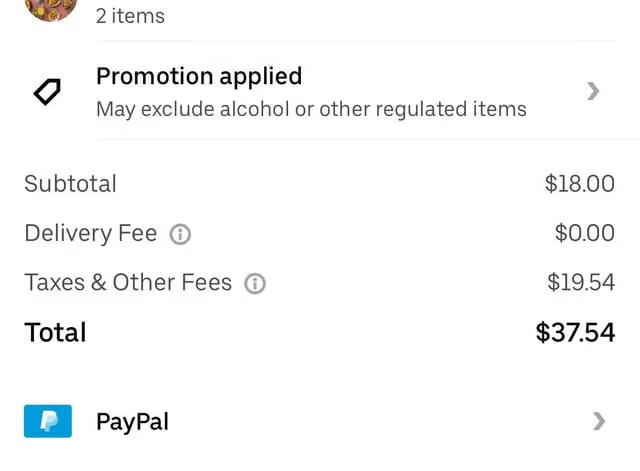
In this example, the customer isn’t paying for delivery, but if delivery charges were added, the total cost could increase significantly.
Such high costs may make customers hesitant before ordering from your restaurant or going for platforms with lower fees, which can impact your profits. However, commission fees don’t apply to restaurant orders that opt for self-delivery.
2. Delivery fees
Customers pay these fees based on the location. They pay less for nearby restaurants and they’ll always know how much before selecting a restaurant.
Typically, the fee starts at a minimum of 20% and varies depending on factors like distance, order size, and time of day, customers will see this fee added to their total at checkout.
3. Driver benefit fees
Uber Eats charges customers a driver benefit fee, which helps you cover things for them like the driver’s healthcare and insurance.
Under Prop 22, drivers are guaranteed a minimum of 120% of the local minimum wage for their active time on the platform, along with a per-mile vehicle expense reimbursement, which is set at $0.37 per mile as of 2026.
4. Tips
Tips are optional. Uber states that 100% of the tip goes to the delivery person, so it shouldn’t be treated as platform revenue when calculating what Uber keeps from an order.
5. Minimum order fee
Uber Eats charges a minimum order fee to customers. The amount varies for restaurants and you get to decide it.
Which Factors Increase Your Total Uber Eats Cost?
How Can Your Restaurant Lower Uber Eats Fees?
1. Use pickup and self-delivery where the math works
Pickup carries a much lower percentage fee than marketplace delivery. Self-delivery can also reduce the platform fee when you already have a dependable local delivery operation.
Compare the same order across channels: platform fee, labor, vehicle, insurance, packaging, customer support, and failed-delivery costs. Choose the option that leaves the highest contribution margin, not the one with the lowest advertised rate.
2. Track contribution margin, not just order volume
Use Uber Eats Manager to review which menu items, campaigns, and order periods produce profitable sales. For each order, start with the subtotal and subtract the platform fee, food, packaging, labor, discount, advertising, refunds, and delivery cost. A promotion that creates more orders is not helping if too little remains.
3. Give repeat customers a direct ordering option
Uber Eats can be valuable for discovery. Once customers know your restaurant, give them an easy way to order directly through your website.
Promote that channel through receipts, packaging, QR codes, email, social media, and loyalty offers. Compare the repeat-order rate and margin from each channel every month.
Track order count, average order value, contribution margin, ad spend, refund rate, customer acquisition cost, and repeat-order share by channel on a monthly basis. These figures will tell you whether a higher plan or a different fulfillment method is earning its keep.
Legal and Tax Considerations for Uber Eats Fees
Understanding the legal and tax implications of commission fees is crucial for accurate financial planning and compliance.
Tax deductibility
Commission fees paid to Uber Eats are generally considered business expenses and may be tax-deductible. However, tax laws vary by location and business structure.
VAT and sales tax
Depending on your location, commission fees may be subject to VAT or sales tax. In some jurisdictions, these taxes are added on top of the commission rate, increasing your total costs.
Important: Always consult with a qualified tax professional or accountant to understand the specific tax implications for your restaurant and location.
Make Sure the Uber Eats Commission Is Buying You Something
A 20% to 30% commission can make sense when Uber Eats introduces your restaurant to customers you may not have reached on your own.
But it becomes harder to justify when the same fee is attached to every order from customers who already know your restaurant and are ready to buy again.
That is where a hybrid approach can improve the economics. You can continue using Uber Eats for marketplace discovery while giving returning customers a convenient way to order directly through your restaurant’s website.
Restolabs provides that direct ordering channel without taking a percentage-based marketplace commission from every order.
You pay for the platform rather than surrendering a share of every sale. Payment-processing or delivery-provider fees may still apply, but Restolabs itself doesn’t charge commission based on the order value.
With Restolabs, your restaurant can:
- Add direct ordering to its existing website. Connect an “Order Online” button to a branded ordering page instead of sending repeat customers back to a third-party marketplace.
- Accept multiple types of orders from one system. Enable customers to place pickup, delivery, curbside, dine-in QR-code, catering, and scheduled orders through your restaurant’s direct channel.
- Control the menu and ordering experience. Manage menu items, modifiers, availability, pricing, branding, ordering hours, delivery zones, and fulfillment options rather than operating inside a marketplace-controlled storefront.
- Protect the kitchen during busy periods. Limit how many orders your restaurant accepts within a set period, while busy-hours controls can temporarily pause online ordering and restart it automatically.
- Connect ordering with existing restaurant technology. Restolabs supports integrations with POS systems, payment gateways, delivery providers, gift cards, loyalty tools, and marketing platforms.
- Track direct-order performance. Review order trends, sales performance, and customer behavior through real-time analytics instead of relying only on reports supplied by a marketplace.
- Expand beyond a basic ordering page. Restolabs also offers optional SEO-focused restaurant websites and branded iOS and Android apps for restaurants that want a more complete owned ordering experience.
Christina Ramirez, owner of a Great Wraps outlet in Houston, used Restolabs to establish an independent online ordering channel. According to the Restolabs case study, catering grew from zero to 20% of the restaurant’s total transactions within one year.
Schedule a demo today to experience how Restolabs helps you maximize profits.

Sruthi Sekar specializes in brand strategy, growth, and user experience in the hospitality industry. As the driving force behind Restolabs, she helps restaurants harness technology to scale and thrive. With a background in design, branding, and entrepreneurship, she brings a sharp focus on crafting digital experiences that drive real business impact.
Frequently Asked Questions
Uber Eats lists participating restaurants in its marketplace, allows customers to place orders, processes payments, and can connect orders with couriers. Restaurants pay fees according to the plan and fulfillment method they select.
Uber Eats generally charges restaurants a 20% to 30% Marketplace Fee on standard US marketplace delivery plans. Pickup, self-delivery, Uber Direct, and Webshop use different fee models, so restaurants should compare them separately.
The amount of website maintenance depends on how the ordering site is hosted and connected to the restaurant’s existing website. Restaurants still need to keep their menu, pricing, hours, availability, and fulfillment information accurate.
Store categories can help customers understand what a restaurant offers and may influence how easily they find relevant options while browsing. Restaurants should make sure their category, menu, and business information accurately reflect what they sell.
Discounting deliveries may encourage customers to complete an order, but the discount should be measured against the contribution margin it produces. Higher order volume does not automatically mean the promotion is profitable.
Commission free ordering can help restaurants save money on repeat orders by removing the percentage-based marketplace commission charged on each sale. Payment-processing and delivery-provider charges may still apply.
.jpg)
.jpg)
.jpg)

.png)




.webp)

.svg)
.webp)