
Key Takeaways
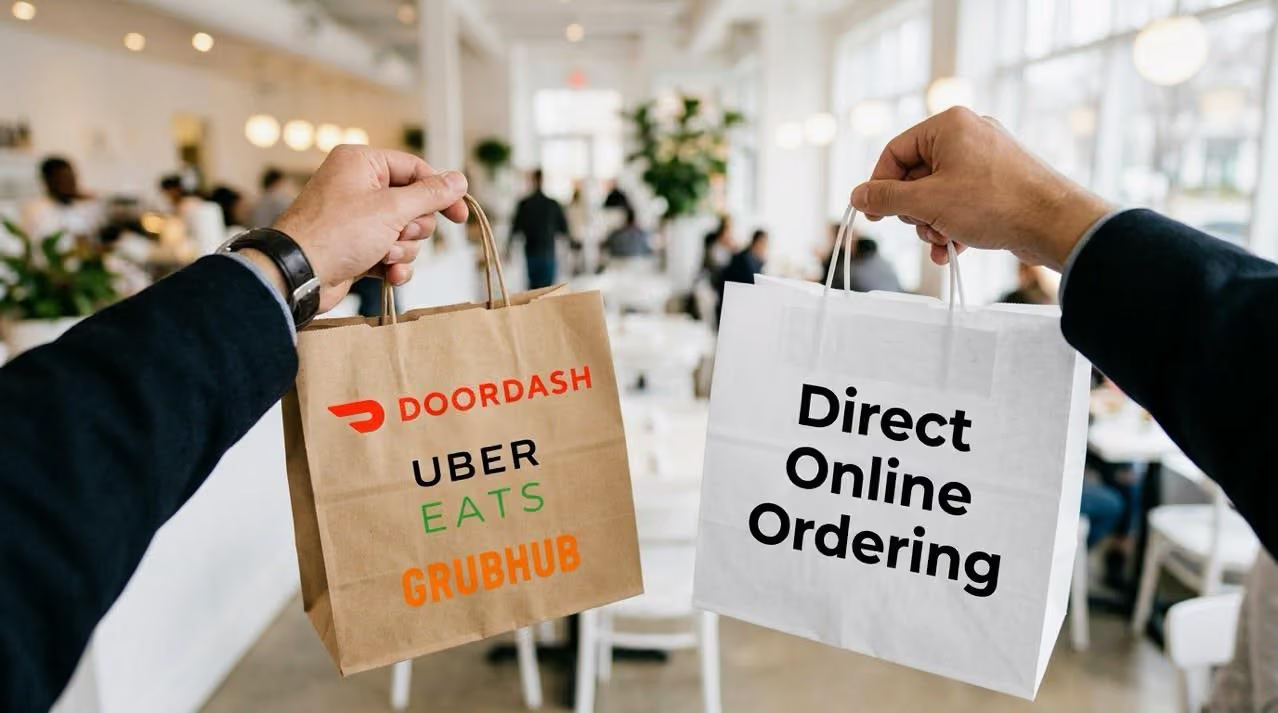
- Two models, two futures: Uber Eats competitors broadly fall into two categories: marketplaces that optimize for reach and speed, and direct ordering systems that optimize for control, margin stability, and long-term growth.
- Cost curves matter: Per-order fees scale linearly with volume. Subscription-based systems flatten costs as demand grows.
- Data defines leverage: When customer identity and order history live outside your systems, loyalty and reactivation remain rented, not built.
- Hybrid is realistic: Many restaurants use marketplaces for discovery and direct ordering for repeat business. The question is which channel runs your core revenue.
- Restolabs path: Restolabs provides a unified ordering system that keeps menus, fulfillment, payments, loyalty, and reporting inside your operation, not inside a marketplace.
You’re probably here because your restaurant is either listed on one or more food delivery apps, including Uber Eats, or you’re weighing whether to join. You’ve seen what a popular food delivery service can bring: visibility, convenience, and new customers.
But you’ve also felt the trade-offs. However, at this point, it’s starting to feel expensive, inflexible, or both.
That tension, unfortunately, defines much of the food delivery market in 2027. Delivery and visibility still matter. But so does control over your margins, your brand, and your customer relationships. The good news is that you have more options than ever.
While lists of the best food delivery apps often focus on how customers order food, this guide covers Uber Eats competitors from the restaurant side: what each delivery platform costs and whether it lets customers order directly from you.
By the end, you’ll know which alternative matches how you want your restaurant to operate, grow, and stay profitable.
Top Uber Eats Competitors in 2027 (Marketplace Alternatives)
Let’s review three major third-party delivery marketplaces that restaurants most often evaluate as alternatives to Uber Eats. Each food delivery service gives local restaurants a different balance of reach, fees, marketing, and fulfillment.
1. Grubhub
Grubhub is a long-established US delivery marketplace with strong urban penetration. It positions itself as a restaurant growth platform, combining marketplace exposure with operational tooling, POS integrations, and optional direct-ordering products.
Grubhub partners with over 375,000 restaurants in the US. It boasts of ease of onboarding, system compatibility, and merchant-facing support.
Customers can use the same app to browse menus, place individual orders, or coordinate group ordering. Seamless and Grubhub operate on the same platform after merging. Grubhub+ provides delivery savings for Amazon Prime members.
What Grubhub gets right
- List your restaurant where customers are already searching, allowing them to find you by cuisine, location, and ordering intent inside the Grubhub app
- Receive and manage all Grubhub orders in one place, via a merchant portal or tablet, with optional POS integration to reduce manual entry
- Choose how orders are fulfilled, whether that’s pickup, self-delivery using your own staff, or Grubhub-managed delivery
- Use marketplace promotions to offer promo codes and offer deals tied to quieter periods or specific menu items
What Grubhub could improve
- Cost is the most commonly cited drawback in Grubhub reviews, with even satisfied restaurants acknowledging that profitability can become challenging for frequent or high-volume orders
- The platform has a few usability gaps, such as the inability to easily edit item selections once added to the cart, and having to clear and rebuild orders
Grubhub pricing and fees
2. DoorDash
DoorDash is the largest food delivery marketplace in the US.
It serves as both a consumer app and a merchant commerce platform, offering restaurants multiple ways to participate: full marketplace listing, direct ordering on owned channels, and on-demand delivery through its driver network.
Like other apps in this category, DoorDash combines customer discovery and fulfillment within one system. DoorDash offers a subscription service known as DashPass. The platform emphasizes operational flexibility, real-time control, and integration with existing restaurant systems.
What DoorDash gets right
- Integrate DoorDash into your existing tech stack, often through POS systems or middleware, which is especially useful if you operate at scale
- Accept orders in the way that fits your setup, whether through a tablet, direct POS integration, or web-based merchant tools
- Automatically route orders to your own drivers or DoorDash’s delivery network, or switch between the two as needed
- Track live orders and operational performance, including order status, prep times, delivery times, fulfillment flow, and sales trends
What DoorDash could improve
- Multiple reviews note that complex menu modifiers, special instructions, and custom builds don’t always translate cleanly into DoorDash’s interface
- When deliveries go wrong (late, incorrect, or missing items), restaurants often feel they lack direct control and must depend heavily on DoorDash for resolution
DoorDash pricing and fees
3. SkipTheDishes
Skip (Formerly known as Skip the Dishes) is Canada’s largest food delivery marketplace, with deep penetration across mid-sized markets and suburban areas. It operates in over 250 cities, giving its network of roughly 47,000 partnered restaurants access to customers nationwide.
Like Uber Eats, Skip manages the consumer app, payments, courier network, and order tracking, allowing restaurants to focus on food preparation while Skip handles fulfillment.
What SkipTheDishes gets right
- Get access to a large, highly loyal Canadian customer base, especially in non-metro and regional markets where other platforms are weaker
- Control your own menu pricing and update items at any time through the Partner Portal
- Integrate Skip with major Canadian POS tools (TouchBistro, Lightspeed, Square, Aloha Cloud), enabling automatic order flow
- Offer built-in promotion capabilities such as Top Placement, Free Delivery, and Free Item campaigns, with documented lifts in views and order volume; these promotional tools can also help restaurants compete for customers looking for the best deals
What Skip could improve
- The performance model can feel unforgiving as orders not accepted within 10 minutes are auto-rejected, directly lowering your Skip Score and visibility
- Pickup and courier wait-time thresholds (such as the 5-minute pickup target) can be difficult to maintain during peak service
Skip pricing and fees
Top Uber Eats Competitors in 2027 (Direct Online Ordering Alternatives)
Let’s review three major direct ordering platforms that restaurants most often evaluate as alternatives to Uber Eats:
1. Restolabs
Restolabs is a commission-free direct ordering platform that gives restaurants a full-featured, all-in-one system without the premium price tag. You can launch in under a week, moving from setup to live ordering without extended onboarding or technical overhead.
The platform supports direct ordering across your website, branded mobile app, QR codes, and shareable links for social channels like Facebook and Instagram. Orders flow through your own ecosystem, with full ownership of customer data and zero per-order commissions.
Restolabs connects cleanly with the rest of your stack, including POS systems, payment gateways, and delivery partners such as Uber Direct, Checkmate, and DoorDash.
Beyond order intake, it provides native tools for customer retention through push notifications, point-based rewards, coupons, banners, combo offers, and targeted promotions that increase order frequency and basket size.
A 30-day free trial with no contracts gives restaurants full access to the platform from day one, making it easy to evaluate real operations before committing.
What Restolabs gets right
- Give you true end-to-end control over your digital storefront, including white-glove website build-outs, custom domains, and high-quality menu presentation
- Integrate deeply across your operational stack, including POS systems, KDS, printers, payment gateways, and delivery partners, so orders flow cleanly from checkout to kitchen
- Use intelligent order throttling and scheduling to control volume during peak hours, pause intake when needed, and allow customers to place advance orders without overwhelming your team
- Offer granular delivery controls, including radius-based, area-based, and map-based zones, with custom fees and minimums for each region
- Support multilingual ordering across 10+ languages, enabling localized experiences for diverse customer bases without duplicating menus
- Provide actionable analytics on customer behavior, sales trends, and channel performance, even on entry-level plans
- Build repeat demand with native growth tools, including push notifications, point-based loyalty, coupons, banners, and combo offers designed to increase frequency and basket size
What Restolabs could improve
- Automated marketing features are still evolving, with further enhancements expected soon
Restolabs pricing and fees
2. Owner.com
Owner.com is a premium direct-ordering and marketing platform built for independent restaurants. The company centralizes contact details, dining history, and order data from every transaction into a single customer record, so you can see who orders and how often.
From the same dashboard you manage the website, SEO pages, review generation, and business listings, and connect ordering to delivery dispatch without running three standalone tools alongside each other.
What Owner.com gets right
- Automate abandoned-cart recovery through email and text messages
- Use Smart Upsells to display data-driven add-on recommendations during checkout
- Run prebuilt marketing campaigns for holidays, sporting events, and other high-volume ordering occasions
- Launch a branded mobile app with loyalty points, rewards, and targeted push notifications
What Owner.com could improve
- AI-driven marketing and SEO tools could offer greater transparency and customization, including clearer explanations of automated decisions
- Hardware options remain limited, so restaurants that need customer-facing displays for loyalty sign-ups or tablets for tableside ordering may have to use a separate solution
Owner.com pricing and fees
It is worth noting that the lower-priced Flexible plan still scales with order volume because of its 5% restaurant fee.
Tired of paying Owner.com monthly fees and getting zero flexibility?
With Restolabs, get your restaurant’s online ordering site live in less than a week, bring more customers, and keep 100% of your revenue at less than half the price.
3. Olo
Olo is an enterprise restaurant technology platform that powers digital ordering, payments, delivery, catering, and customer engagement through websites, mobile apps, and other direct-ordering channels.
You can use it to accept orders through branded digital storefronts while managing menus, handoff modes, and fulfillment for pickup, delivery, and curbside orders.
For multi-location operations, you can use the same enterprise infrastructure across restaurant concepts and virtual brands without fragmenting digital ordering across separate systems.
What Olo gets right
- Support AI-driven cross-selling and automated item recommendations during checkout
- Leverage APIs and webhooks for integration with POS, payments, and external systems
- Provide passwordless login and checkout for faster repeat ordering without traditional account credentials
- Apply customizable capacity rules and order throttling to control digital order intake based on location, time, and kitchen throughput
What Olo could improve
- Its dashboard data doesn’t always refresh in real time, potentially delaying visibility into recent orders and activity
- Some users have reported occasional interface responsiveness issues
Olo pricing and fees
- Custom pricing; not publicly disclosed
Why Are Restaurants Searching for Uber Eats Competitors?
A few structural realities drive the shift:
1. Rising commission fees and shrinking margins
Uber Eats’ commissions, often hovering around 20–30%, hit hard once delivery becomes a meaningful share of revenue. When food costs, labor, rent, and utilities are already tight, giving up that much per order feels like a tax on every order, not marketing spend.
2. No ownership of customer data and ordering history
Even though you get access to customers through Uber Eats, you don’t truly own them. You can see orders coming in, but you can’t freely market to those customers, build long-term loyalty on your terms, or bring them back without paying again.
Even when someone loves your food and orders repeatedly, each transaction still runs through the platform, with the same commission attached.
3. Uber Eats controls your brand experience
In a marketplace, your restaurant is displayed alongside dozens of others in a standardized layout. Your menu, your promotions, and even how your food is presented follow platform rules.
If you’ve invested in a distinct brand or a premium experience, that can feel like you’re being flattened into a commodity. Choice becomes driven by price, placement, or convenience, not loyalty.
4. Growth depends on a system you don’t control
You don’t fully decide how visible you are when you’re promoted, or how disputes and refunds are handled. A slight change in rankings or local competition can reduce orders coming through Uber Eats overnight, without warning or explanation.
When a channel becomes vital to your revenue but unpredictable to manage, it’s natural to want something more stable alongside it.
How Do Different Uber Eats Competitors Compare?
Restaurants often compare tools as if they all solve the same problem. They don’t. The main difference is whether the platform supplies marketplace demand and delivery or gives you infrastructure for accepting direct orders. Each model changes how your business operates.
1. Commission-based food delivery marketplaces
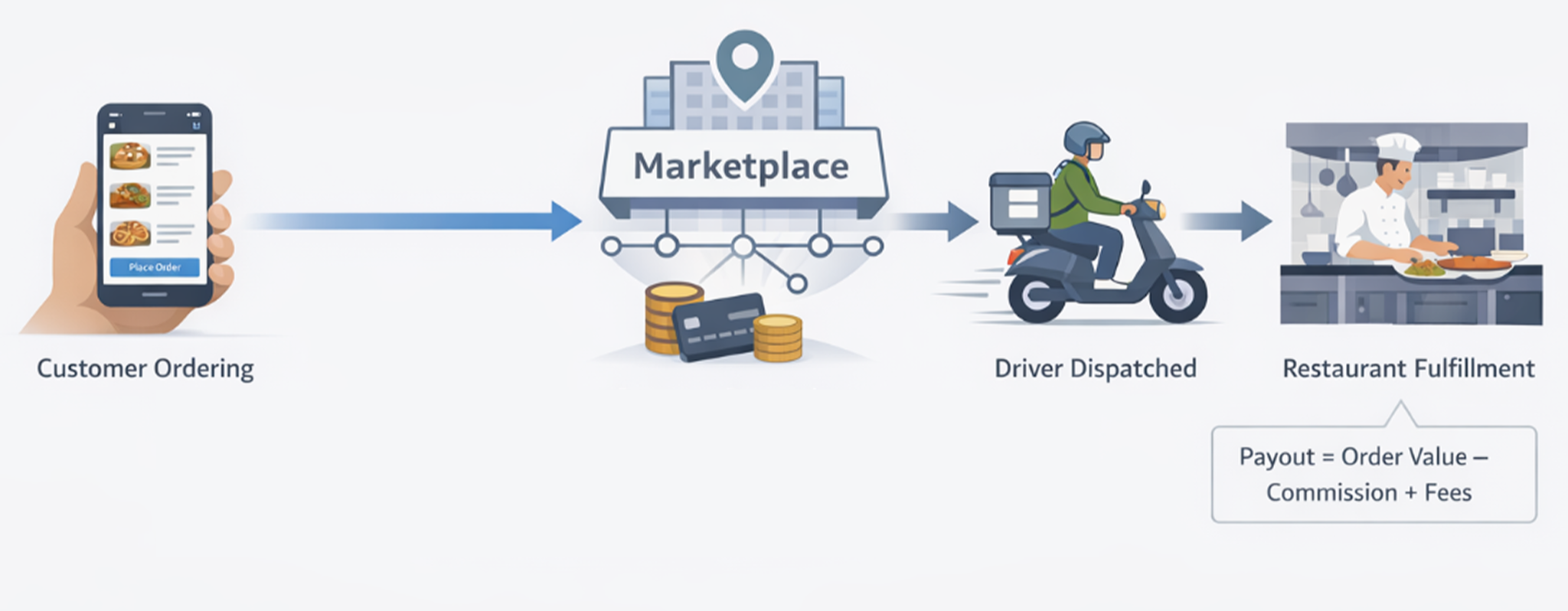
These platforms act as end-to-end ordering and delivery engines. They bring customers, process payments, and handle last-mile logistics through a network of delivery drivers.
How orders flow
- Your restaurant appears in marketplace search results
- Customers browse your menu and place an order
- The platform collects payment and assigns a delivery partner
- The order reaches your kitchen
- You receive the order value minus commission and service fees
When this model makes sense
The marketplace is apt for restaurants that want immediate delivery coverage without building internal delivery operations.
You don’t manage drivers, routing, or delivery support. Orders arrive ready to prepare, and fulfillment happens outside your team, although advertising, payment processing, and other services may add to the total cost.
What marketplaces do well
- Showcase your restaurant to new customers already in “order mode”
- Drive demand through location, cuisine, and dish discovery
- Handle delivery coordination end-to-end
That visibility can create fast volume, especially in dense delivery zones and during peak hours.
Where the model breaks down:
a. Unit economics
- Each order carries a commission, often 20–30% as you’ve seen in Uber Eats, because marketplaces charge restaurants for access to demand and fulfillment
- Delivery and service fees, placement charges, and other fees compound the total cost
- Fees apply to first-time and repeat orders
- As the delivery share grows, the total platform cost rises in direct proportion
For customers, the order's delivery fee and additional surcharges can make small orders feel disproportionately expensive.
b. Customer ownership
You see what was ordered, not who ordered it, in a usable way. Email addresses, phone numbers, and complete customer histories stay with the platform. You can’t build independent loyalty loops. Bringing the same customer back means paying the platform again.
c. Operational friction
Platform workflows govern menu and pricing changes. Modifications, availability changes, and sync cycles introduce delays. Out-of-stock items can remain orderable. Incorrect pricing can go live. These issues unnecessarily create staff interruptions.
2. Direct Ordering Platforms
These systems give you an owned ordering channel. Customers order from you, not from a marketplace.
How orders flow
- Customers order through links you control: your website, branded page, Google profile, QR codes, or social media
- Orders don't pass through a marketplace app
- Payments go directly to your account
- The platform may charge a fixed subscription, a per-order fee, or a hybrid price; payment processing, delivery, and other services may carry separate charges

What changes operationally
Orders land in one system using your menu, pricing, and availability rules. You control item structure, modifiers, and inventory behavior. Menu updates apply instantly across all your ordering links without waiting for marketplace review or sync cycles.
What this model unlocks
- Access to flat-rate plans that can provide more predictable costs and lower fees as order volume grows
- Direct access to customer identity and order history
- Ability to run loyalty programs and post-order follow-ups
Customer data remains visible. You know who ordered, what they ordered, and how often they return. Order history belongs to your business.
Delivery becomes modular
Ordering is separated from fulfillment. You can:
- Offer pickup only
- Use your own delivery drivers
- Connect third-party delivery services for last-mile fulfillment
The ordering experience stays the same regardless of how the food reaches the customer. For example, you can choose delivery management methods based on distance, order value, and staffing rather than platform rules. Repeat customers also order through the same direct link, improving margins over time.
Why Choose Restolabs Among Uber Eats Competitors?
If marketplaces are optimized for reach and speed, an owned system is optimized for control. This is the role Restolabs, an online ordering platform, plays.
You can launch ordering on your website or a branded page and accept orders without routing them through a marketplace app. Setup typically takes under a week. Orders flow directly into your operation. Payments settle to you.
Centralize menu, pricing, and order logic
Restolabs becomes the system of record for your digital menu. Items, modifiers, availability, and pricing are managed in one place and reflected across every ordering surface. This removes the drift that happens when menus are updated across multiple platforms. You eliminate mismatches, out-of-stock errors, and last-minute staff corrections during service.
Own every ordering entry point
Orders no longer originate inside a third-party app. Customers order through channels you control: your website, branded mobile apps, social links, and in-store QR codes. Checkout doesn’t require account creation. That reduces friction at peak hours and shortens time-to-order.
Separate ordering from fulfillment
With Restolabs, ordering becomes independent of delivery. You can offer:
- Pickup
- In-house delivery
- Third-party delivery
The ordering flow remains the same. Delivery rules, throttling limits, and inventory controls let you regulate volume during rush periods. Advance and catering orders become first-class workflows rather than exceptions.
Operate at one location or at scale
Restolabs supports single-location restaurants, multi-unit brands, and ghost kitchens.
Menus, pricing, and availability can be managed across outlets without duplication. Order routing, kitchen communication, and payment processing are automated. Staff dependency during service decreases because the system absorbs coordination work.
Retain customer identity and order history
Lastly, when you use Restolabs, every order remains attached to a real customer. You retain names, contact details, and order history. This allows repeat ordering, direct communication, and future promotions without paying a marketplace to reach the same customer again.
Ultimately, the best food delivery service isn’t simply the one people use to order food; it’s the one that helps your restaurant build a direct customer relationship. Customer ownership becomes more valuable when it leads to repeat business.
Across Restolabs’ 2025–2026 dataset, 38.2% of customers ordered more than once, with a median reorder interval of 8.9 days.
“We saw a 25% month-on-month surge in online orders, with zero extra marketing. We’re now processing triple-digit daily orders.”
— Aditya Raolji, Pizza Pirates, Saskatoon, Canada
Discover how Restolabs helps restaurants own their online ordering with zero commission fees. Try it free for 30 days, then switch to predictable, subscription-based pricing so your costs stay flat even as orders increase.
Book a demo with Restolabs today.

Asavari drives content development at Restolabs. With over a decade of experience partnering with fast paced technology and marketing teams, she turns complex product and industry details into clear, meaningful communication for restaurant partners.
Frequently Asked Questions
Usually, no. Switching from Uber Eats to another marketplace can change commission rates or promotional fees, but the underlying cost model stays the same. You still pay per order, including repeat orders, and customer data remains outside your systems. Costs may shift, but they don’t flatten as volume grows.
Commission-free platforms typically charge a fixed monthly or annual subscription. The fee covers software access, ordering infrastructure, and support. Costs stay predictable because they don't increase with order value, order frequency, or repeat customers.
Yes. Many restaurants use marketplaces for discovery while routing repeat customers to direct ordering links. Marketplaces bring in new diners. Direct ordering handles pickup, house delivery, and repeat business. The two can coexist. The difference is which one runs your core revenue.
You should look at where your repeat orders come from, how often customers reorder, and how much commission you pay monthly. You should also assess whether your team can manage menu updates, fulfillment options, and customer communication through a direct ordering system. This helps determine whether a shift will reduce workload or add complexity.
Online ordering owned by the business makes the most sense when delivery volume is steady, and repeat orders account for a meaningful share of sales. At that point, fixed software fees are usually less than ongoing per-order commissions, especially since repeat customers reorder without additional marketplace fees.





.webp)

.svg)
.webp)