
Key Takeaways
The right restaurant mobile app builders give you control over ordering, customer data, and daily operations while reducing reliance on third-party platforms. In this guide, you’ll learn how different tools compare, what features actually matter, and which type of platform fits your restaurant’s needs. You’ll also understand how each builder approaches ordering, customization, and integrations so you can choose with clarity. The goal is to help you move from comparison to confident decision-making.
You did the hard part – you cooked the food, delivered a great experience, and earned a repeat customer. But when they decide to come back, the order often goes through a third-party app that charges you up to 30% just to “introduce” you to someone who already knows your brand.
Over time, that adds up. If your restaurant is doing $30,000 a month in online orders, you could be losing close to $9,000 in commissions every single month.
That’s why more restaurants are moving toward building their own online presence through direct ordering platforms
If you’re specifically looking to strengthen your mobile ordering experience, this guide is for you. Here, we’ve broken down the top restaurant mobile app builders in 2026 based on their features, real-world use cases, and how well they support ordering, operations, and long-term growth.
How We Chose the Best Restaurant Mobile App Builders
With so many app builders claiming to be “restaurant-friendly,” it can be difficult to separate generic mobile app platforms from solutions that actually support restaurant operations.
Some tools are built specifically for direct ordering and delivery management, while others focus more on general app creation with flexible customization options.
To make this comparison useful, we evaluated platforms based on how well they support real restaurant workflows, not just how quickly they can launch an app.
We used a structured scoring framework to shortlist the best restaurant mobile app builders in 2026. These were the key criteria we considered:
1. Restaurant-specific functionality (25%)
We prioritized platforms that support core restaurant workflows such as direct online ordering, delivery zone management, kitchen display system (KDS) compatibility, POS integrations, printer sync, and order throttling during peak hours.
2. Branded mobile experience (20%)
A strong mobile app should feel like an extension of the restaurant’s brand. We looked at how well each platform supports fully branded iOS and Android apps, app store publishing, customer experience, and mobile ordering convenience.
3 Customer retention features (15%)
Driving repeat orders matters more than just acquiring first-time customers. We evaluated loyalty programs, push notifications, coupons, promotional banners, reordering flows, and customer engagement tools that help restaurants retain customers without relying on third-party marketplaces.
4. Operational flexibility (15%)
Restaurants need systems that adapt to real-world service demands. We assessed features like scheduled ordering, advance ordering, delivery routing, pickup workflows, multi-location support, and the ability to manage both in-house and third-party delivery operations.
5. Data ownership and reporting (15%)
Owning customer relationships is critical for long-term growth. We looked at how much control restaurants have over customer data, order history, performance analytics, and the ability to use those insights for marketing and decision-making.
6. Ease of setup and scalability (10%)
Some restaurants need a fast no-code solution, while others need deeper backend customization. We considered onboarding speed, ease of use, customization options, and how well each platform supports growth over time.
This approach helped us compare both restaurant-native platforms like Restolabs and flexible app builders like Appy Pie and Emergent AI, so you can choose based on operational fit.
Top Restaurant Mobile App Builders at a Glance
Here’s a snapshot of the best restaurant mobile app builders and what each offers:
*Please check each tool’s website for the latest pricing.
Key Features to Look for in Restaurant App Builders
Choosing a restaurant app builder based only on “look and feel” is a common mistake. In our experience, what actually determines success is how well the app connects with your operations behind the scenes.
A great mobile app goes beyond taking orders. It ensures those orders flow instantly into your POS, kitchen, and delivery workflows without manual intervention. Therefore, when comparing restaurant mobile app builders, these are the features to consider:
1. Order flow control and POS integrations
Check if the platform in question handles incoming orders and whether it integrates with your existing systems. Orders should move directly into your POS tool, kitchen display system (KDS), or printer without requiring manual entry.
You should also be able to control how orders are accepted by setting preparation times, limiting order volume during peak hours, or pausing orders when needed. Without these controls, high order volumes can quickly overwhelm your kitchen and affect service quality.
2. Delivery management and fulfillment flexibility
Next, evaluate how the platform handles delivery. It should allow you to define delivery zones, set fees and minimum order values, and manage both in-house delivery and third-party providers from the same system.
This becomes important as you scale, since relying on a single delivery method limits flexibility. A platform that supports both in-house dispatch and external providers allows you to adjust fulfillment based on demand, location, or cost.
3. Menu management and availability controls
Menu flexibility directly impacts order accuracy. The platform should enable you to update item availability in real time, control when specific items are shown, and manage modifiers, add-ons, and combinations without friction.
4. Mobile ordering experience and branded apps
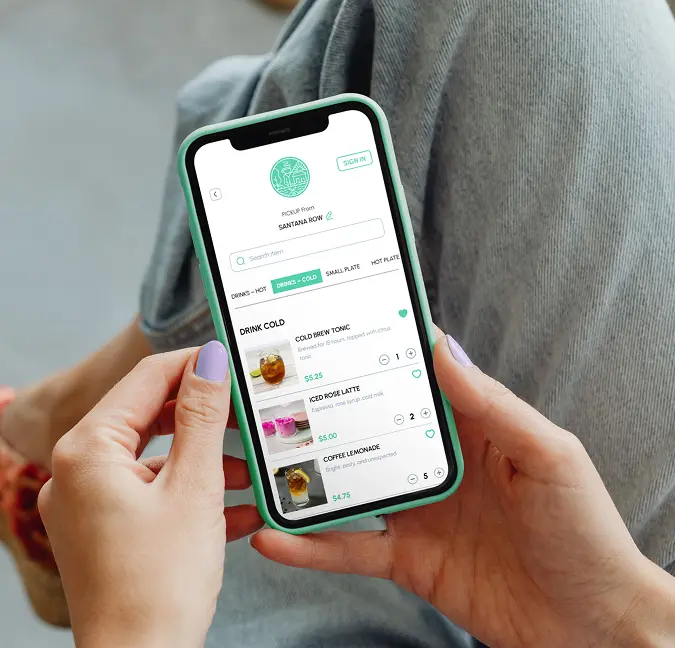
The ordering experience on mobile should be fast and intuitive. Your customers should be able to browse the menu, customize items, and reorder past purchases without friction.
Some platforms also provide fully branded mobile apps for iOS and Android. This gives you a consistent ordering channel that isn’t dependent on third-party marketplaces and keeps your brand front and center. As more customers prefer ordering directly from their smartphones, mobile commerce continues to reshape how restaurants attract, engage, and retain digital-first diners.
5. Loyalty programs and customer retention tools
Retention features determine whether customers come back to your app or switch to other platforms. The system should support loyalty points, rewards, coupons, and promotional campaigns that can be managed directly within the platform.
6. Push notifications and promotions
Direct communication is critical for driving engagement.
The platform should allow you to send push notifications for offers, updates, and reminders. Combined with in-app promotions such as banners and discounts, this gives you a direct channel to reach customers without relying on external marketplaces or paid acquisition.
7. Customer insights and order analytics
Finally, review the level of visibility you get into customer and order data.
You should be able to track order trends, customer frequency, and product performance over time. This data helps you understand what is working, which items drive the most demand, and how customer behavior changes based on promotions or timing.
The 4 Best Restaurant Mobile App Builders in 2026
Below are the top restaurant mobile app builders, with a detailed look at their features, capabilities, and where they fit best:
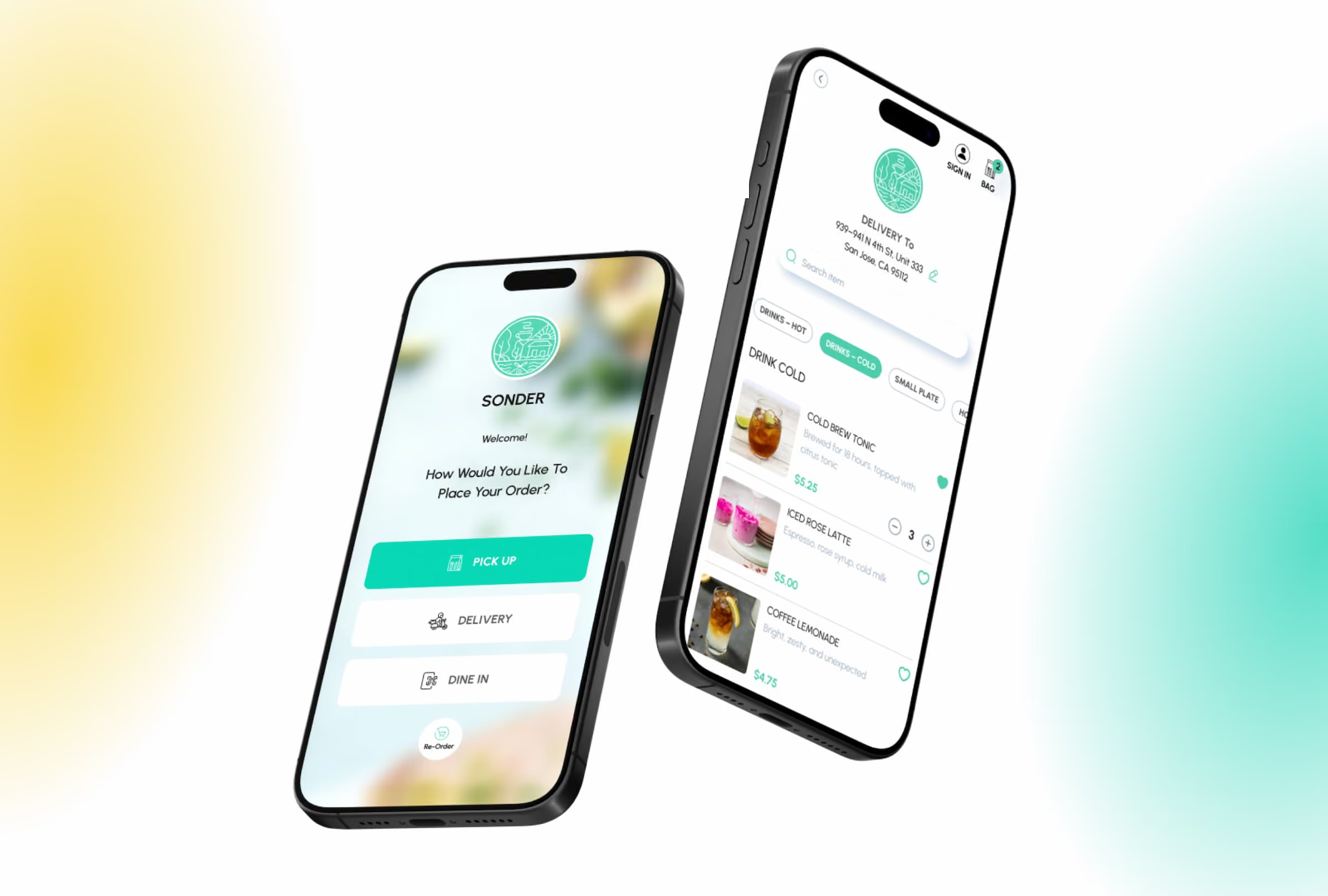
Restolabs is a direct online ordering platform designed for restaurants that want fully branded iOS and Android apps backed by a complete ordering and operations system.
Unlike generic mobile app builders, Restolabs connects online ordering, delivery management, customer retention, and backend operations in one place, helping restaurants run everything from a single platform while keeping full control over customer data and margins.
Restolabs Features
- POS Integration and Seamless Operations: Orders sync in real time with POS systems and kitchen printers, with menu updates reflected instantly. Integrate with payment gateways and delivery partners like DoorDash, Uber Direct, Grubhub Connect, and Shipday for smooth order flow from checkout to fulfillment.
- Built-in Loyalty and Customer Retention Tools: Drive repeat orders with loyalty programs, push notifications, coupons, and targeted promotions, all managed within the same platform.
- Delivery Management and Order Control: Configure delivery zones, fees, and minimum order values. Manage peak-hour demand with throttling, scheduling, and pause controls. Support delivery, pickup, curbside, and pre-orders.
- Customer Data and Analytics: Track customer behavior and performance across web, app, and QR ordering channels from a unified dashboard while retaining full ownership of your customer data.
- Offer Fast, Flexible Payments: With multiple gateways (including Stripe), along with saved cards and digital wallets like Apple Pay and Google Pay for seamless checkout
- Multilingual Ordering Experience: Support multilingual ordering across 10+ languages from a single menu setup, without duplicating configurations
- Multiple Ordering Modes: Enable multiple ordering modes within the app, including delivery, pickup, and curbside pickup.
- Preordering: Allow customers to place advance and pre-orders directly through the mobile app.
What Restolabs Gets Right
Orders flow directly into your kitchen, not a separate system
App orders sync in real time with POS systems and kitchen printers, so there is no manual entry or disconnected workflows. Menu updates like item availability, pricing, or sold out status are reflected instantly across the app, keeping everything accurate during service.
Built for repeat customers, not one-time users
Regulars can reorder in seconds using past order history, saved addresses, and one tap checkout. Since most app users are returning customers, this makes it significantly easier to drive frequent, habitual ordering.
Frictionless checkout that reduces drop-offs
Saved cards, Apple Pay, Google Pay, and digital wallets make checkout fast and effortless. Fewer steps at checkout means higher conversion and fewer abandoned orders.
Guides customers to order more, not just browse
Restaurants can highlight offers, bestsellers, combos, and featured items directly within the app. This helps surface the right choices at the right time, improving conversion and increasing average order value.
Human support from setup to launch and beyond
App store submission, approvals, and updates are handled for you, with direct access to a team whenever you need hel
What Restolabs Can Improve
- AI marketing features are still evolving, with further enhancements expected soon
Restolabs Pricing
Restolabs Ratings and Reviews
- G2/Capterra: 4.7/5
Appy Pie is an AI restaurant app builder that lets you create and publish mobile apps for your restaurant. You can simply start by describing your app idea in a prompt, after which the platform generates a basic app structure with menus, screens, and ordering flows.
From there, you can configure your app using a visual editor, preview and test the app on a real device using QR-based access, and submit it to app stores directly through the platform.
Appy Pie features
- Handle app store submission, including packaging, metadata, and compliance requirements for Google Play and Apple App Store
- Manage menus, app content, and configuration settings through a centralized dashboard after launch
- Customize branding elements such as logos, colors, and themes within predefined templates
What Appy Pie gets right
- Makes app development accessible to beginners through an intuitive drag-and-drop interface that requires no coding knowledge
- Reduces the need for third-party tools by offering integrated hosting, backend database management, and ongoing maintenance within the platform
What Appy Pie can improve
- Costs can increase over time, as essential features like branding removal, iOS support, and compliance-related updates require paid upgrades
- App functionality can be unstable, with reports of features breaking or apps crashing without user-side changes
Appy Pie pricing
Appy Pie Ratings and Reviews
- G2/Capterra: 4.7/5
GoodBarber is a no-code app builder. It enables you to create fully native iOS and Android apps using platform-specific technologies rather than hybrid wrappers, along with progressive web apps (PWAs).
The platform is structured around sections and extensions. You can define the app’s layout by organizing sections, control visual elements through a built-in design system, and add functionality by selecting extensions from its library.
A live preview reflects changes across devices before the app is packaged for store distribution.
GoodBarber features
- Assemble app functionality through a modular extension system with 190+ add-ons for features, integrations, and workflows
- Connect third-party tools and external data sources through APIs and integrations such as Zapier, YouTube, and ChatGPT
- Enable offline access to app content without an active internet connection
What GoodBarber gets right
- Enables effective user engagement through push notifications, supported by analytics that help track performance
- Expands reach by automatically generating a high-performing PWA alongside native iOS and Android apps
What GoodBarber can improve
- Customer support response times are often slow, typically ranging from 24 to 72 hours, and responses may lack sufficient detail, requiring multiple follow-ups
- Some users report technical issues, including bugs in critical areas like payment processing or checkout experiences on Android
GoodBarber Pricing
GoodBarber Ratings and Reviews
- G2/Capterra: 3.5/5
Emergent AI is a full-stack AI development platform that helps you build, automate, and scale applications using natural language prompts instead of traditional coding workflows.
You can create apps faster, manage backend infrastructure with less manual setup, connect operational workflows across tools, and use specialized AI agents for research, analytics, and automation, making it easier to move from idea to execution.
Emergent AI features
- Research market trends, scan the web, and generate structured professional reports
- Analyze data, identify patterns, and visualize insights through dashboards and reporting workflows
- Automate workflows, connect APIs, and manage scheduled operational tasks across tools and systems
What Emergent AI gets right
- Its backend capabilities deliver more reliable, production-ready outputs with stronger overall functionality
- Rapid iteration simplifies testing, updating, and refining app features through simple prompts instead of lengthy development cycles
What Emergent AI can improve
- Pricing and token usage can feel less transparent, making it difficult to predict costs and often requiring additional credits midway through building a full app
- Fully using the platform’s capabilities can take experimentation, especially when learning the most effective prompting methods and project structure
Emergent AI pricing
Emergent AI Ratings and Reviews
- G2/Capterra: Not enough reviews
What to Ask Before Choosing a Restaurant App Builder
A polished demo can hide the hard part. The real test starts when a Friday-night menu change collides with delivery timing, store hours, and POS sync. Before committing, restaurants should ask how the builder handles item availability, modifiers, and location-level rules. If those answers stay vague, the app may look branded while daily operations stay messy.
The second question is ownership. When a guest orders through the app, where do customer profiles, order history, and campaign data actually live? Teams planning to grow beyond a single launch need clarity on exports, reporting, and integrations. Otherwise, switching later can feel less like an upgrade and more like rebuilding the ordering engine from scratch.
Support matters more than most buyers expect. Publishing an app is one milestone; keeping menus current, promotions timely, and ordering smooth is the ongoing job. For operators who want to see that workflow in context, Restolabs offers a tailored walkthrough through its Book a Demo page, so teams can evaluate fit before they commit.
Which App Builder Should You Choose?
Your choice ultimately depends on what you’re trying to achieve:
- If you want to launch quickly with minimal effort → Appy Pie
- If you need deep design control and customization → GoodBarber
- If you want AI-powered custom app building and launch on your own → Emergent AI
- If you want full control over ordering, operations, and customer data → Restolabs
Each platform solves a different problem. The best choice is the one that aligns with how your restaurant operates and grows.
Why Restolabs Stands Out In The Mobile App Builder Space
At this point, you have everything you need to make an informed decision, from understanding the key features that matter to evaluating how different app builders approach ordering, customization, and operations.
The next step is simple: test what works for your restaurant.
You can start by exploring a few of the platforms we’ve covered: book a demo, try a free trial, and see how each tool fits into your day-to-day operations. Look closely at how easily you can manage orders, update menus, run promotions, and handle peak-hour demand.
The right platform should feel intuitive, reliable, and aligned with how your kitchen actually runs.
If you’re looking to simplify that decision and move forward with a platform that brings everything together—ordering, delivery, customer data, and mobile apps—Restolabs offers a more unified approach.
With Restolabs, you can manage orders in real time, configure delivery and checkout flows, and use built-in tools like loyalty programs, push notifications, and promotions to drive repeat business, all from a single system.
If you’re ready to build a stronger, more profitable direct ordering channel, book a demo with Restolabs to explore in detail.

Sruthi Sekar specializes in brand strategy, growth, and user experience in the hospitality industry. As the driving force behind Restolabs, she helps restaurants harness technology to scale and thrive. With a background in design, branding, and entrepreneurship, she brings a sharp focus on crafting digital experiences that drive real business impact.
Frequently Asked Questions
Mobile apps help you increase revenue by enabling direct ordering, reducing dependence on third-party platforms, and encouraging repeat purchases. When you own the ordering channel, you avoid commission fees, promote offers directly, and make reordering faster for customers.
Restaurant mobile app builders let you launch and manage your own branded ordering experience without heavy development effort. They give you control over your menu, ordering flow, and customer data, while also supporting customizable branding, built-in loyalty programs, and commission-free ordering.
Mobile apps keep your restaurant top-of-mind by giving you a direct communication channel. You can send push notifications, run promotions, and make it easy for customers to reorder, which helps turn occasional buyers into repeat customers.
Yes. Most modern platforms like Restolabs support integrations with POS systems, payment gateways, delivery providers, and kitchen display systems. This ensures orders flow directly into your existing setup without manual intervention
Focus on how well the platform fits your operations. Look for strong order management, delivery flexibility, menu control, integrations, and ease of use. Also consider whether it supports your growth goals, like scaling locations, managing peak-hour demand, and retaining customers over time.









.webp)

.svg)
.webp)