

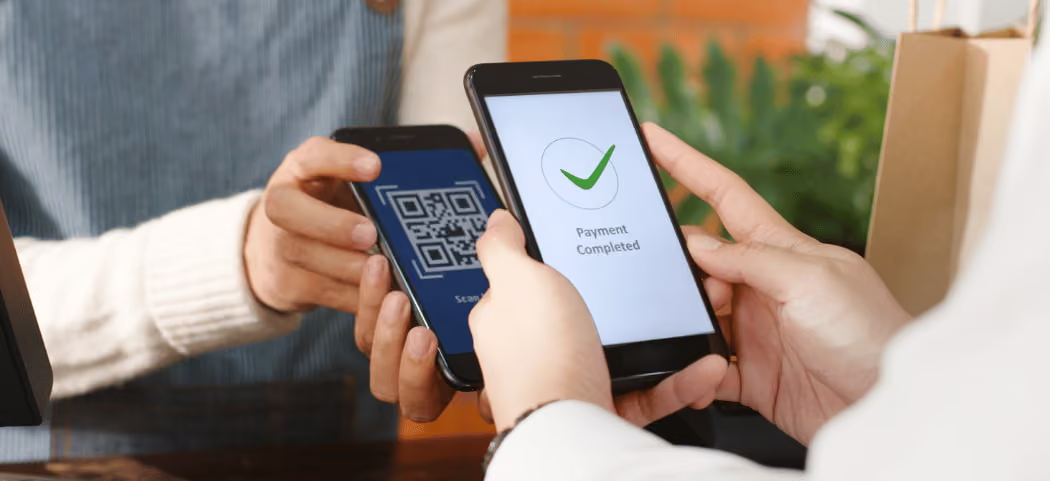
Key Takeaways
- AI and Automation Revolution: 73% of restaurant operators plan to invest in AI solutions by 2025, with voice ordering and predictive analytics leading adoption.
- Digital-First Operations: Online ordering systems are no longer optional but essential infrastructure, with restaurants seeing 30% higher check averages from digital orders.
- Labor Solutions: Kitchen automation and robotics address the 70% annual turnover rate in restaurants while improving consistency and reducing training costs.
- Data-Driven Decision Making: Restaurants using analytics platforms report 15% lower food costs and 22% improved forecast accuracy.
- Customer Personalization: AI-powered recommendation engines increase average order value by 18-26% through tailored suggestions.
- Customer Data Ownership: Restaurants that process orders through direct, owned channels retain first-party customer data for loyalty marketing, repeat-order campaigns, and long-term revenue growth — without sharing that data with third-party platforms.
What Is Restaurant Technology?
Restaurant technology refers to the digital tools and systems that operators use to run, grow, and connect every part of their business. This includes online ordering platforms, point-of-sale (POS) systems, contactless payment processing, kitchen display systems (KDS), inventory management software, customer relationship management (CRM) tools, loyalty programs, delivery management platforms, reservation systems, and AI-powered analytics.
The goal is not simply to add tools. The goal is to connect front-of-house guest experiences, back-of-house kitchen operations, and digital ordering channels into one coherent system — so that operators spend less time managing disconnected workflows and more time growing the business.
Restaurant Technology Trends at a Glance (2026)
Use this table as a quick filter before diving into the detailed sections below. Each trend is ranked by its relevance to restaurant operators in 2026.
Restaurant technology used to mean adding one more tool to an already crowded workflow. In 2026, the stakes are different. The right systems can protect margins, reduce manual work, and give restaurants a direct relationship with every customer who orders online.
That shift matters most for operators who are tired of paying commissions for orders they helped create. Direct ordering, AI-assisted workflows, connected payments, delivery management, and real-time analytics are no longer "nice-to-have" upgrades. They are becoming the operating layer behind profitable restaurant growth.
The evaluation lens for every tool in this guide is straightforward: Does it protect margins? Does it reduce manual work? Does it let the restaurant own its customer relationships? If the answer is yes, it belongs in the 2026 tech stack.
Consumer behavior data reinforces the urgency. According to Technomic, 47% of consumers are more likely to order from a restaurant that offers mobile ordering, and 56% prefer to use a restaurant's own website or app over third-party platforms. A further 59% are interested in AI-powered assistants to streamline their ordering experience — signals that the operators who invest now will capture outsized loyalty later.
👉Also Read: Ultimate Guide To Launch D2C Food Delivery Business
How Technology is Changing the Restaurant Industry
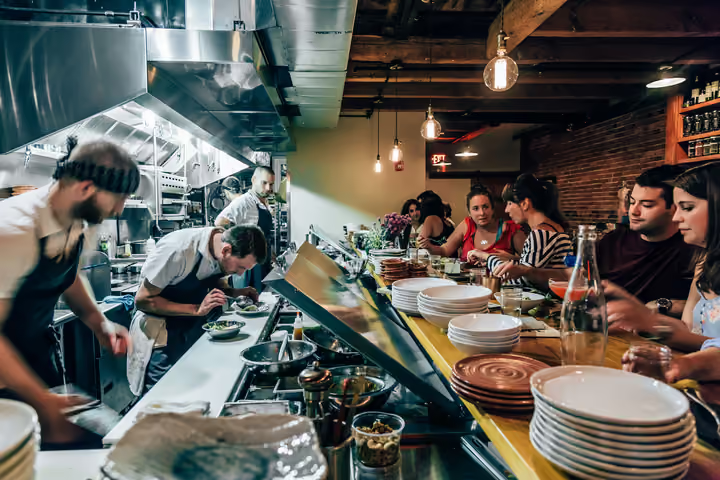
Think about what a Friday dinner service looked like five years ago: orders scribbled on paper tickets, staff running between the front counter and the kitchen, delivery calls competing with dine-in guests, and no reliable way to know which menu items were actually driving profit. Most of that friction was not a staffing problem. It was a technology problem.
A guest who orders from their phone, pays without waiting for the check, and earns loyalty points automatically does not see "restaurant technology." They see a smoother meal. For operators, that same experience reduces manual work, improves order accuracy, and creates more chances to bring the customer back.
The operators getting the most value from technology are not chasing every new tool. They are building connected workflows where online ordering, payments, customer data, and delivery operations move together — eliminating the manual rekeying, the missed tickets, and the lost loyalty that disconnected systems create.
According to NetSuite's restaurant industry report, 86% of restaurant operators consider technology adoption "extremely important" to their competitive strategy. The question is no longer whether to invest in technology. It is which tools to prioritize first.
The Digital Transformation Journey
The restaurant industry's digital transformation has accelerated dramatically, with technology now touching every aspect of operations. According to NetSuite's restaurant industry report, 86% of restaurant operators consider technology adoption "extremely important" to their competitive strategy.
This shift isn't just about adding digital tools-it's about fundamentally rethinking restaurant operations. Modern restaurants now operate as technology platforms that happen to serve food, rather than food businesses that use technology. This mindset shift is critical for success in an increasingly digital-first consumer environment.
The most successful operators are creating integrated technology ecosystems where their POS systems communicate seamlessly with inventory management, customer relationship platforms, kitchen display systems, and online ordering solutions like those offered by Restolabs. Within these connected ecosystems, restaurant chatbots have become an increasingly common tool for automating customer interactions while supporting online ordering and guest communication.
The data flow matters as much as the tools themselves. When a direct online order triggers a kitchen display ticket, updates inventory counts, logs a customer's preference, and queues a loyalty reward — all without a staff member touching a keyboard — that is what a connected tech stack looks like in practice. Restolabs is built to plug into that ecosystem: commission-free ordering that connects with POS, delivery, and payment systems so operators can scale without surrendering data or margin.
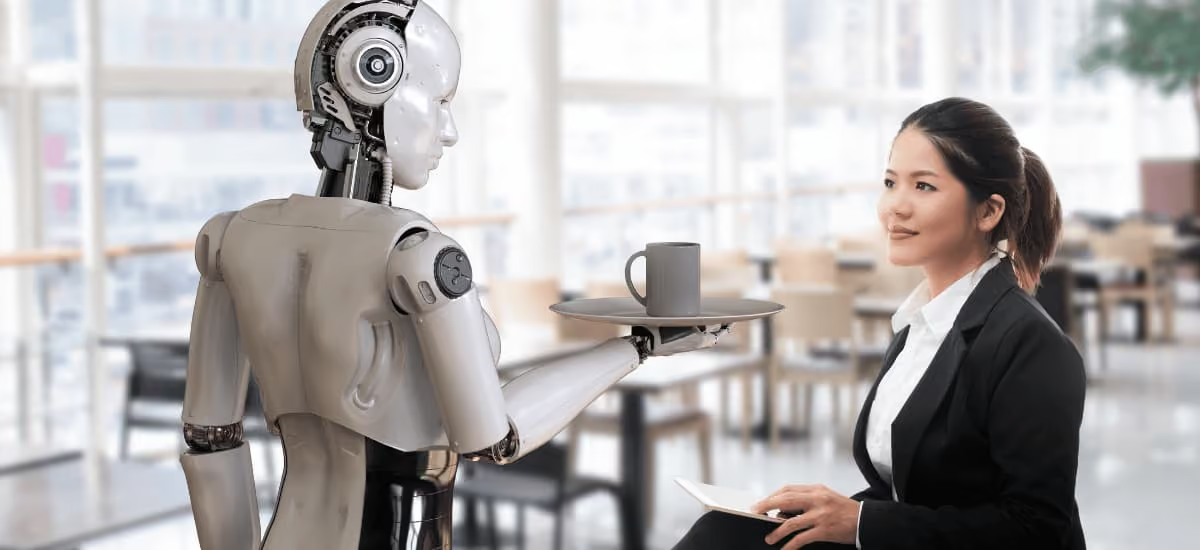
Front-of-House vs Back-of-House Restaurant Technology
Not every technology belongs in the same budget conversation. Understanding which tools affect the guest experience versus which ones improve internal operations helps operators prioritize spending and avoid over-investing in areas that are not their biggest bottleneck.
Restaurant POS, Kitchen Display, and Cloud-Based Operations
The POS system is not just a cash register anymore. A modern restaurant POS connects every order — whether it comes in through the front counter, a self-service kiosk, a mobile app, or an online ordering platform — into one unified data stream. Payments, inventory adjustments, loyalty point accrual, kitchen tickets, and sales reporting all flow from that single source of truth.
Kitchen Display Systems (KDS) sit at the end of that chain. When an order is placed, the KDS shows kitchen staff exactly what to prepare, in what sequence, and with what modifications — without a paper ticket passing through three hands. Restaurants using KDS report faster ticket times, fewer errors reaching the table, and better coordination during high-volume service periods.
Cloud-based POS and KDS systems also mean that operators can monitor performance remotely, push menu updates across locations simultaneously, and access real-time sales data without being physically on-site. For multi-location brands, this level of operational visibility is a meaningful competitive advantage.
Why Integrated Restaurant Technology Matters More Than Standalone Tools
Buying a great inventory tool that does not talk to your POS is like hiring a great chef who cannot read the tickets. The tool works fine in isolation. But the operation still breaks at the connection point.
Integrated restaurant technology solves that problem. When your online ordering platform connects with your POS, your POS feeds your kitchen display, your KDS updates inventory, and your inventory data informs your purchasing — every part of the business makes better decisions with less manual work. Operators using integrated systems report fewer order errors, more accurate demand forecasting, lower food costs, and faster guest service.
The business case is clear. According to DH Hospitality, restaurants that implement integrated technology solutions see an average 22% increase in annual revenue compared to those using disconnected point solutions. The gap between connected and disconnected operations is widening every year.
7 Restaurant Technologies Operators Should Prioritize in 2026
Not every food technology trend deserves space in a restaurant operator's budget. In 2026, the highest-value tools are the ones that protect margins, reduce manual work, improve order flow, and help restaurants build direct relationships with customers. These innovations are also inspiring entirely new restaurant concepts that rethink how fast food and casual dining generate revenue.
Use this section as a practical filter: prioritize technology that increases direct orders, connects with existing systems, and gives the restaurant more control over revenue and customer data.
E-commerce & Direct Online Ordering
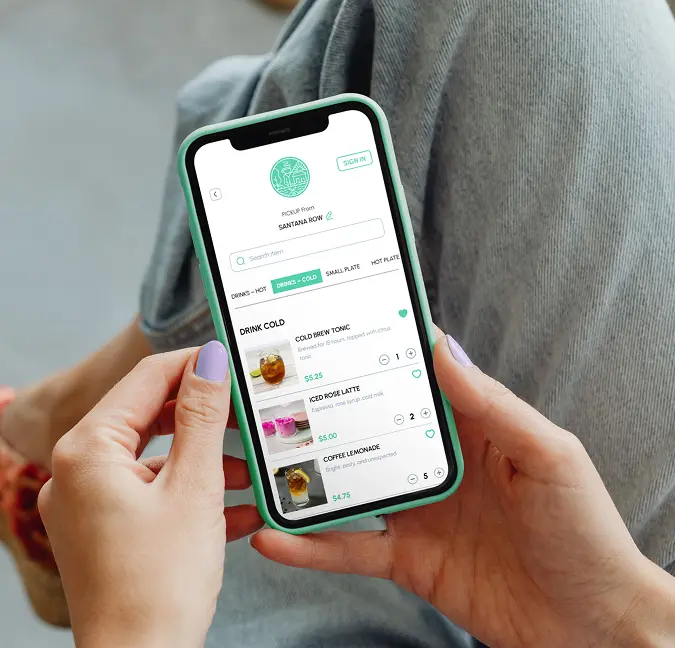
Digital ordering is now the front door of the restaurant for a growing share of guests. Operators who build that front door on their own platform — rather than a marketplace — keep more revenue, control the pricing, and retain the customer relationship for repeat marketing.
Food Safety and Transparency
The food industry is facing increasing pressure to ensure the safety and transparency of its products. Technologies such as blockchain and DNA-based authentication are being used to trace the origin of food products and verify their authenticity. This helps prevent food fraud and ensures that consumers get what they paid for.
Internet of Things (IoT)
IoT technology is being used to monitor and control food production and supply chains. Sensors and other devices can be used to track temperature, humidity, and other environmental factors affecting food quality and safety. For restaurant operators, IoT delivers the most immediate value in smart equipment monitoring: refrigerators, fryers, and HVAC systems that alert management before they fail — rather than after. Chick-fil-A's IoT deployment across its smart restaurants uses over 1,000 sensors and has resulted in 50% fewer equipment failures and significant energy cost reduction.
Artificial Intelligence (AI) & Personalization
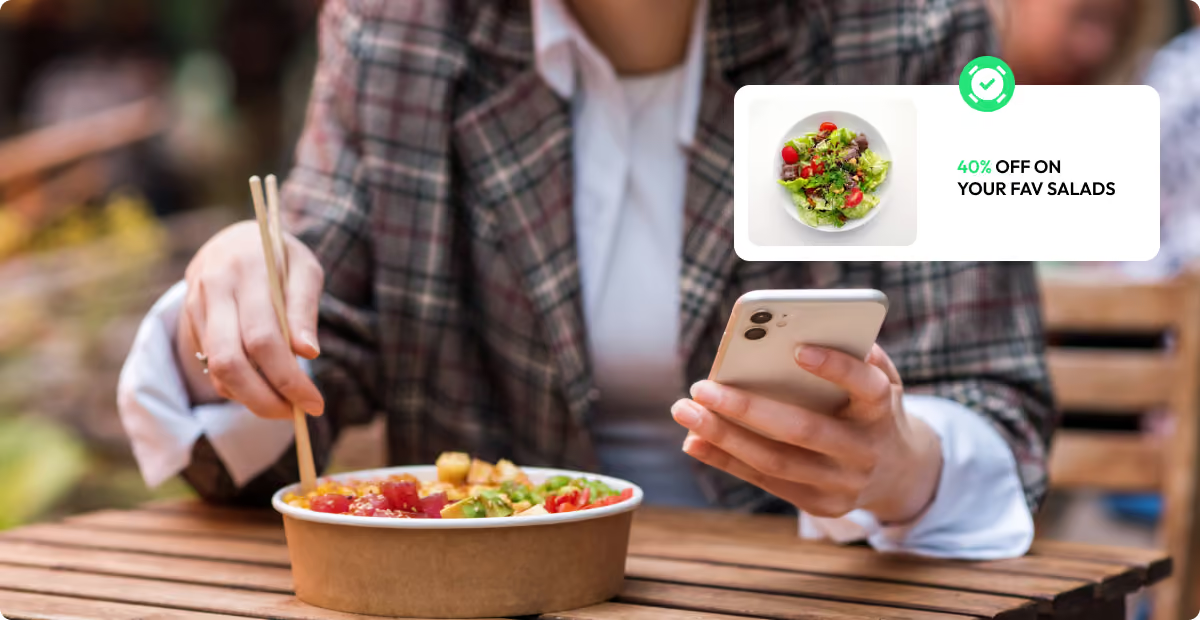
AI does its best work in restaurants when it is connected to real ordering data. A guest who regularly orders a spicy chicken bowl on Thursdays should see that item promoted when they open the app on Wednesday evening. That is not a gimmick — it is a measurable revenue driver.
AI-powered recommendation engines connected to direct ordering platforms increase average order value by 18–26%. The key is that the data powering those recommendations must belong to the restaurant — not a third-party marketplace that owns the guest relationship.
Watchlist Trends (Lower Priority for Most Operators)
The following trends are worth monitoring but are not yet core infrastructure for most independent restaurants, QSRs, or mid-size chains:
- Plant-based and cell-based proteins — menu strategy more than technology investment for most operators.
- Personalized nutrition — relevant for health-focused concepts but limited operational ROI today.
- 3D food printing — highly experimental; best suited for specialty or novelty dining concepts.
- VR dining experiences — niche experiential application with limited scalability for mainstream operators.
Top Restaurant Technology Trends for 2026
As we look ahead to 2026, several key technology trends are reshaping how restaurants operate and engage with customers. These innovations aren't just enhancing existing processes-they're enabling entirely new business models and revenue streams.
1. Voice-Activated Ordering Systems
Voice AI technology has evolved dramatically, with natural language processing now sophisticated enough to handle complex food orders with 97% accuracy. Restaurants implementing voice ordering systems report 35% faster order processing and significant labor savings during peak hours. Major chains like Chipotle and McDonald's are already testing voice AI in drive-thrus with plans for full deployment by 2026. Restaurant chatbots are another important part of this shift, helping businesses answer customer questions instantly, automate order placement, and provide support across websites and messaging platforms.
2. Predictive Analytics for Inventory and Staffing
Advanced AI algorithms now analyze historical sales data, weather patterns, local events, and even social media trends to predict demand with remarkable accuracy. Restaurants using these systems report 40% less food waste and 25% lower labor costs through optimized scheduling. The technology is becoming increasingly accessible to independent restaurants through cloud-based subscription models.
3. Robotic Kitchen Assistants
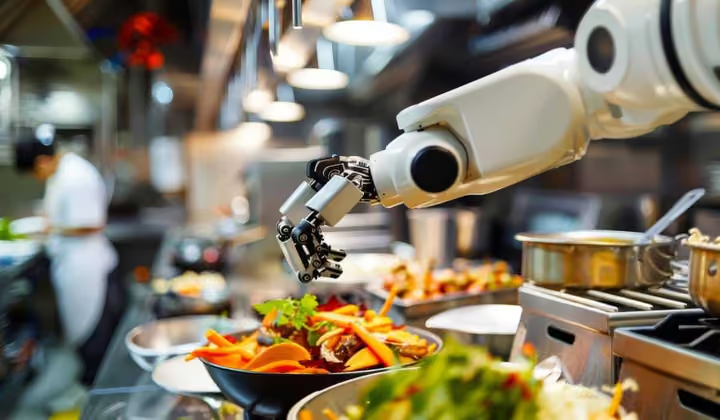
Beyond simple automation, next-generation kitchen robots can now handle complex cooking tasks with precision. These systems learn and improve over time, maintaining perfect consistency while adapting to changing conditions. White Castle's partnership with Miso Robotics demonstrates how even traditional chains are embracing this technology to address labor challenges while improving food quality.
4. Augmented Reality Staff Training
AR training platforms reduce onboarding time by 60% while improving knowledge retention. New employees wear AR glasses that overlay instructions on real-world equipment, guiding them through complex procedures step-by-step. This technology is particularly valuable in an industry with high turnover rates, ensuring consistent operations despite staffing changes.
These emerging technologies represent just the beginning of a fundamental transformation in how restaurants operate. By embracing these innovations strategically, restaurants can not only survive but thrive in an increasingly competitive landscape.
👉Also Read: Key Technological Macro Trends in the Restaurant Industry
5. Direct Online Ordering as Core Infrastructure
Online ordering has crossed from "nice to have" into essential infrastructure. But not all online ordering is equal. Restaurants that route orders through their own direct channel — rather than exclusively through third-party marketplaces — keep more revenue per order, control pricing and promotions, and build a customer list they own outright.
Platforms like Restolabs allow restaurants to launch commission-free direct ordering quickly, with POS and payment integrations that make the switch operationally seamless. The ROI case is straightforward: every direct order that replaces a marketplace order immediately improves per-order margin.
6. Loyalty Programs and First-Party CRM
Loyalty technology is most powerful when connected to direct ordering. When a guest orders through a restaurant's own app or website, every purchase builds a profile: what they order, how often, what promotions move them to act. That data enables automated win-back campaigns, birthday offers, and personalized upsells — none of which are possible when the order happens on a third-party marketplace that retains the customer data.
Starbucks launched its CRM system in 2010 and saw a 26% increase in revenue from its rewards program by 2015 — a proof point that owned customer relationships compound over time.
7. Contactless and Mobile Payments
Payment friction is one of the fastest ways to lose a guest at the finish line. Contactless payments — via NFC, QR code, or mobile wallet — remove that friction and speed up table turns. Sweetgreen began accepting contactless payments in 2018, and Starbucks built its mobile payment system into its loyalty app in 2011, turning checkout into a touchpoint for engagement rather than delay.
8. Menu Management and Dynamic Pricing Technology
Centralized menu management tools allow operators to update pricing, item availability, modifiers, and limited-time offers across every ordering channel simultaneously. For restaurants managing their own direct ordering platform, this also means running channel-specific promotions — a discount that applies only to app orders, for instance — without manual updates across multiple systems.
Analytics-driven menu optimization goes further: identifying which items carry the highest margin, which combinations drive the largest check sizes, and which underperformers should be removed or repositioned. Wendy's began using digital menu boards in 2012 and saw a measurable increase in sales driven by better item visibility and real-time promotion control.
9. Delivery Aggregation, First-Party Ordering, and Fulfillment Optimization
Delivery technology in 2026 is as much about business model decisions as it is about logistics. Third-party delivery aggregators provide reach, but they also extract a significant commission on every order and retain the customer's contact information. First-party delivery — where the guest orders through the restaurant's own platform and the restaurant manages fulfillment — keeps more margin and more data.
The best-performing restaurants in 2026 are not abandoning marketplaces entirely. They are using them for discovery while building owned channels for repeat business — where the margin and the customer relationship both stay with the restaurant.
10. Reservation, Waitlist, and Table Management Technology
For full-service restaurants, table management technology directly affects revenue per seat. Online reservation platforms reduce no-shows through automated reminders, capture guest notes for personalized service, and optimize seating sequences to improve table turn rates. Virtual waitlists eliminate the physical queue and let guests wait wherever they choose — reducing the abandonment that comes from long in-person waits.
Restaurant Technology Trends in 2026 and Real-World Adoption Examples
For restaurant operators, the most useful thing about early adopters is not that they moved first — it is what their results reveal about which technologies deliver real returns. The examples below show how direct ordering, delivery management, CRM, and automation each created measurable business outcomes for restaurants that committed to them.
Online Ordering
Online ordering is no longer just a convenience feature. For many restaurants, it is the difference between owning the customer relationship and renting it from a third-party marketplace.
When a restaurant relies only on third-party platforms, every digital order can carry a margin penalty of 15–30% in commission fees. Direct online ordering changes that equation by letting guests order from the restaurant's own website or app while the operator keeps more revenue, controls pricing, and builds a customer list they can actually use for loyalty and re-marketing.
Proof point: Domino's launched direct online ordering in 2008 and by 2016 reported a 28% sales increase in the first quarter — demonstrating how digital convenience, when owned by the brand, compounds over time into structural growth.
Contactless Payments
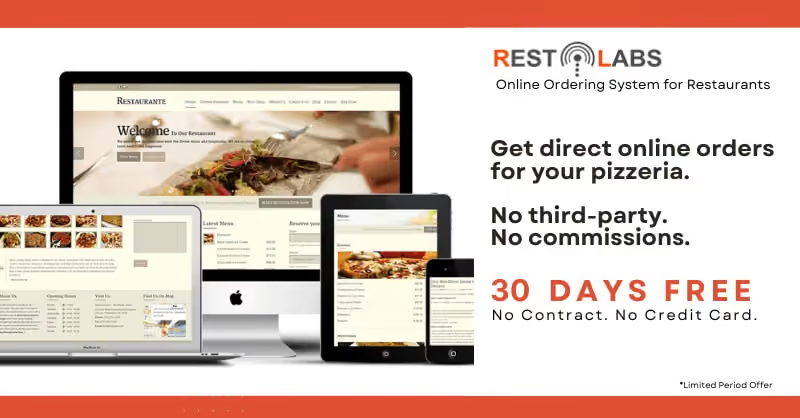
Contactless payments allow customers to pay for their orders without touching cash or credit cards. This technology has become more popular due to the COVID-19 pandemic, as it reduces the risk of transmitting the virus. Sweetgreen, for instance, started accepting contactless payments in 2018, and Starbucks, which launched its mobile payment system in 2011.
Self-Service Kiosks
During a lunch rush, the bottleneck is often not the kitchen. It is the line forming before guests even place an order. Self-service kiosks give customers a faster path to checkout while freeing staff to handle fulfillment, hospitality, and issue resolution.
Proof point: McDonald's rolled out self-service kiosks in 2015 and reported a 5–6% sales increase in those locations — driven not just by speed, but by the higher average order values that come when guests browse at their own pace.
Delivery Management Systems
Delivery gets expensive when restaurants have to manage orders, drivers, status updates, and customer calls across disconnected tools. A delivery management system brings those moving parts into one workflow, so teams can track fulfillment without losing control of the guest experience.
For restaurants using direct online ordering, delivery management also protects the brand relationship. The order starts with the restaurant, the updates come from the restaurant, and the customer stays connected to the restaurant — not to a third-party app. Pizza Hut's delivery management deployment in 2017 contributed to a 4.4% sales increase by the first quarter of 2019.
Digital Menu Boards
Static printed menus cannot respond to a sold-out item, a weather-driven promotion, or a time-sensitive upsell. Digital menu boards can — and they can do it simultaneously across every screen in the restaurant without anyone touching a printer. Wendy's deployed digital menu boards in 2012 and reported a 1–2% sales lift in those locations, driven by better item visibility and real-time promotional control.
Inventory Management Software
Manual inventory counts are a source of both waste and inaccuracy. Inventory management software automates stock tracking, flags variance alerts when actual counts drift from expected levels, and generates purchase orders based on real consumption data rather than gut estimates. When connected to the POS, the system updates inventory counts with every order — eliminating the lag between what sold and what needs to be reordered.
Advanced platforms add recipe-level costing, supplier integrations, and demand forecasting that accounts for day-of-week patterns, local events, and seasonal shifts. Subway deployed inventory management tools in 2012 and saw a 25% reduction in food waste — a result that directly improves food cost percentage without requiring menu changes.
Customer Relationship Management (CRM) Systems
A CRM is only as valuable as the data feeding it. When guest data comes from direct ordering channels, operators can segment by order frequency, average spend, favorite items, lapsed time since last visit, and dozens of other signals. Those segments power automated campaigns — win-back offers to lapsed guests, upsell nudges to high-spenders, birthday rewards for loyal regulars.
A customer who orders through a marketplace often belongs to the marketplace first. A customer who orders directly belongs to the restaurant. That difference matters when operators want to understand repeat behavior, send timely offers, reduce paid acquisition costs, and build long-term loyalty. Starbucks' CRM, built on owned customer data from its app, drove a 26% revenue increase from its rewards program by 2015.
Website and Social Media Photography
High-quality food photography on a restaurant's website and social media pages can attract potential customers and increase sales. Shake Shack uses mouth-watering images of its burgers and fries on its website and Instagram page to entice customers.
👉Also Read: 5 Best POS Systems For Restaurants - Pros, Cons & Pricing
Augmented and Virtual Reality Onboarding
Augmented and virtual reality can train new employees and familiarize them with the restaurant's operations. This technology can help new hires learn faster and reduce training costs. An example is McDonald's, which has used virtual reality to train new employees since 2016.
Virtual Reality Dining Experiences
Virtual reality can also be used to provide customers with unique dining experiences. Companies that have succeeded with this trend include The Arbour, a Pasadena, California restaurant offering a virtual reality dining experience that transports customers to a different location with each course.
Sustainable Practices
Restaurants are increasingly adopting sustainable practices, such as using compostable or reusable packaging, sourcing ingredients locally, and reducing food waste. Examples of companies that have been successful with this trend include Chipotle, which has committed to using only compostable or reusable packaging by 2026.
Biometrics
Biometric technology, such as facial recognition or fingerprint scanning, can be used to enhance security and improve the customer experience. Companies that have succeeded with this trend include Alibaba's KFC restaurant in Hangzhou, China, which uses facial recognition technology to make personalized meal suggestions to customers based on their previous orders.
Real-World Examples of Restaurant Technology Adoption
McDonald's: The fast-food giant has invested heavily in technology over the past few years, including implementing self-order kiosks and mobile ordering. The company has reported increased sales and improved customer satisfaction as a result of these technological advancements.
Domino's Pizza: Domino's has embraced technology to improve its delivery and ordering processes. The company has implemented GPS tracking for deliveries and an easy-to-use mobile app, leading to increased sales and a more streamlined ordering process.
Starbucks: Starbucks has adopted mobile ordering and payment options to improve customer convenience and reduce wait times. The company has reported increased sales and improved customer satisfaction as a result of these initiatives.
Sweetgreen: This salad chain has invested in automation and data analytics to improve operations and provide a more personalized customer experience.
Subway: Subway has implemented new technology, such as mobile ordering and delivery partnerships, to improve its customer experience and compete with other fast-food chains.
Innovative Technology Implementation Case Studies
Spyce (Boston): Founded by MIT graduates, Spyce created the world's first restaurant featuring a robotic kitchen that cooks complex bowl-based meals. The system can produce up to 350 meals per hour with remarkable consistency. This technology-first approach attracted investment from renowned chef Daniel Boulud and was eventually acquired by salad chain Sweetgreen to scale the technology.
Chipotle's Digital Kitchen Concept: Chipotle's "Chipotlane Digital Kitchen" locations feature no dining rooms but instead focus entirely on digital order fulfillment through drive-thru lanes and walk-up windows. These smaller-footprint locations process twice the digital orders of traditional Chipotle restaurants while requiring 25% less staff.
CloudKitchens: Founded by former Uber CEO Travis Kalanick, CloudKitchens has revolutionized the ghost kitchen model by providing turnkey infrastructure for delivery-only restaurant concepts. Their technology platform integrates multiple delivery services, provides real-time analytics, and enables restaurants to launch with minimal capital investment.
Chick-fil-A's IoT Restaurant: Chick-fil-A has implemented an IoT platform connecting everything from refrigerators to HVAC systems. Their smart restaurants use over 1,000 sensors to monitor food safety, equipment performance, and energy usage in real-time, resulting in 50% fewer equipment failures and significant energy savings.
More Resources on Brand Studies
👉How Restolabs' Online Ordering For Restaurants Helps Increase Average Online Order Value
👉How These Restaurants Are Maximizing The Power Of Online Ordering System
👉What's The Secret To A Successful Coffee Shop?
Benefits of Restaurant Technology for Operators and Guests
Adopting new technology in the restaurant industry can provide several benefits for businesses. Here are some of the top advantages:
- Improved Efficiency: Technology can automate time-consuming tasks, such as order-taking and inventory management, freeing up staff to focus on other tasks. This can lead to faster service, reduced wait times, and improved customer satisfaction.
- Cost Savings: Technology can help reduce labor costs by automating certain tasks and reducing the need for additional staff. Additionally, technology can help reduce food waste by providing more accurate inventory tracking and ordering, which can lead to cost savings on food purchases.
- Enhanced Customer Experience: Technology can provide customers with a more seamless and personalized experience, such as through mobile ordering or customized recommendations based on past orders.
- Increased Revenue: Technology can help increase revenue by attracting more customers, increasing order sizes, and reducing order errors
- Competitive Advantage: Adopting new technology can help restaurants stay ahead of the curve and stand out from competitors who have yet to adopt similar technology.
- Improved Data Management: Technology can provide valuable data insights, such as customer demographics and popular menu items, to help businesses make informed decisions to improve operations and menu offerings.
Strategic Business Growth Through Technology
Beyond operational improvements, restaurant technology creates strategic growth opportunities that weren't previously possible. Leveraging technology strategically allows restaurants to:
- Develop Multiple Revenue Streams: Technology enables restaurants to simultaneously operate traditional dining, takeout, delivery, meal kits, and virtual brands from a single location.
- Scale Without Physical Expansion: Digital platforms allow restaurants to reach new customers and markets without opening additional physical locations.
- Build Valuable Customer Databases: Owning direct ordering channels creates first-party customer data that can be leveraged for targeted marketing and loyalty programs.
- Optimize Menu Engineering: Data analytics identify high-margin, popular items that should be promoted and low-performing items that should be reconsidered.
- Create Subscription Revenue: Technology enables recurring revenue through meal subscriptions, membership programs, and exclusive digital offerings.
According to DH Hospitality, restaurants that strategically implement integrated technology solutions see an average 22% increase in annual revenue compared to those using disconnected point solutions.
Also Read: Using Online Ordering In Every Inch To Grow Your Restaurant Business
How to Implement Restaurant Technology Trends Successfully
Successfully implementing new restaurant technology requires a strategic approach that balances innovation with practical considerations. Here's a framework for restaurants looking to modernize their technology stack:
1. Assess Your Current State and Define Objectives
Begin by evaluating your existing technology infrastructure and identifying specific business challenges you want to address:
- Conduct a technology audit to document current systems and integration points
- Identify operational bottlenecks and customer experience pain points
- Define clear, measurable objectives for technology implementation (e.g., reduce order errors by 30%, increase online orders by 25%)
- Assess your budget constraints and potential ROI for various technology investments
2. Prioritize Technologies Based on Impact
Not all restaurant technologies deliver equal value. Prioritize investments using this framework:
Best technologies to implement first (small and mid-sized restaurants):
- Direct online ordering platform (commission-free, owned channel)
- Contactless and mobile payment processing
- POS integration with online ordering and KDS
- Basic loyalty and CRM connected to direct ordering data
- Inventory management with POS integration
- Delivery management for owned-channel fulfillment
- Analytics and reporting dashboards
- Kitchen automation and robotics (once foundation is in place)
How to Evaluate Restaurant Technology Before You Buy
Every vendor will claim their platform is the easiest, most integrated, and best-value solution. Here is a practical buying checklist that cuts through the noise:
- Commission model: Does the platform charge per-order commissions, or a flat monthly fee? Commission fees compound at scale.
- Customer data ownership: Who owns the guest data generated by orders? The restaurant should own it — not the platform.
- Integration capability: Does it connect with your existing POS, delivery tools, and payment processors without custom development?
- Setup time and support: How quickly can the restaurant start accepting orders? Is there dedicated onboarding support?
- Scalability: Can the platform grow with the business — adding locations, virtual brands, or new ordering channels?
- Contract flexibility: Are there long-term contracts or lock-in clauses? Flexible, contract-free plans reduce switching risk.
- Reporting depth: Does the platform provide actionable sales, customer, and menu analytics — or just transaction logs?
- Security and compliance: Is the platform PCI compliant? How is customer payment data protected?
- Total cost of ownership: Factor in setup fees, monthly fees, transaction fees, support costs, and integration costs — not just the headline price.
3. Choose the Right Technology Partners
Selecting appropriate vendors is critical for successful implementation:
- Evaluate integration capabilities with your existing systems
- Consider scalability as your business grows
- Assess customer support quality and availability
- Review security practices and compliance certifications
- Check references from similar-sized restaurants in your segment
- Compare total cost of ownership, not just initial pricing
- Confirm customer data ownership terms: the restaurant should retain full access to all guest data generated through the platform
Evaluate commission model: prioritize platforms with flat fees over per-order commissions to protect margin at volume
4. Create an Implementation Roadmap
Develop a phased approach to technology adoption:
- Start with pilot programs to test technologies before full-scale deployment
- Schedule implementations during slower business periods when possible
- Create contingency plans for potential disruptions
- Establish clear timelines with specific milestones
- Assign internal champions responsible for each technology initiative
5. Invest in Staff Training and Change Management
Technology implementation often fails due to inadequate training and resistance to change:
- Involve staff early in the selection process to build buy-in
- Develop comprehensive training programs for all affected employees
- Create simple reference guides and troubleshooting resources
- Identify and train "super users" who can support their colleagues
- Recognize and reward successful adoption
6. Measure Results and Continuously Improve
Technology implementation is not a one-time event but an ongoing process:
- Establish key performance indicators (KPIs) aligned with your objectives
- Regularly review performance data and gather user feedback
- Make necessary adjustments to configurations and processes
- Stay informed about new features and updates from your technology partners
- Continuously evaluate new technologies against your evolving business needs
By following this structured approach, restaurants of all sizes can successfully navigate the complex landscape of restaurant technology and realize meaningful business improvements.
Common Restaurant Technology Mistakes to Avoid
Most technology failures in restaurants are not caused by bad tools. They are caused by avoidable decisions made before implementation begins. Here are the mistakes that consistently cost operators time, money, and operational stability:
- Adopting tools without clear goals: Technology should solve a specific problem. If the problem is not defined before the purchase, the tool will not be used correctly.
- Choosing systems that do not integrate: A great inventory tool that cannot communicate with the POS creates manual work rather than eliminating it.
- Overlooking staff training: The best platform delivers zero value if the team does not use it correctly. Training is not optional — it is the implementation.
- Ignoring customer data ownership: Agreeing to platform terms that give the vendor access to guest data limits what the restaurant can do with that data for loyalty, re-marketing, and personalization.
- Underestimating hidden fees: Commission structures, transaction fees, and integration costs often do not appear in headline pricing. Always calculate total cost of ownership.
- Over-automating the guest experience: Technology should improve hospitality, not replace it. Removing all human touchpoints can alienate guests who value service.
- Failing to measure ROI: Without defined KPIs before implementation, there is no way to know whether the technology is working — or when to course-correct.
Ready to Transform Your Restaurant with Technology?
The restaurant industry is rapidly evolving with technological advancements that are reshaping every aspect of operations. From AI-powered ordering systems and kitchen automation to contactless payments and data analytics, these technologies aren't just enhancing efficiency-they're creating entirely new business models and revenue streams.
While implementing new technology presents challenges, from integration complexities to staff training needs, the competitive advantages are undeniable. Restaurants that strategically adopt these innovations will be positioned to thrive in an increasingly digital-first industry landscape.
Restolabs provides the comprehensive online ordering platform you need to start your digital transformation journey. Our commission-free solution gives you complete control over your customer data while seamlessly integrating with your existing systems. Schedule a demo today to see how Restolabs can help your restaurant stay ahead of technology trends and drive sustainable growth.

Sruthi Sekar specializes in brand strategy, growth, and user experience in the hospitality industry. As the driving force behind Restolabs, she helps restaurants harness technology to scale and thrive. With a background in design, branding, and entrepreneurship, she brings a sharp focus on crafting digital experiences that drive real business impact.
Frequently Asked Questions
The leading technology trend in restaurants is AI-powered ordering and personalization systems. These platforms analyze customer data to provide tailored menu recommendations, optimize pricing, and streamline the ordering process. Major chains including Wendy's, McDonald's, and Yum Brands have invested heavily in AI technology, with voice ordering becoming increasingly common in drive-thrus. This technology not only enhances customer experience but also improves operational efficiency by predicting demand patterns and reducing order errors.
Small restaurants can make technology affordable through several strategies. First, prioritize technologies with clear ROI, starting with online ordering systems and digital payment solutions that directly impact revenue. Consider cloud-based subscription models that eliminate large upfront costs in favor of manageable monthly fees. Many vendors now offer tiered pricing specifically designed for independent restaurants. Explore technology grants and small business loans focused on digital transformation. Finally, implement technologies incrementally, starting with core systems before expanding to more advanced solutions. Remember that many technologies quickly pay for themselves through labor savings, reduced waste, and increased sales volume.
Adopting new restaurant technology comes with several potential risks. Integration challenges can arise when new systems don't properly connect with existing platforms, creating operational disruptions. Cybersecurity vulnerabilities may increase as more systems connect to the internet, potentially exposing customer data. Staff resistance can undermine implementation if employees aren't properly trained or don't understand the benefits. There's also the risk of investing in technologies that quickly become obsolete or don't deliver expected returns. Finally, over-automation can potentially damage the customer experience if it removes the human elements that diners value. These risks can be mitigated through careful planning, thorough vendor vetting, comprehensive staff training, and phased implementation approaches.
Technology enhances restaurant customer experience in multiple ways. Digital ordering platforms allow customers to browse menus at their own pace, customize items precisely, and avoid order errors. Personalization technology provides tailored recommendations based on past preferences, creating a more relevant dining experience. Contactless payment options speed up transactions and reduce wait times. Self-service kiosks eliminate lines during peak periods. Behind the scenes, kitchen display systems and automation ensure consistent food quality and faster service. Loyalty programs powered by technology reward repeat customers and create a sense of recognition. Together, these technologies create a more convenient, personalized, and efficient dining experience that meets modern consumer expectations for speed and customization.




.webp)

.svg)
.webp)