
.avif)
Key Takeaways
- AI for restaurant marketing uses customer and transaction data to support segmentation, campaign planning, content generation, review management, and repeat-order marketing.
- The most useful AI solutions start with accurate first-party data from systems such as your POS, online ordering platform, CRM, and loyalty programs.
- Generative AI can help you create marketing content, promotional materials, social posts, campaign drafts, and content calendar ideas faster.
- AI for restaurant marketing can also support local SEO, Google reviews, audience targeting, campaign analysis, and informed decision making.
- Start with one recurring task, use the historical data you already have, generate the output, review it, and track the result against revenue.
- Restolabs provides the customer data, direct online ordering, integrated promotions, POS integration, and reporting foundation that can support more advanced AI-powered marketing workflows over time.
Today’s customers live in an AI-driven world. Which means whether they’re deciding where to dine-in, scrolling for a quick takeaway, or tapping delivery apps, algorithmic rankings and recommendations decide who gets seen and who gets skipped.
The visibility gap hits harder than most restaurant owners realize. With average net profit margins standing at just 4%–7%, even a drop in foot traffic or order volume results in an immediate and severe impact for them.
The good news: the same AI that controls the rankings can work in your favor.
In this blog post, we’ll learn how AI for restaurant marketing is being used, what benefits it brings, and how you can start using it in a practical way for your own business.
But first, let’s cover the basics.
What Is AI in Restaurant Marketing? (And How It Works)
AI for restaurant marketing refers to the use of Artificial Intelligence (AI) technologies such as Machine Learning (ML), predictive analytics, and automation to analyze customer data, generate insights, and execute marketing activities with minimal manual intervention.
These technologies integrate with the systems you already use, including:
- POS tool
- Online ordering platform
- Email software
They process data from multiple sources, like order history, reservation data, loyalty activity, and external reviews to identify patterns in customer interactions over time.
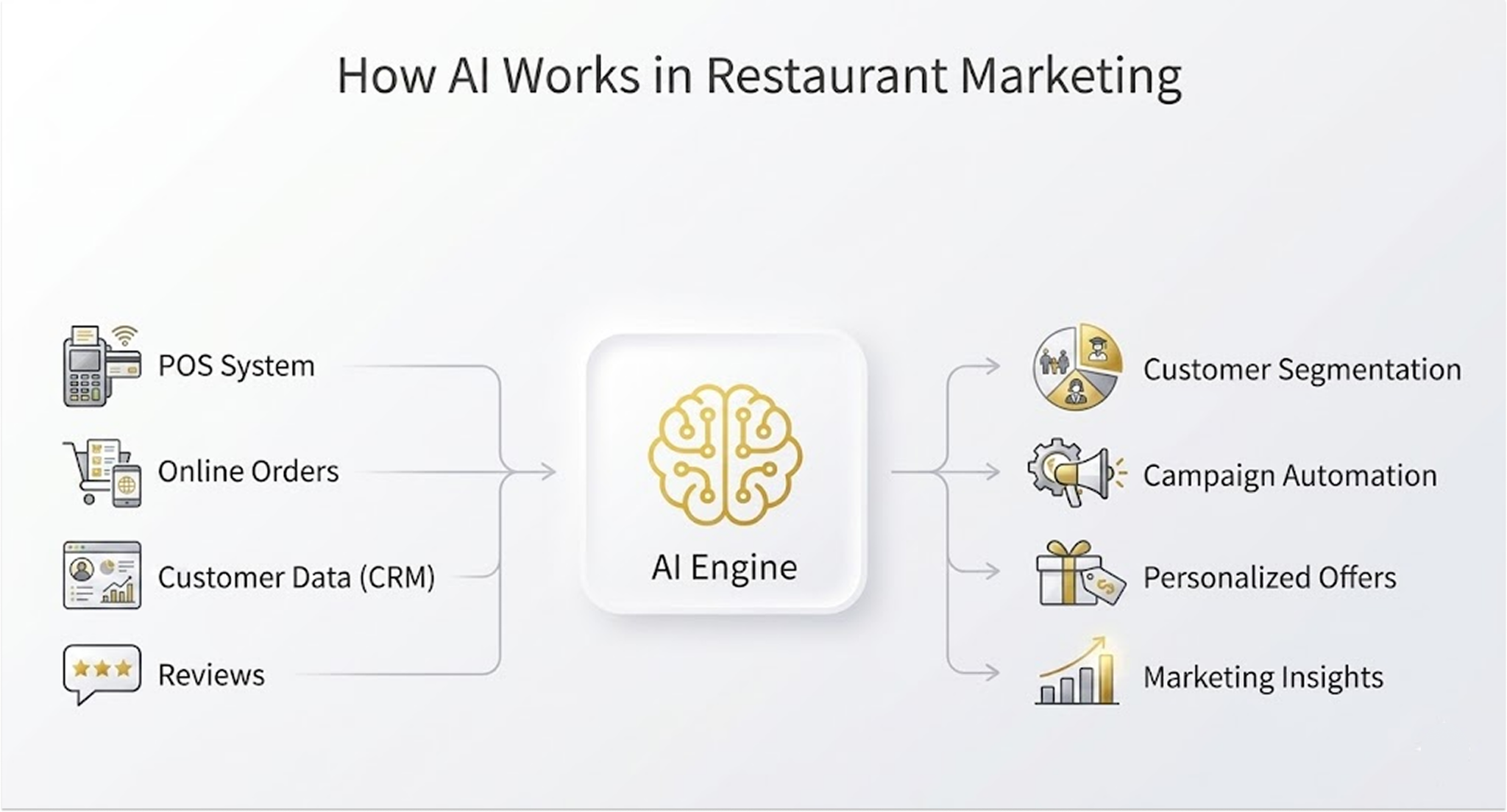
Based on these signals, AI enables automated functions, such as user segmentation, campaign scheduling, personalized offers, and content generation.
For a restaurant business, that can mean using AI software to analyze historical data, identify potential customers, support loyalty programs, create marketing content, and make more informed decisions from the data already flowing through restaurant operations.
What Are the Benefits of AI for Restaurant Marketing in 2026?
Deloitte reports that eight in 10 restaurant executives say their investments in AI technologies will increase in the next fiscal year. More specifically, 33% of restaurant operators plan to invest in AI-powered guest marketing. The reasons for AI adoption are clear:
1. AI reduces customer acquisition costs
Finding new customers is increasingly expensive. AI enables you to focus on people who already know about you – past diners, lapsed regulars, loyal takeaway customers – where conversion is far cheaper.
For instance, if someone hasn’t ordered in 60 days from you, AI can automatically send them a targeted offer to re-engage them before they forget you exist.
2. AI enables personalized marketing at scale
Generic “10% off everything” promotional blasts are easy to tune out. Customers in this day and age expect offers that reflect their actual tastes.
AI can analyze order history and dietary preferences to suggest items relevant to them. For example, if a customer always orders vegan takeaway, they’ll only receive plant-based recommendations, not a weekend BBQ special.
3. AI improves marketing efficiency with limited staff
Marketing tasks like scheduling email campaigns, responding to reviews, and drafting social media content are where AI saves the most time.
Restaurants using it for this work report saving anywhere between 3 and 5 hours a week, time that goes back into the floor, the kitchen, or ending shifts on time.
4. AI helps use first-party customer data more effectively
Your ordering and POS systems collect detailed customer behavior data, and yet in all probability, you barely scratch the surface of it. AI can turn that into demand forecasts accurate enough to account for weather and local events.
That way, when you push a dine-in special on a sunny Friday afternoon, it’s because the data told you to, not because you had a hunch.
This is where leveraging AI becomes especially useful for restaurant operators managing multiple locations, small chains, or restaurant groups.
Analyzing historical data across locations can help you stay aligned around local demand, customer behavior, seasonal campaigns, and restaurant operations.
5. AI helps compete on data with established businesses
Large restaurant chains and third-party delivery platforms have used customer data and automation for years.
AI finally gives independent restaurants like you access to the same playbook. You can analyze your order history, identify your highest-value customers, and act on that information in ways that previously required a dedicated marketing team.
The advantage shifts from who has the biggest budget to who uses their data better.
Which AI Tools and Use Cases Matter for Restaurant Marketing?
As AI-driven tools become a core part of your marketing stack, their real value lies in supporting day-to-day execution. Here are some of the most common use cases to consider:
1. Content asset creation
Promotions, limited offers, weekend specials, and email announcements require a steady stream of content. Writing copy from scratch is possible, but it slows execution and makes it harder to stay consistent when you’re working with a lean team or managing multiple priorities.
AI improves email marketing campaigns by personalizing content for recipients. You can enter a short prompt into the AI tool; for example:
“Write a promotional email for a new weekend brunch menu with a 10% discount” or “Create 3 Instagram captions for a new vegan pizza launch.”
This prompts the tool to generate multiple variations, including captions, email copy, and short promotional messages. You can then review these drafts, adjust the tone if needed, and finalize them for use across channels – 36% of operators use AI for copywriting tasks.
2. Social media planning and distribution
Keeping social media active requires regular posting. However, it often gets deprioritized during busy service hours. Generative AI automates social media content creation for restaurants.
With it, you can take an existing campaign, such as a Valentine’s Day promotion, a lapsed customer win-back, or a new menu launch, and convert it into a structured social media plan.
The tool can break that into individual posts across days, suggests publishing times based on engagement patterns, and format each content asset for the platform it’s going on. Moreover, 51% of restaurant operators use AI for video creation.
So all you need to do is check the plan, tweak the post timing or content if needed, and set everything up in one go.
For local visibility, AI can also support content planning around Google Business Profile updates, Google Maps discovery, Google reviews, local SEO, and organic visibility when those activities are part of your marketing workflow.
AI helps optimize local search visibility to improve foot traffic.
3. Campaign execution and audience targeting
Running email campaigns means switching between writing copy, designing layouts, selecting audiences, and deciding when to send. The more steps involved, the less frequently it gets done.
Using an AI tool, you can generate email drafts for different campaign types, including subject lines, messaging, layout structure, and visual elements aligned with your restaurant brand.
It can also help build audience segments automatically—for example, identifying customers who recently shifted from dine-in to delivery or those who stopped ordering specific items—and assign the campaign to the right group.
This is also where AI for restaurant marketing can support brand management, loyalty programs, seasonal campaigns, and customer experiences by helping you match the right offer with the right audience.
4. Review response and reputation management
Customer reviews across Google, delivery platforms, and social media. AI tools for restaurant marketing can track new reviews as they come in, categorize them by sentiment and keywords, and flag anything that needs your urgent attention.
From there, it can draft a response that fits the context, whether the review is a compliment, a complaint, or somewhere in between, so you can quickly approve and send.
For restaurants managing a Google Business Profile, this can help you keep up with Google reviews, identify recurring issues, respond to positive reviews, and protect local visibility without reviewing every message manually.
5. In-restaurant order platform automation
AI-powered ordering platforms work directly with your customer data as it’s generated, so you can define simple rules based on behavior, such as gaps in ordering, repeat purchases, or item preferences.
Once these rules are set, the platform can automatically apply them to incoming orders. This can trigger actions like sending a follow-up offer after a period of inactivity, highlighting relevant items during checkout, or spotting customers likely to reorder.
Because AI runs continuously in the background, you don’t need to plan or schedule each campaign manually. Over time, you can track which rules drive repeat orders or higher order value and optimize them to improve performance.
AI tools can analyze menu structure and dish performance. AI can increase average check size through upselling strategies. In addition, AI identifies low-performing dishes to cut from menus.
The wider food industry is also using AI powered solutions for inventory management, managing inventory, food waste reduction, delivery optimization, reservation management, table management, and real time analytics.
These use cases sit closer to restaurant operations, but they show how AI solutions can simplify operations beyond marketing – for instance:
- AI can reduce food waste by 20%.
- AI improves staffing efficiency by 20% through better scheduling.
- AI tools streamline reservations and optimize table turnover rates.
AI predicts guest arrival patterns for better table management. More specifically, AI reduces wait times and maximizes seating capacity.
If you’re curious to explore AI marketing tools, here are some commonly used options in the market. The right AI tools will depend on your restaurant operations, data, team size, and the automation features you need:
How Do You Implement AI in Your Restaurant Marketing Strategy?
By now, you’ve seen how AI is here to stay, shaping different aspects of your business. More importantly, you’d also agree that using it isn’t as complex or out of reach as it sounds. So if you’re ready to implement AI in your marketing, here’s how to get going:
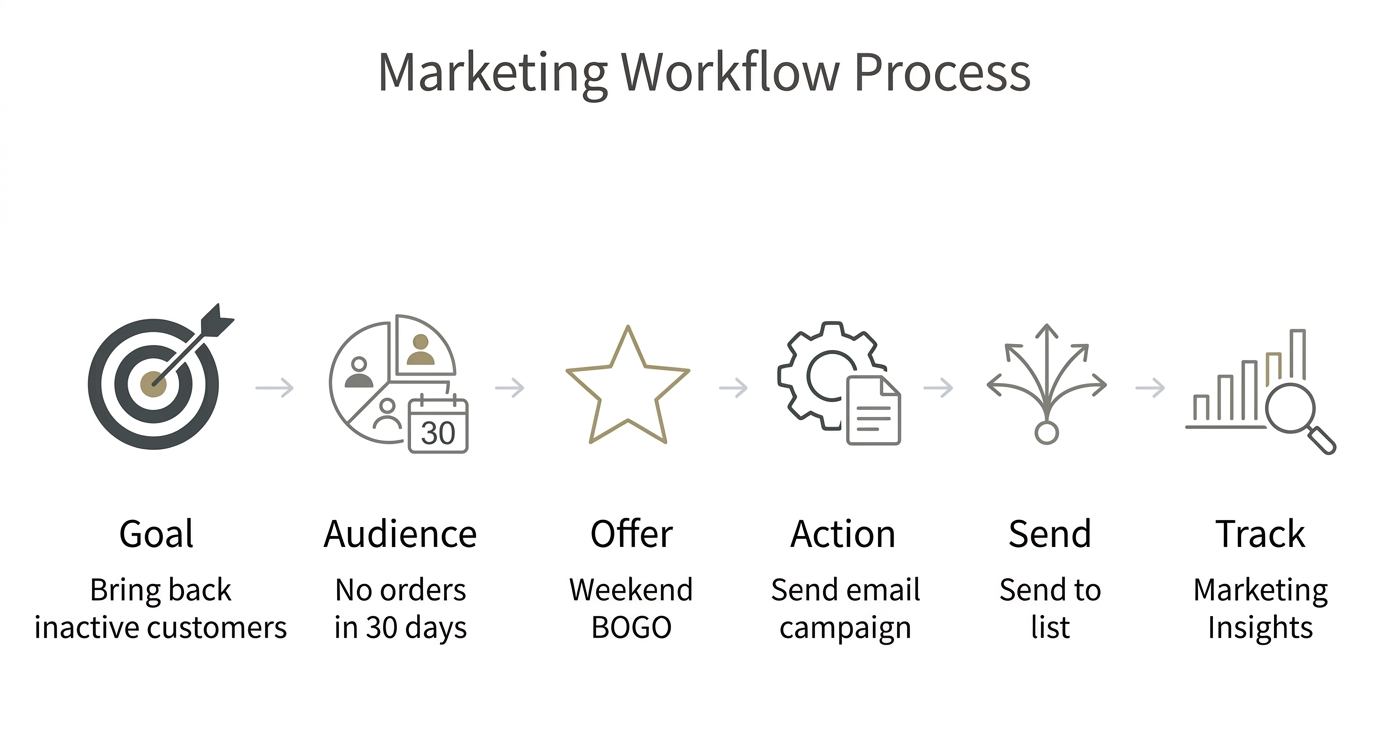
1. Pick one recurring task in your workflow
Look at how your restaurant marketing currently runs across the week and identify one thing that repeats. This could be:
- Sending a weekend email campaign
- Responding to customer reviews
- Planning social media posts
Once you spot that task, turn it into a single goal.
For example, if you send a promotional email every Friday, you can think about using AI to generate the first draft for your next campaign. Or, if you plan social posts at the start of the week, you may want to create visuals in one go, review them, and schedule them.
At this stage, you’re not rehashing your strategy. You’re only choosing one clear starting point to bring AI into the fold.
2. Use the data you already have
Go to the system where your customer data exists. This could be your POS system, online ordering platform, or CRM tool. Pull a customer list and analyze a few basic fields like:
- Last order date
- Order frequency
- Average spend
Now connect this information to the task you picked in Step 1. For example, if you’re sending a weekly promotional email, pull a list of recent customers who have ordered in the last few weeks. This gives you a clear audience for your next campaign.
3. Generate the output using AI
Here, take that task and create the content.
In your online ordering platform, open the AI feature and write a clear prompt including your offer and audience details.
Here’s a prompt example you can use:
Write a short promotional email for a restaurant.
The offer is: Buy 1 Get 1 Free on pizzas this weekend.
The audience is recent customers who have ordered in the last 30 days.
Keep the tone friendly and casual. Keep it under 120 words. Include a clear call to action.
Once you get the output:
- Add your restaurant name
- Include any missing details like dates or links
- Adjust the tone if needed
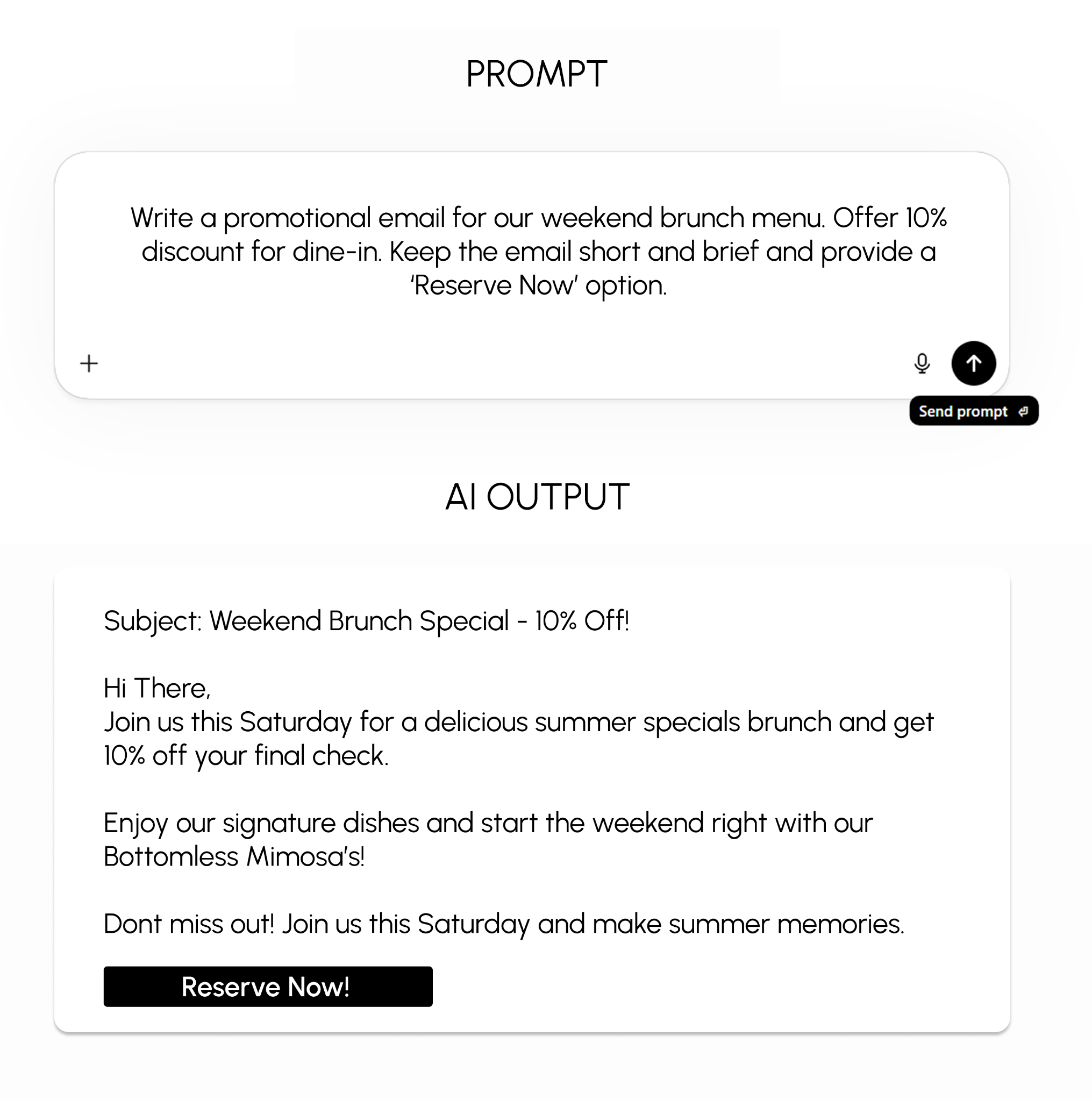
Paste the final message into your email or messaging tool and send it.
4. Make small changes after publishing
After sending the campaign, give it a few weeks (or days depending on the task frequency) and check how customers responded.
In our example, you might look at how many people opened the email or clicked on the offer. Based on what you see, change one thing – this could be the offer, messaging, or send time.
5. Track results tied to revenue
Check how your chosen activity connects to revenue.
For example:
- How many customers placed an order after the campaign
- How much revenue came from the offer
- Whether order values changed
You can usually find this data in your POS system or ordering dashboard. Focus on these outcomes to understand what’s working.
How Does Restolabs Make AI for Restaurant Marketing Smarter?
While fully AI-driven marketing features are gradually emerging in restaurant technology, they rely heavily on having the right systems in place first.
Restolabs is evolving in this exact direction, with future AI capabilities being built on top of its core strengths – customer data, direct online ordering, and integrated promotions.
When customers order through your Restolabs-powered ordering platform, you gain access to valuable first-party data like contact details, order history, and spending patterns.
Instead of relying on guesswork, you can see what your customers actually order, how often they return, and which items drive the most revenue.
This makes it easier to make smarter marketing decisions, whether that’s promoting high-margin items, identifying repeat customers, or understanding ordering trends over time.
Repeat customers are one of the most reliable drivers of restaurant revenue. You can leverage Restolabs’ built-in promotional tools to easily create:
- Coupons to drive short-term demand
- Loyalty rewards to encourage repeat visits
- Combo offers to increase average order value
- Promotional banners to highlight offers and new items
Because these promotions appear during the ordering process, they influence decisions at the exact moment customers are ready to buy.
Managing marketing campaigns often means juggling multiple tools. Restolabs simplifies this by keeping your promotions and customer information connected in one place.
You can roll out and manage offers directly within your ordering platform, while also exporting customer data for use with external tools like email marketing platforms when you need more advanced campaigns.
For restaurant groups, small chains, and businesses operating across multiple locations, having customer data, promotions, ordering activity, and reporting available through one platform can help teams stay aligned while they simplify operations.
Weston B of Eli’s Coffee Shop says Restolabs can “integrate easily with our POS and Loyalty platforms and process a high number of orders without issues.”
Book a demo with Restolabs to see how you can use customer data and automation to improve your restaurant marketing.

Asavari drives content development at Restolabs. With over a decade of experience partnering with fast paced technology and marketing teams, she turns complex product and industry details into clear, meaningful communication for restaurant partners.
Frequently Asked Questions
AI for restaurant marketing improves customer engagement by making every interaction more relevant. Instead of sending generic offers, you can use customer data, like order history, visit frequency, and preferences, to deliver personalized promotions, recommendations, and reminders.
AI marketing automation for restaurants minimizes costs by optimizing time-consuming tasks like campaign creation, customer segmentation, and review responses. This allows you to run consistent marketing without needing additional staff or agency support. AI also helps focus efforts on high-conversion audiences, such as past customers, minimizing spend on expensive new customer acquisition over time.
To measure the success of AI for restaurant marketing, you should track metrics directly tied to revenue. These include repeat orders, campaign-driven sales, average order value, customer retention rates, open rates and click-through rates. AI predicts pricing changes to optimize demand and revenue.
You can use AI to generate, edit, resize, or improve images for menus, social media, and promotions – 42% of operators use AI for image creation. AI can enhance food photography quality for online menus. Your team should still check that the final image accurately represents the dish customers will receive.





.webp)

.svg)
.webp)