

.jpg)
Key Takeaways
- QSR demand is concentrating by daypart, channel, and location, so a single operating model leaves money on the table.
- Drive-thru, pickup, delivery, and dine-in are not moving together. Your fulfillment mix should follow your cuisine and basket, not a template.
- Retention is now a timing problem. The reorder window matters more than the loyalty program alone.
- Value menus and bundles only protect margin when the basket architecture fits the category.
- Our data shows Friday is the highest ordering day, dinner from 5:30 to 8:30 PM is the main peak, and roughly 80% of orders come from returning customers.
What is changing in QSR demand right now?
QSR demand is becoming more channel-specific and more time-specific. Drive-thru still matters, takeout stays dominant, delivery keeps expanding, and the real edge comes from matching each order type to the right daypart and location.
Think of QSR as a convenience category where behavior is bunching into moments instead of filling the week evenly. Guests are not ordering a little bit all the time. They are ordering hard on Friday at dinner, then going quiet on Monday afternoon. That pattern is invisible if you only track monthly totals.
This is where broad restaurant commentary and QSR reality part ways. Generic industry coverage chases overall traffic growth. For QSR, speed, access, and order timing decide the outcome. A store can post flat traffic and still lose money if it is overstaffed at 3 PM and underprepared at 6 PM.
The channel shift is industry-wide. Drive-thru represents 70% of QSR transactions, according to the National Restaurant Association via Mordor Intelligence, 2025. For a side-by-side against a slower, higher-check format, the fast-casual restaurant industry report is a useful comparison.
The point for operators is direct. Demand is not just growing or shrinking. It is concentrating. That means your labor plan and your promotion calendar need to follow the actual order curve, not a flat weekly average.
Which QSR trends matter most for channel mix?
The biggest channel trend is that one fulfillment model no longer fits every concept. Pickup-heavy categories, delivery-native categories, and late-night concepts each behave differently, so the right mix depends on cuisine, basket size, and daypart.
QSR operators do better when they think in segments rather than slogans. Pizza, coffee, bakery, sandwiches, and grocery-style concepts do not win the same way, and treating them as interchangeable is how a good promo idea flops in the wrong store.
The volume behind these patterns is significant. Our data from the Restolabs 2026 Online Ordering Behaviour Report shows pizza alone drives close to a third of all activity on the platform, while sandwich concepts run the deepest baskets.
Takeaway still anchors the category more than any single technology story. Takeaway services hold a 46.05% share in 2025, according to Mordor Intelligence, 2025. A coffee shop that leans into fast pickup and a grocery-style operator that treats delivery as default are both reading their own data correctly, even though their answers look nothing alike.
The same promo or labor plan should not be copied across every store. A late-night delivery push makes sense for pizza and falls flat for a bakery that closes at noon. Match the plan to the segment, then to the daypart.
Why is retention one of the biggest QSR trends?
Repeat guests drive most of the revenue, so retention is not a loyalty program question as much as it is a timing question. The issue is not whether to re-engage customers. It is when, so the next order lands inside the natural reorder window rather than after they have already gone elsewhere.
Loyalty programs only work when timing and relevance match how people actually order. A points balance sitting in an app does nothing if the reminder arrives two weeks after the guest already reordered somewhere else. In a category built on convenience, repeat ordering is worth more than chasing new traffic in isolation.
When most of your volume comes from people who already know you, the timing of your message becomes the lever. Here is how the reorder window tends to unfold.
Repeat behavior is not evenly distributed, so a first-time guest and a weekly regular should not get the same message. Build the retention calendar around the reorder window instead of a generic monthly send. That single shift, from calendar-driven to behavior-driven, is what separates a loyalty program that pays for itself from one that just prints coupons.
How do menu and pricing trends show up in QSR performance?
Menu and pricing trends in QSR are really basket strategy questions. Value menus, bundles, meal deals, and limited-time offers all matter, but they only work when they match the order occasion and the economics of the category.
The framing that matters is margin and basket size, not trend chasing. A lower-ticket category needs different upsell mechanics than a high-check one. Pushing a large discount on a $16 coffee-and-pastry order can erase the margin you were trying to grow, while the same discount on a $57 sandwich basket barely moves the check.
Timing your menu tests matters as much as the offer itself. Rolling out a new bundle in the slowest part of the year gives you noisy data and thin volume to learn from.
Pricing pressure also sits inside a wider technology shift. Some 54% of QSR brands plan to increase spend on new technology in 2026, according to Business Wire, 2026. Value only protects margin when the basket architecture fits the category, so build combos around depth for high-check concepts and around speed for low-check ones.
What role will AI and new store formats play in QSR operations?
AI in QSR matters most where it reduces friction, improves prediction, and supports faster decisions. That includes demand forecasting, menu guidance, order accuracy, and personalization, especially when the store format is built for speed.
The useful applications are unglamorous. Predicting how much dough to prep before a Friday dinner rush. Flagging an order that looks likely to be wrong before it hits the line. Timing a personalized offer to land inside the reorder window. Kiosks, smart kitchen display systems, smaller footprints, and hybrid service models all belong to the same shift toward moving faster and serving more accurately.
The investment is real. That same 54% of QSR brands planning to raise tech spend in 2026 lists AI-driven kiosks, smart kitchen display systems, and unified commerce among the priorities, according to Business Wire, 2026.
AI earns its keep when it helps you predict demand, cut friction at the handoff, and personalize the next offer. A model that tells you nothing you can act on before the dinner peak is just an expensive dashboard.
How should QSR operators think about dayparts and staffing?
Dayparts drive most QSR execution errors. If staffing, prep, and promotions are not built around breakfast, lunch, dinner, weekend mornings, and late-night demand, the store will be overstaffed in the quiet windows and underprepared when orders spike.
Annual averages hide the real action. A schedule built on flat weekly headcounts will always be slightly wrong, because demand is not flat. Plan around the moments that actually produce orders.
Staffing should follow the order curve, not the clock alone. Two shifts of identical size, one on Monday afternoon and one at Friday dinner, will produce very different results. Only one of them is aligned with where the revenue actually shows up.
Which QSR trends vary by market?
Fulfillment habits, basket size, and late-night behavior are not the same everywhere, so QSR trends shift meaningfully by market. A multi-location operator should not copy a U.S. offer plan into the U.K., Singapore, or the UAE without adjusting for local demand.
Geography changes both the channel mix and the best time to sell. The same category can lean pickup in one country and delivery in another, and the late-night window that carries a UAE store may be dead space in a U.S. one.
Local demand patterns should shape offers, hours, and fulfillment priorities. For an operator running stores across regions, the fastest way to leak margin is assuming the home-market playbook travels intact.
How does Restolabs help restaurants own QSR orders?
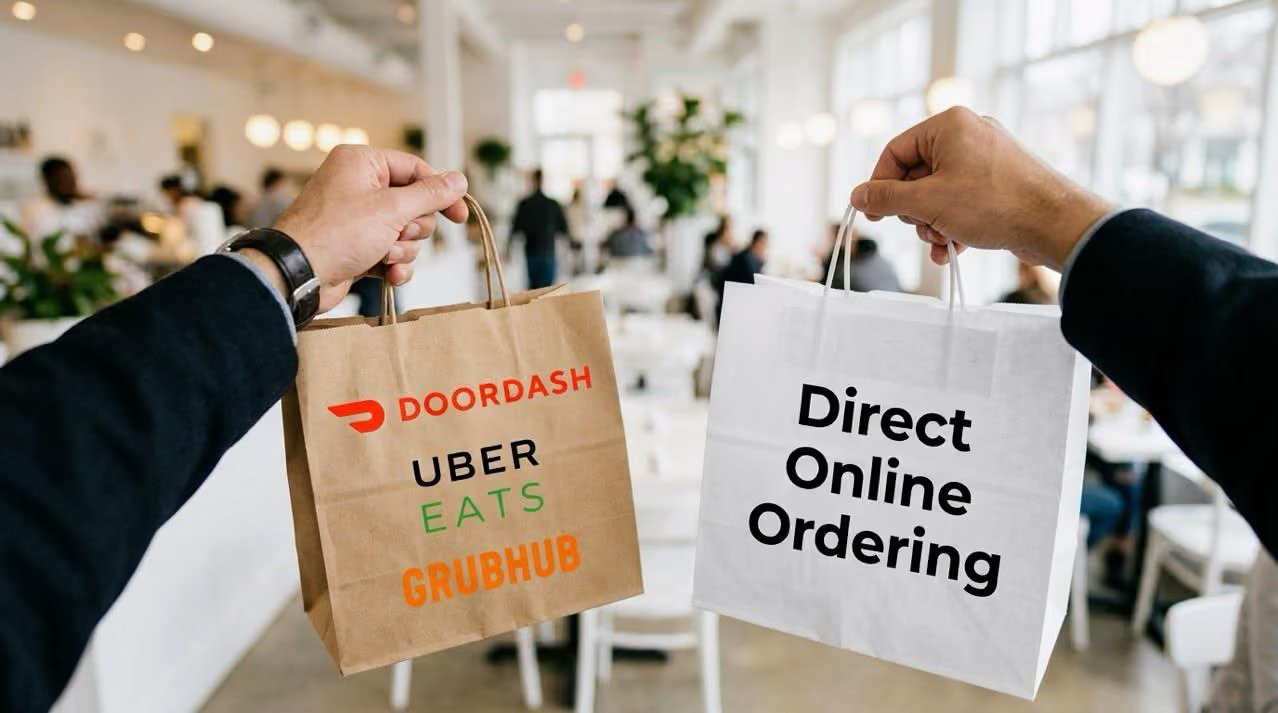
Restaurants that want to grow direct ordering need more than traffic. They need a system that helps them keep customer data, avoid unnecessary commission drag, and make the ordering experience simple enough for repeat use.
Restolabs gives operators a way to serve that demand directly, with menu sharing, setup support, and integrations that fit the way modern QSRs already run. That matters most when the business is trying to turn peak traffic into repeat orders instead of losing guests after the first transaction.
Ready to take back your online ordering? Book a Demo

Sruthi Sekar specializes in brand strategy, growth, and user experience in the hospitality industry. As the driving force behind Restolabs, she helps restaurants harness technology to scale and thrive. With a background in design, branding, and entrepreneurship, she brings a sharp focus on crafting digital experiences that drive real business impact.
Frequently Asked Questions
QSR trends are centered on channel mix, retention, AI-assisted operations, menu value, and daypart-based staffing. The strongest operators are aligning service to the moments customers actually order.
Yes. Drive-thru remains one of the most important QSR channels and still accounts for a large share of total transactions across the industry.
Our data shows the median time between repeat orders is 8.9 days, which makes day 7-10 the strongest re-engagement window.
Coffee, bakery, sandwiches, and many American QSR concepts skew toward pickup, while grocery and convenience lean heavily into delivery.
AI is most useful when it improves forecasting, ordering accuracy, menu guidance, and timing-based personalization, especially around peak dayparts.
Our data shows when orders happen, which channels win by segment, and how quickly customers return, so operators can connect trends to daily execution.
QSR is more speed-driven and occasion-driven, with sharper dependence on channel mix, peak timing, and convenience. For a broader comparison, see the fast-casual restaurant industry report.






.webp)

.svg)
.webp)