
Key Takeaways
- A SWOT analysis helps owners separate internal and external factors so they can see what the restaurant controls, what it needs to respond to, and where the best opportunities sit.
- The strongest restaurant SWOT analysis examples use performance data, customer feedback, competitor research, and team input rather than assumptions.
- Strengths and weaknesses are internal; opportunities and threats come from the competitive environment, market trends, consumer preferences, and other external forces.
- A useful SWOT does more than fill four boxes. It connects findings, prioritizes decisions, and turns them into a focused restaurant strategy.
- Restolabs can support the process with order, menu, channel, customer, and operational data that helps restaurants test assumptions against real performance.
Isn’t the restaurant industry a masterclass in chaos? In 2025, 42% of restaurant operators said their restaurant wasn’t profitable, according to the National Restaurant Association.
Whether you’re running a neighborhood café, a growing franchise, a food truck, or a streamlined cloud kitchen, you’re constantly reacting – to sudden spikes in food or labor costs, viral TikTok reviews, new competitors, or shifts in how customers want to order.
And that’s exactly why a SWOT analysis can be useful. It gives you a structured way to step away from the day-to-day noise and look at what’s working, what’s holding you back, and where the strongest opportunities or risks lie.
You might feel like you’re doing “well,” but without a clear framework, it’s nearly impossible to see the gaps draining your margins or the growth opportunities sitting right under your nose. Conducting a SWOT analysis helps a restaurant create a strategic roadmap for success.
In this guide, we’ll show you exactly how to prepare and conduct one, work through a practical example step by step, and turn the findings into actions you can execute and measure.
What Is a SWOT Analysis for Restaurants?
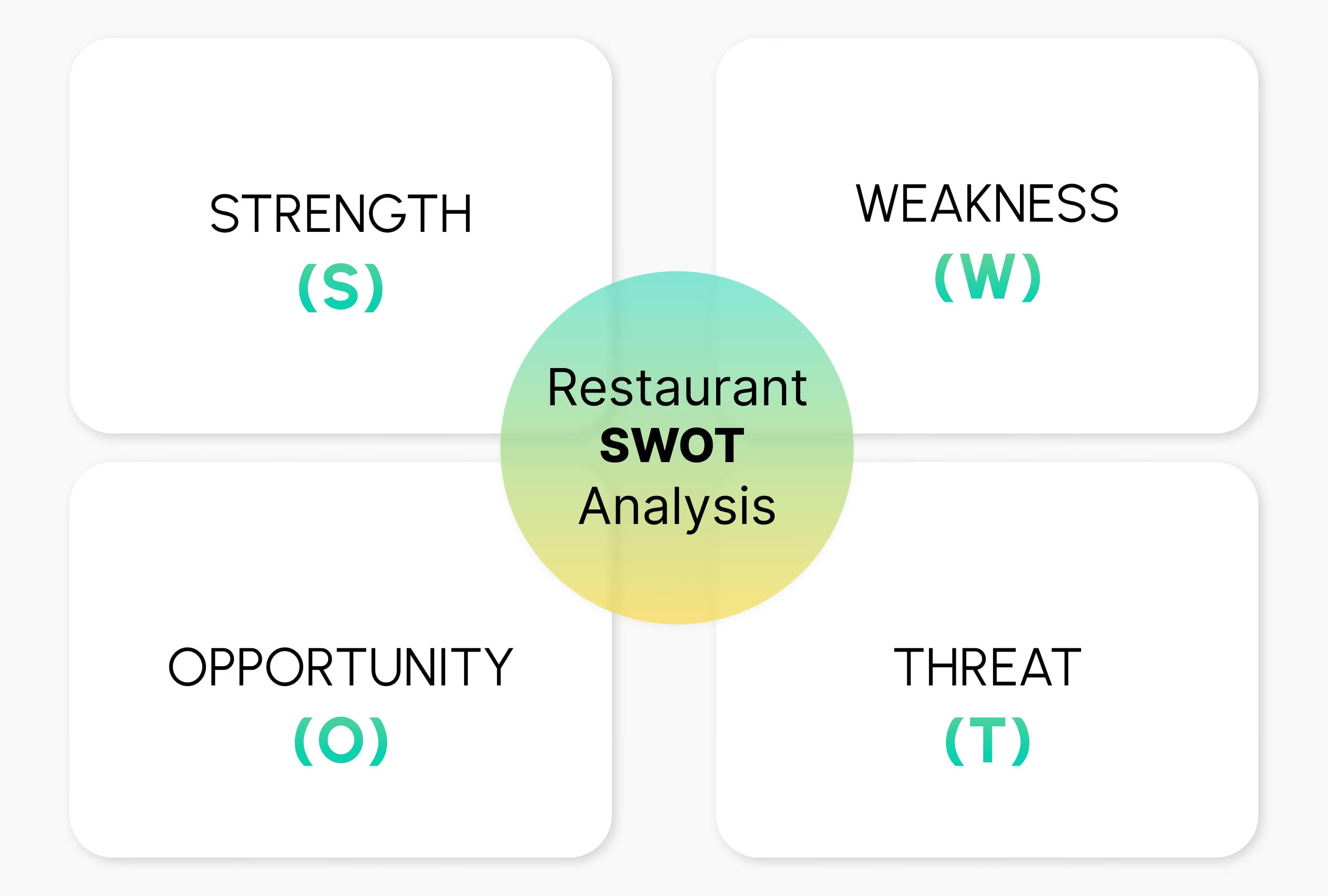
Simply put, it’s a strategic planning framework that organizes the factors influencing your restaurant’s performance into four categories: strengths, weaknesses, opportunities, and threats.
A restaurant SWOT analysis evaluates internal and external factors through four key areas: Strengths, Weaknesses, Opportunities, and Threats.
- Strengths (S): What your restaurant does well and what drives revenue or gives you a competitive edge
- Weaknesses (W): Where performance drops, customer satisfaction suffers, or inefficiencies exist
- Opportunities (O): External factors you can leverage to grow or reach a broader customer base
- Threats (T): External risks that could affect revenue, demand, costs, or your market position
Think of it this way:
- Internal factors in a SWOT analysis include strengths and weaknesses. These reflect what’s happening within your business, from your menu and staff to food quality, exceptional customer service, operational costs, your loyalty program, and day-to-day processes.
- External factors in a SWOT analysis include opportunities and threats. These include supply chain disruptions, economic downturns, food trends, evolving dining preferences, and shifting competitor strategies you must respond to but can’t fully control.
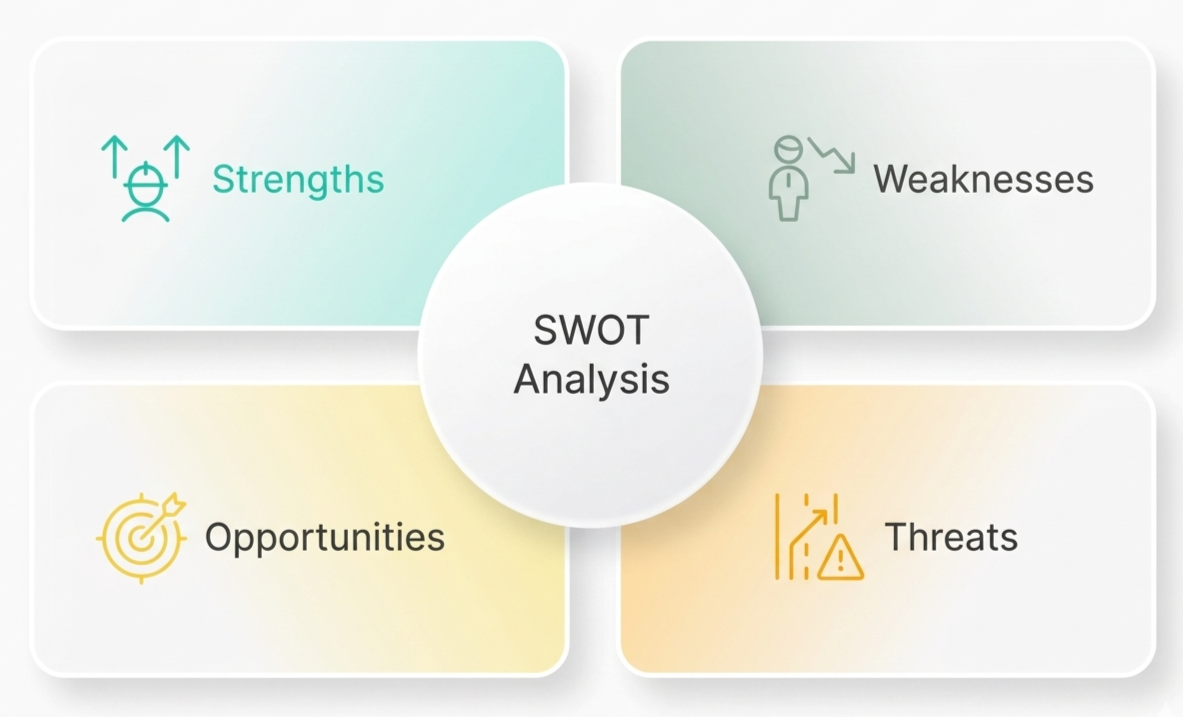
Most people create a two-by-two grid for the SWOT matrix – as shown below:
What Does a Restaurant SWOT Look Like?
A useful restaurant SWOT should be specific enough to help you make a decision. “Good food” or “lots of competition” won’t tell you much unless you can explain what they mean for your business. Here’s what a completed SWOT analysis might look like for a typical local restaurant:
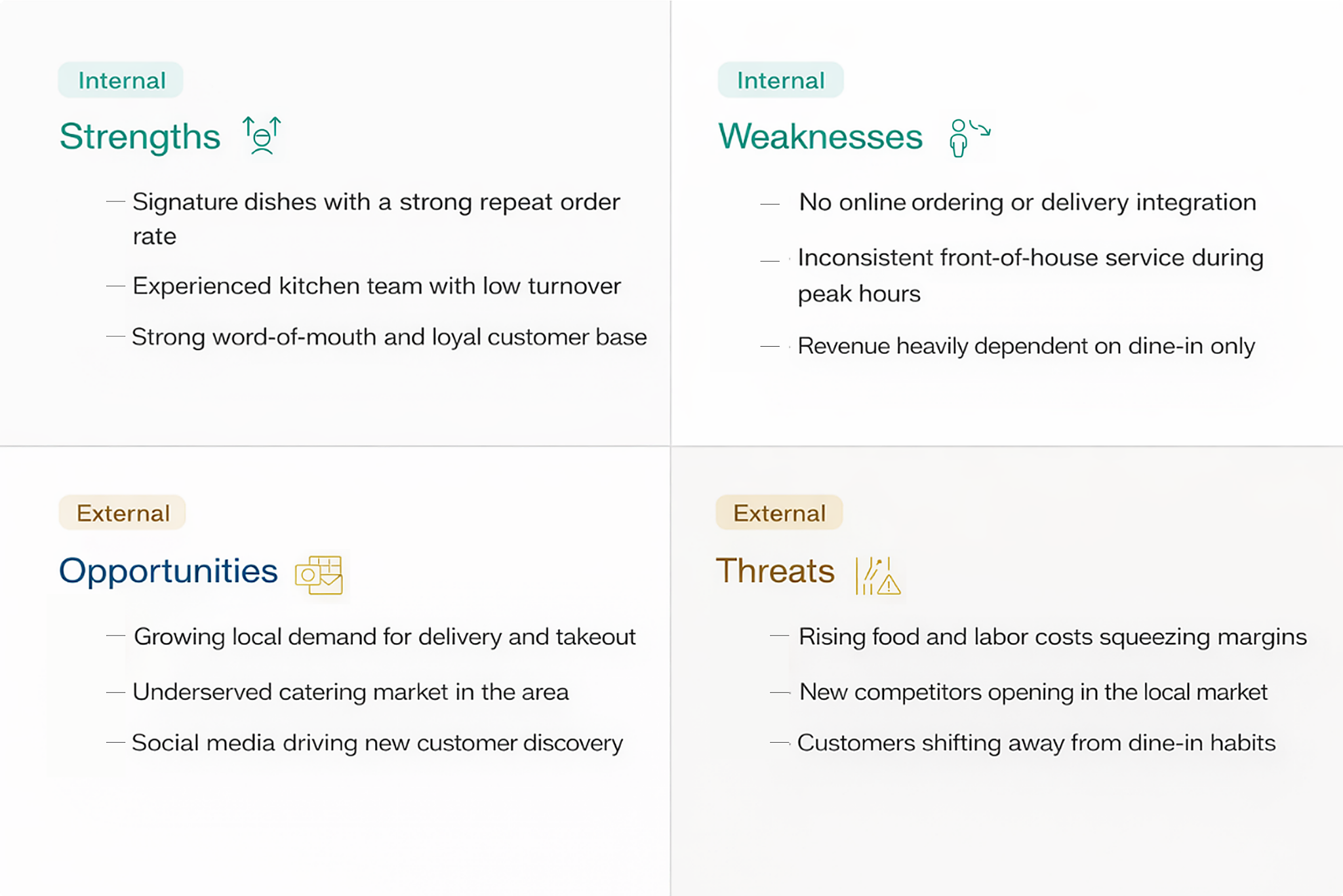
For instance, strong customer loyalty can be a crucial strength for a restaurant. Weaknesses like slow service can harm customer satisfaction. Inconsistent food quality is a common restaurant weakness too.
On top of it, growing demand for delivery and takeout is an opportunity for restaurants. Rising ingredient costs are squeezing already-thin margins for restaurants. New competitors opening nearby can threaten existing restaurants' market share.
How Should You Prepare a Restaurant SWOT?
Before diving into the four quadrants, define a specific objective for your SWOT analysis. Then gather enough evidence to keep the exercise grounded in what is actually happening:
Step 1: Define the goal of your SWOT analysis
First of all, identify one specific problem your restaurant is facing.
For example, you might be dealing with weakening weekday lunch sales, rising commissions from food delivery services, uncertainty around opening a second location, or concern that your current marketing strategy is not reaching the right target market.
To sharpen the focus, ask yourself a few quick diagnostic questions:
- Are weekday sales consistently lower than weekends?
- Are online orders growing slower than last quarter?
- Are delivery costs shrinking your margins?
- Are labor costs rising faster than revenue?
- Are negative online reviews pointing to the same recurring issue?
- Has a new competitor changed demand in your local market?
Goal of this step: Come up with a single question that your SWOT analysis should answer. For example: “How can I increase weekday lunch orders over the next six months?”
This matters because a SWOT analysis done to improve weekday lunch sales should not look identical to one built to launch a new loyalty program, reposition a luxury dining concept, or decide whether to open a second location.
Step 2: Gather data about your restaurant’s performance
Now, to ground your discussion in actual numbers, pull up your sales reports. Start by breaking down revenue across channels such as:
- Dine-in
- Pickup
- Direct online ordering
- Third-party delivery services
- Catering, if relevant
Review at least the last three to six months of data. Then, look at order volume across:
- Different times of the day
- Weekdays versus weekends
- Dine-in versus off-premise orders
- Individual menu items or categories
- Promotions and loyalty offers
This will help you identify peak order periods, slow windows, demand gaps, and channel differences that may not be obvious at a high level.
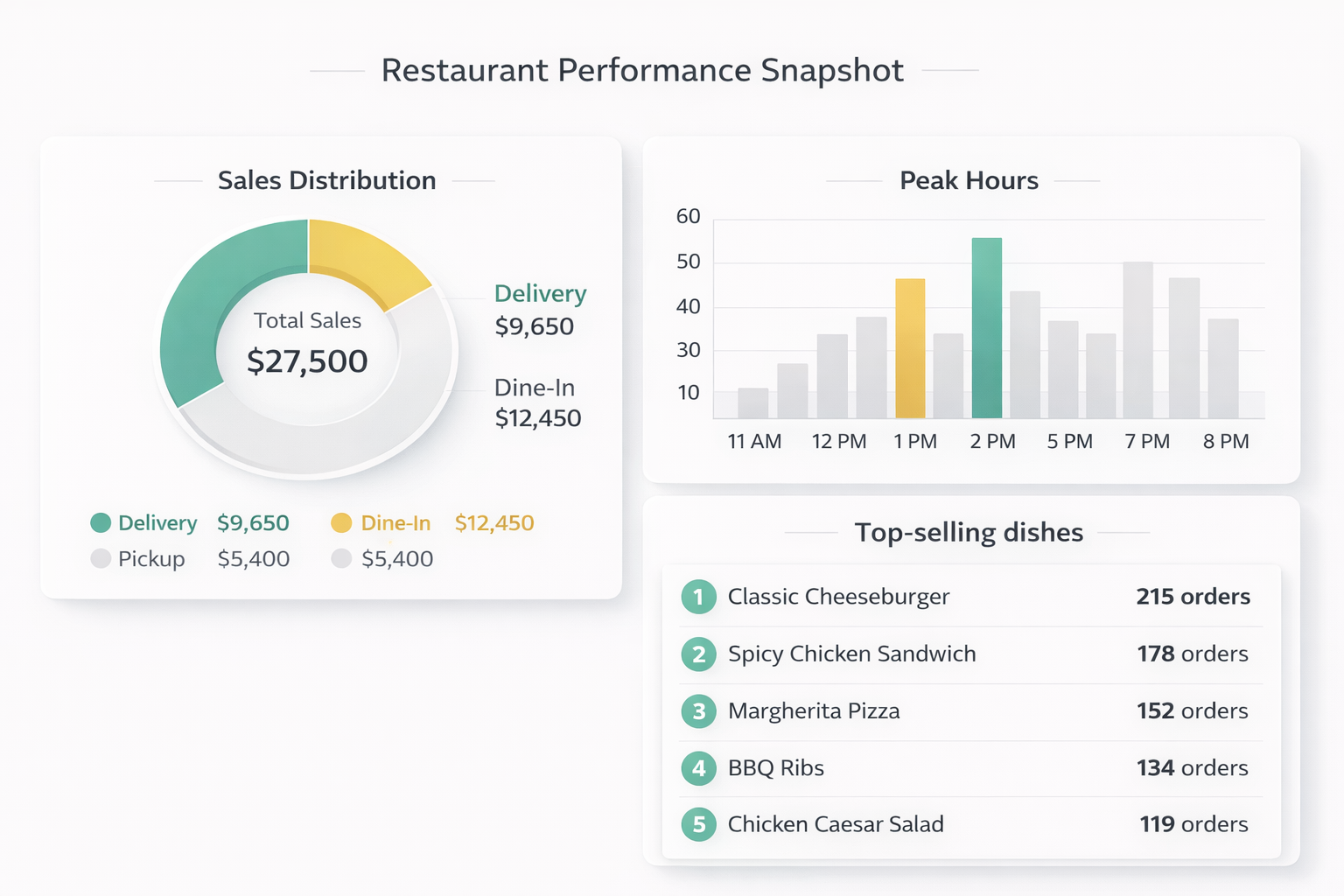
Goal of this step: Identify your strengths and weaknesses from the restaurant performance data.
Which is your best-performing dish? Which dishes are rarely ordered but have good margins? What is your slowest period? Are your peak hours actually converted into more revenue? Are certain channels bringing volume but weak margins?
Step 3: Review customer feedback and online reputation
Before your SWOT analysis, do a deep dive into the places where customers regularly leave feedback. Look at Google reviews and your online ordering platform first since these tend to reflect recent customer experiences.
Then scan Yelp, third-party delivery reviews, and social media comments for more context around service, atmosphere, pricing, food quality, and brand perception.
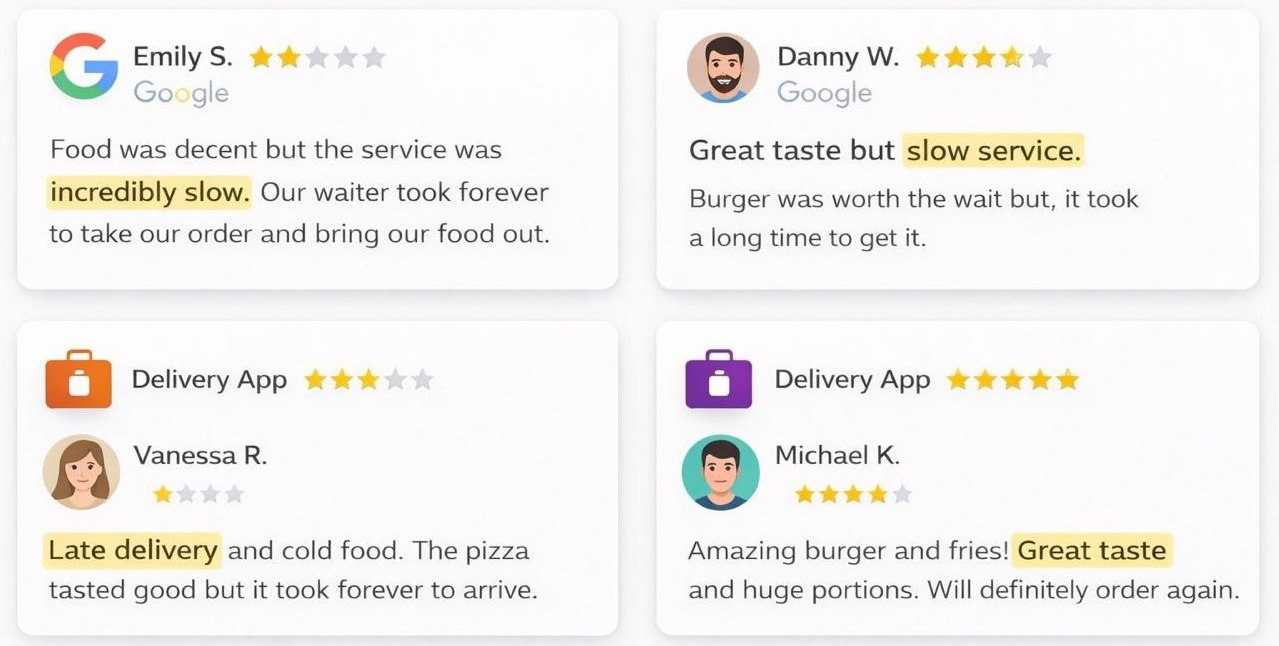
During your research, scan for themes customers mention more than once:
- Specific dishes
- Service speed
- Order accuracy
- Pricing
- Wait times
- Packaging and delivery problems
- Exceptional service from staff
- Requests that come up repeatedly
A single comment can be ignored. Anything that keeps showing up is worth noting. Identifying weaknesses requires an honest assessment of performance-limiting areas.
For example, repeated praise for exceptional customer service can support a strength. Repeated complaints about slow service or inconsistent food quality should sit under weaknesses.
Goal of this step: Identify what customers repeatedly call out as your strengths and weaknesses. Their feedback should carry real weight in the analysis.
Step 4: Study your competitors and local market
Next, take some time to understand how your restaurant compares with others in your area.
List a few direct competitors with a similar cuisine, price range, location, or target audience. Review their menus, pricing, customer ratings, delivery options, loyalty programs, and positioning across Google Maps, Yelp, Uber Eats, and social media.
Take note of:
- What they are doing better than you
- Where they fall short
- What they aren’t offering at all
- How strong their social media presence is
- Which offers or menu items they push most heavily
A strong online presence is crucial for attracting customers. But don’t automatically label social media as a strength because you post regularly. Look at whether your visibility, reviews, engagement, and ordering presence are genuinely helping you attract a broader customer base.
For example, you might notice that a nearby restaurant with similar pricing has significantly higher ratings because of faster service. Or you may find that nobody in your area is offering a particular cuisine, seasonal menu, private dining option, or office-lunch format that customers seem to want.
Goal of this step: Identify market gaps, uncover opportunities to differentiate, and spot potential threats that could affect performance. For example:
- When competing restaurants with the same cuisine have clear best-selling items, it signals strong market demand.
- If you offer the same dish but it performs poorly, that may point to a current weakness.
- If you don’t offer it at all, it may point to an opportunity.
- If several competitors are already fighting for the same demand, you may be looking at a crowded market rather than a simple growth opportunity.
Step 5: Define your restaurant’s position in the market
Take a moment to define how your restaurant is positioned. Are you aiming to be:
- A premium fine dining restaurant?
- A luxury dining concept?
- One of the more accessible casual dining restaurants in the area?
- A quick-service restaurant?
- A food truck built around convenience?
- A value-for-money option?
- A specialist concept aimed at a very specific customer base?
This context matters because the same factor can be interpreted differently depending on your market position.
Higher prices may be a weakness for a budget-focused restaurant but completely aligned with a premium brand. Longer service times may frustrate customers in a quick-service setup but be perfectly acceptable in an experience-led restaurant offering a multi-course tasting menu.
Likewise, a convenient location may be a major strength for a lunch concept, while a prime location matters much less if your restaurant strategy is heavily focused on delivery.
Goal of this step: Understand what your restaurant is trying to be so you can correctly identify what is a strength, weakness, opportunity, or threat.
Your SWOT should reflect whether your menu offerings, food quality, service, pricing, and customer experience actually meet customer expectations for that positioning.
Step 6: Take feedback from key team members
A SWOT analysis for restaurants is more accurate when it includes input from the people handling daily operations, such as a manager, kitchen lead, and front-of-house lead. Keep the group small so the discussion stays efficient.
How Do You Conduct a Restaurant SWOT?
Once you’ve defined the goal and gathered the evidence, organize the findings into the SWOT matrix, look for connections between them, and use those connections to decide what to do next.
At this point, you’ve defined your goal, reviewed your performance data, studied customer feedback and competitors, and collected input from your team. Now it’s time to organize, analyze, and act on those findings.
Let’s work through the process with one example.
The SWOT goal: “How can we improve weekday lunch sales?”
The figures below are illustrative. They show how the exercise works and are not Restolabs benchmarks.
1. Organize: Bucket your findings into a SWOT matrix
2. Analyze: Turn your SWOT into decisions
Now that your findings are organized, the next step is to interpret what they mean together. Don’t look at each quadrant in isolation. Look for connections across them. Identifying strengths boosts competitive advantage in restaurants.
- When a strength aligns with an opportunity, it shows where you should double down.
Example: Best-selling dishes + weekday lunch demand → Promote these dishes during lunch.
- When a weakness connects to a threat, it highlights a risk that needs fixing.
Example: Low lunch visibility + competitors running lunch offers → You’re losing demand to better marketing.
- When an opportunity exists without a supporting strength, it shows a gap you need to build for.
ample: Office lunch demand + no strong lunch menu → You’re not set up to capture this demand.
Leveraging strengths can help address weaknesses in a business context.
For example, you may not need to create an entirely new lunch menu. If two or three dishes already perform exceptionally well, you can use those restaurant strengths to build a faster, more compelling lunch offer.
3. Action: Drive more weekday lunch orders
Based on your SWOT, the priority becomes clear: “Capture existing weekday lunch demand using what already works.”
What should you do?
- Promote your top-performing dishes during lunch. Take the two or three dishes that already drive most of your revenue and position them as lunch specials.
- Introduce simple, high-converting lunch combos. Bundle those dishes into value-driven combinations to increase both conversion and average order value.
- Increase visibility where customers are already looking. Highlight lunch offers prominently on your ordering page, Google listing, and social channels.
- Target nearby office customers. Position your lunch offering around convenience, quick preparation, easy pickup, and reliable timing.
- Test direct ordering against third-party delivery. If delivery commissions are hurting margins, see whether a stronger direct-ordering offer can shift some demand.
That’s what makes the SWOT useful. The four boxes have now led you to an actual decision.
How Do You Turn SWOT Into Action?
A SWOT analysis becomes useful when you reduce it to a small number of actions, assign measures, and give yourself a date to review whether those actions worked.
After you’ve identified what’s working, what’s not, and where demand exists, the next step is to turn those insights into a focused business strategy.
1. Turn your SWOT into one clear direction
First of all, ask:
- Where is demand already visible?
- What is already working that you can push further?
- What is currently stopping you from capturing that demand?
This gives you one primary focus area, such as weekday lunch, delivery profitability, repeat orders, or menu simplification.
2. Translate that direction into two or three actions
Avoid broad strategies. “Improve marketing” is too vague. “Promote our three best-selling dishes as weekday lunch specials” is something your team can execute.
For the lunch example:
- Promote top-performing dishes as weekday lunch specials
- Introduce simple lunch combos
- Improve visibility of lunch offers across online channels
If an action isn’t specific enough to execute immediately, it isn’t ready.
3. Focus, execute, and measure
Don’t try to fix everything at once. Pick two or three actions, run them for a defined period, and track a clear outcome. For example:
- Increase weekday lunch orders by 15%
- Improve conversion on lunch menu items
- Increase the share of direct lunch orders
- Improve repeat orders from loyalty-program customers
Analyze and prioritize findings to create an action plan. That plan can feed directly into your restaurant strategy, marketing strategy, business plan, or operating priorities.
What Makes a Restaurant SWOT Useless?
Filling four boxes is easy. Filling them with information that genuinely helps you make a decision is much harder. This is where a lot of restaurant SWOTs go wrong.
If your strengths say “great food,” your weaknesses say “competition,” and your opportunities say “social media,” you technically have a SWOT. But you probably don’t have anything useful enough to act on.
1. Calling vague positives “strengths”
“Good food” isn’t a useful strength unless you know what makes it commercially meaningful. A stronger version might be:
- Three signature dishes account for 45% of sales
- Customer reviews repeatedly praise culinary excellence
- High quality food supports premium pricing
- Repeat customers consistently reorder the same menu items
- A loyal customer base keeps returning without heavy discounting
Your restaurant’s strengths should explain why customers choose you or why you perform better than alternatives.
2. Mixing up internal and external factors
Slow service is a weakness because it comes from your own operations. A new competitor opening nearby is a threat because it’s happening outside the business. The distinction sounds basic, but getting it wrong makes your strategy harder to act on.
3. Treating every trend as an opportunity
Just because something is trending doesn’t mean your restaurant should chase it. A tasting menu might make sense for a fine dining restaurant. It probably isn’t the answer for a quick-service concept trying to reduce wait times.
The same goes for seasonal menus, community events, delivery services, new technology, or whatever happens to be trending across the food industry. An opportunity only matters if it fits your concept, capabilities, target market, and customer preferences.
4. Building the SWOT entirely from intuition
Owner instinct is valuable, but don’t let the SWOT become a document that simply confirms what you already believe. Test your assumptions against:
- Sales data
- Customer feedback
- Operational performance
- Market trends
- Competitor activity
- Consumer behavior
That’s where the useful surprises usually show up.
5. Listing everything you can think of
If every quadrant has 15 points, you haven’t prioritized anything. Focus on the factors that materially affect revenue, margins, customer satisfaction, competitive advantage, or your ability to execute.
6. Finishing the matrix and stopping there
The SWOT matrix is the starting point. If the exercise doesn’t change what you’re going to do, what you’ll measure, or what you’ll stop doing, it hasn’t done much for your business strategy.
How Often Should You Update Your SWOT?
Don’t redo your SWOT mechanically every month. Revisit it when meaningful business conditions change, and review it periodically so old assumptions don’t keep driving current decisions.
For many restaurants, a quarterly or twice-yearly review is enough. More importantly, revisit your SWOT when something material changes. That might include:
- Opening or considering a new location
- Entering a more competitive market
- Seeing a sustained drop in sales or customer satisfaction
- Adding food delivery services or another ordering channel
- Facing major labor-cost or ingredient-cost increases
- Experiencing supply chain disruptions
- Changing your menu, market position, or target market
- Introducing a loyalty program
- Seeing new competitors enter the area
- Noticing a clear shift in consumer preferences or evolving dining preferences
What was an opportunity six months ago may now be crowded. An old weakness may have been fixed. A new threat may not have existed when you created the original SWOT. That’s why the framework works best as a periodic decision-making tool, not a one-time planning exercise.
How Does Restolabs Support SWOT Analysis for Restaurants?
By now you have a completed SWOT matrix and a set of strategic directions to act on.
The next question is an important one: where does the data actually come from to keep this analysis honest over time, and what systems do you already have or need to execute on what you’ve found?
Most restaurants already have access to business data. Your online ordering platform, POS system, and delivery integrations are generating signals every day – order trends by channel, peak hour performance, menu item trends, customer reorder rates.
But the problem is this entire setup can often be disconnected. This is where Restolabs changes the equation.
Own your ordering channels
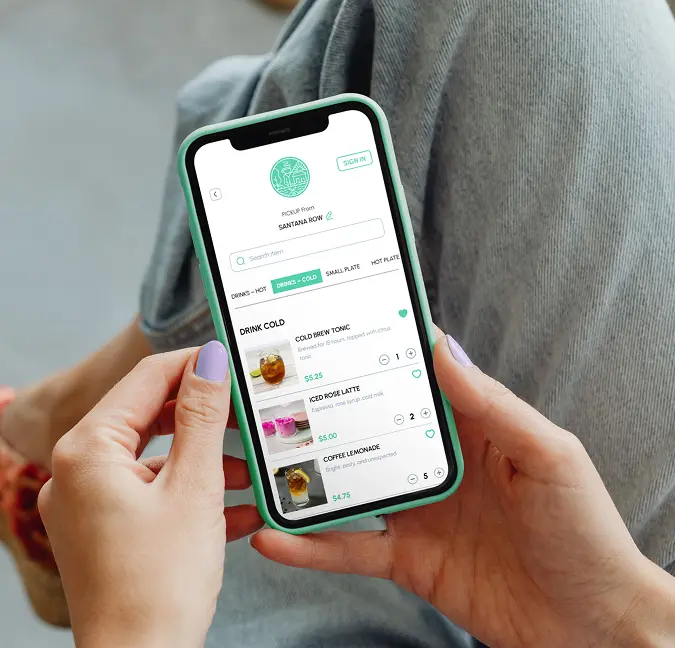
At its core, it lets you launch a branded online ordering system for pickup, delivery, curbside, and dine-in on your website, via social media, and through custom mobile apps.
Orders flow into a centralized dashboard where your team can track incoming volume in real time, adjust preparation times, and manage incoming orders.
With POS integrations, every order syncs automatically with your existing systems, eliminating manual entry, reducing errors, and keeping operations fully aligned.
That connected setup matters in practice too.
Weston B of Eli’s Coffee Shop says, “Overall, we've had a very positive experience with Restolabs. Their ability to integrate easily with our POS and Loyalty platforms and process a high number of orders without issues has made it a productive relationship. When issues arise, their customer support quickly resolves problems.”
Keep service smooth under pressure
Built-in controls like order throttling and busy-hour settings help you maintain service quality during high-demand periods, directly addressing the kind of weaknesses that come up in most restaurant SWOTs.
For dine-in operations, Restolabs supports QR code ordering at the table, minimizing the pressure on FOH staff and improving order accuracy.
If you’re running multiple locations, a single dashboard enables you to monitor orders, manage menus, and adjust store settings across all of them simultaneously.
Convert one-time customers into regulars
On the customer retention side, Restolabs includes coupon builders, loyalty points programs, and promotional banners you can use to drive repeat visits and push specific offers, like the weekday lunch promotion we designed this guide around.
Feed your next SWOT with real data
Restolabs’ robust analytics and reporting capability helps track sales trends, menu performance, and customer ordering behavior over time, giving you the data you need to run your next SWOT with real numbers.
Restolabs also integrates with your existing POS systems, payment gateways, and delivery partners, so it fits into your current stack rather than replacing it.
Ready to put your SWOT into action? Restolabs gives you the ordering infrastructure, customer data, and operational tools to execute on what you’ve found. Schedule a free demo today.

Sruthi Sekar specializes in brand strategy, growth, and user experience in the hospitality industry. As the driving force behind Restolabs, she helps restaurants harness technology to scale and thrive. With a background in design, branding, and entrepreneurship, she brings a sharp focus on crafting digital experiences that drive real business impact.
Frequently Asked Questions
A SWOT analysis for a fast food restaurant should focus on order speed, menu efficiency, and cost control. You should review peak-hour performance, delivery trends, and customer expectations around pricing and convenience before filling each quadrant.
A SWOT analysis for a restaurant business should include internal factors like menu performance, staffing, and operations, along with external factors such as competition, pricing trends, and customer demand shifts. It should connect each point to a clear business goal.
A SWOT analysis example for a fast food restaurant often highlights speed and consistency as strengths, limited menu flexibility as a weakness, rising demand for quick delivery as an opportunity, and intense local competition as a threat. It focuses on high-volume operations and pricing pressure.
A SWOT analysis for a new restaurant relies more on market research than historical data. You should evaluate location demand, competitor positioning, and initial cost structure while identifying early risks like low brand awareness or limited repeat customers.
Yes. A fine dining restaurant may place more weight on culinary excellence, exceptional service, high quality food, private dining, tasting-menu performance, brand reputation, and whether the overall experience supports premium pricing. Its opportunities and threats may also look very different from those of casual dining restaurants, a food truck, or a quick-service concept because customer expectations, market position, and spending behavior are different.



.jpg)
.jpg)
.jpg)




.webp)

.svg)
.webp)