

.jpg)
Key Takeaways
- Donut shops win on morning convenience, not big baskets, so the strongest online strategy usually starts with speed and repeat visits.
- Pickup matters more than delivery in this category because fresh, fast, local orders fit how donut customers actually buy.
- Friday leads overall, but Monday to Wednesday can steady demand when used as a fill-in pattern rather than a replacement for peak days.
- Returning customers drive most orders, which makes reorder timing more valuable than chasing one-time basket growth.
How big is the donut shop opportunity?
Donut shops are a low-ticket, high-repeat category. Frequency and convenience move revenue far more than basket size ever will.
Think of a donut shop the way its customers do: a quick breakfast habit or a mid-morning snack run, not a sit-down meal you plan around. That framing changes what "opportunity" even means here. You are not chasing a bigger check. You are chasing more mornings.
According to our data from the Restolabs 2026 Online Ordering Behaviour Report, Bakery & Donuts sits in a $12-18 AOV band, one of the lowest of any cuisine, and makes up roughly 8% of overall cuisine volume. That combination tells you the category is meaningful in count but small in ticket, which is exactly why order velocity beats ticket inflation as a growth goal.
It also helps to separate donut demand from broader bakery ordering. A full-service bakery might pull custom cakes, catering trays, and afternoon dessert runs across a wider window. Donut demand is narrower and more morning-led, closer to a coffee habit than a special-occasion purchase.
The market backdrop supports the frequency story. The global doughnut market outlook from Fortune Business Insights projects the category at roughly $12 billion in 2026, with North America holding the largest regional share. That regional strength reflects steady local repeat buying, not one big annual spike.
Most of that volume leans toward immediate consumption and local pickup rather than shipped retail product. So the operator question is simple: is your morning convenience strong enough to justify owning direct online ordering? For most donut shops, the answer follows the daypart data.
Why does pickup beat delivery for donut shops?
Pickup wins because donut demand is local, fast, and tied to freshness. Easy ordering matters far more than delivery-heavy tactics.
A dozen donuts is a "now" purchase. Someone wants a fresh box on the way to the office or in hand before the kids leave for school. Routing that same box through a delivery driver adds time and handling to a product whose whole appeal is that it just came out warm. That is why the behavior skews the way it does.
The broader industry picture lines up. The National Restaurant Association's off-premises research shows off-premises dining driving the majority of restaurant traffic, but within that, pickup remains the preferred lane for fast, local, low-ticket orders. Most advice assumes every category behaves the same. The order data says donuts do not.
For a donut shop, the levers are prep speed, a menu that is easy to scan, and a checkout that takes seconds. A customer grabbing breakfast will not wrestle with a clunky order flow. If the box is ready when they walk in, you have won the transaction.
Delivery still has a place, especially for large office orders or bad-weather mornings. But it is the secondary path, not the headline. Building the whole strategy around delivery would fight the way this category actually buys.
When do donut customers order most?
Morning is the strongest window, especially 7-10 AM, with Friday leading the week and Thursday and Saturday close behind.
This is where the category shows its personality. Donut orders cluster tightly around breakfast and the coffee run. According to our data, morning demand concentrates around 7-10 AM, and the day ranking runs Fri \> Thu ≈ Sat \> Wed ≈ Tue \> Sun \> Mon.
That 7-10 AM block should shape almost everything operational. It is when your digital visibility needs to be sharpest, when staffing should peak, and when the menu needs to be fully live and stocked. A promo that lands at 2 PM misses the moment; one that lands at 7:15 AM catches a customer already deciding where breakfast comes from.
The weekly pattern matters just as much. Friday leads, which fits the "treat the team" and "end-of-week reward" behavior common in offices. Thursday and Saturday sit close enough that they deserve real planning weight. Consumer convenience research from McKinsey echoes the pull of weekend morning coffee and bakery runs, which reinforces why Saturday holds its ground.
Most category advice stops at "open early." The daypart data pushes further: mornings are not just your hours, they are your revenue core. Time your reminders, your fresh-batch messaging, and your featured items to hit before the 7-10 AM decision window, not after it.
Why does Monday-Wednesday matter for donut shop demand?
Monday to Wednesday can smooth volume between peaks, but they work best as support days rather than replacements for Friday morning demand.
The ordering week is not flat, so your promotion strategy should not be either. Our data shows Monday as the lowest ordering day, while Wednesday sits in the middle of the pack. That gap is the opening. If Friday runs hot on its own, your softest days are where a nudge does the most incremental work.
Monday is the natural spot for lighter, habit-building moves: a small "start the week right" office reminder, a modest bundle, a gentle push to reorder the usual box. You are not trying to manufacture a peak. You are keeping the habit warm on the day it is most likely to lapse.
Tuesday and Wednesday act as stabilizers. Treat them as the days that fill the trough between Monday's dip and the Thursday-Friday climb. That is a fill-in cadence, not a plan to force a false seven-day balance. Trying to make every day look like Friday usually just spreads spend thin.
Friday still earns the loudest push. The National Restaurant Association's traffic and daypart research supports pacing promotions to real demand rather than a flat calendar. Staff heavier and promote harder on peak mornings, and use the early week to keep the between-days from going quiet.
What does repeat behavior say about donut customers?
Returning customers drive most donut orders, so reorder timing and habit-building matter more than chasing one-time basket growth.
This is the number that should reshape how a donut shop thinks about growth. Our data shows returning customers account for roughly 80% of orders, and the median gap between repeat orders is 8.9 days. Donut demand is a recurring rhythm, which puts customer retention at the center of the channel, not on the edge of it.
Low AOV is normal here, and that is fine. When someone comes back every week or so, lifetime value builds through frequency, not through a bigger single ticket. Pushing hard on upsizing a $12-18 order fights the category. Getting that same customer to reorder one extra time a month does far more.
The 8.9-day gap also tells you how fast the habit forms. This is not a category where loyalty takes months to establish. A customer who liked their first box is often back inside a week and a half, which means the window to reinforce the habit is short and predictable.
Local convenience is the glue. The same person returns for the same morning routine at the same nearby shop. That predictability is useful for planning. Broader repeat-purchase research from Coresight points to recurring food-service buying as the strongest growth lever in low-ticket categories, which is exactly what the donut pattern shows.
Retention planning should be built around the buying cycle you can actually see, not broad assumptions about who is loyal. The path to profitability usually runs through retention over acquisition, and donuts make that case cleanly.
When should donut shops send reorder and win-back nudges?
A 7-10 day nudge matches the usual reorder cycle, while day 14+ is the point where dormant customers become win-back targets.
Timing beats frequency here. A reminder that lands too late misses a habit that has already cooled; too early and it feels like noise. Our data shows day 7-10 is the optimal re-engagement window, and day 14+ is the practical win-back point. Those two numbers define the whole cadence.
The logic follows the 8.9-day median gap. A nudge in the 7-10 day range arrives just before the second-week drop-off, right when a habitual buyer is due for their next box. That is the reorder message, and it should feel like a convenience, not a pitch: their usual, ready when they are.
Day 14+ is a different customer. Someone who has gone quiet past two weeks is no longer merely "due." They are drifting, and the message needs more reason to return, whether that is a small incentive or a reminder of what they liked. Treating both moments the same wastes the easier of the two conversations.
This is where retention, your email or SMS cadence, and morning ordering behavior come together. Send the reorder nudge to land before a peak morning, and you catch the customer at the exact point they are deciding where breakfast comes from. Gartner's guidance on retention timing in quick-service retail agrees: follow the purchase rhythm, not a generic loyalty calendar. The most useful message is simply the one that arrives before the habit breaks.
How does Restolabs help restaurants own online ordering?
Restolabs helps donut shops and other restaurant operators keep online orders, customer data, and repeat-purchase timing in one place, so the morning habit stays theirs and not a marketplace's.
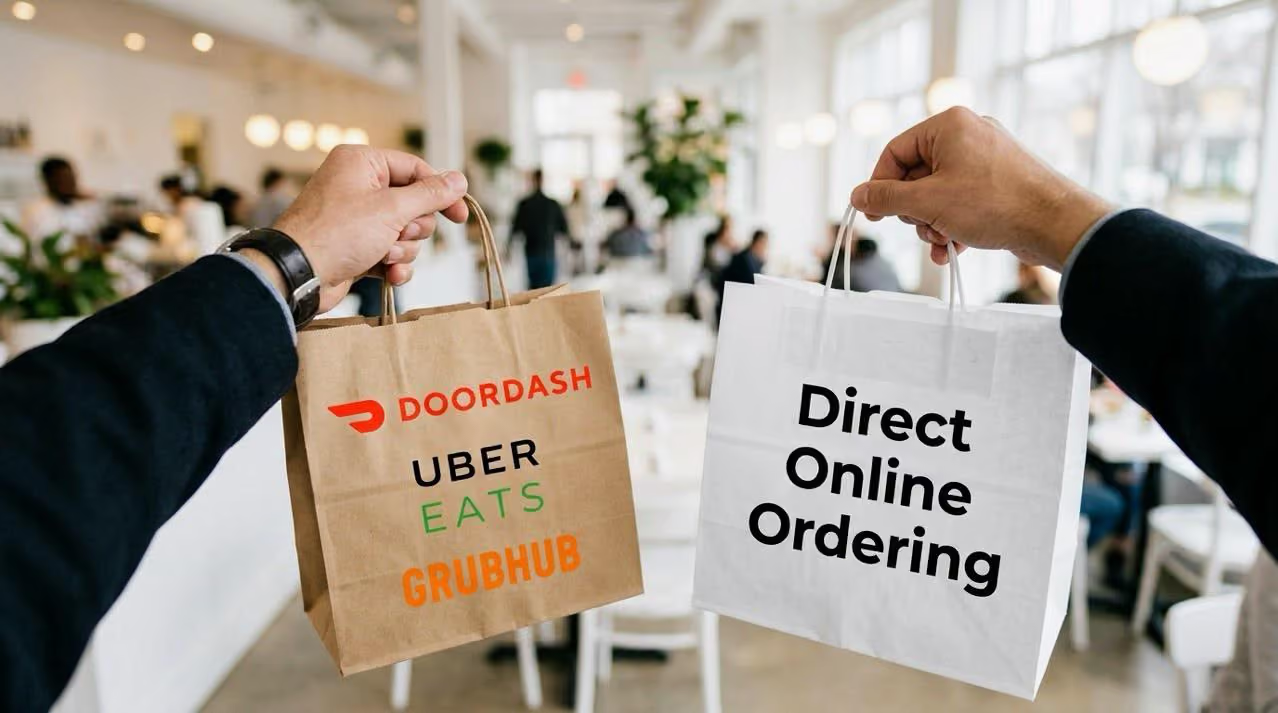
When ordering, customer records, and reorder timing live together, the patterns in this article become usable rather than theoretical. Restolabs gives operators a direct online ordering system with full ownership of customer data, which is what makes a 7-10 day reorder nudge or a Monday habit-builder possible in the first place. You cannot time a nudge to a customer whose contact info sits behind a third-party app.
Tie the stats together and the next move is clear. If pickup is the main path, mornings are the key window, and repeat orders carry the category, then owning the channel is where the value shows up. Fast checkout for the 7-10 AM rush, clean reorder flows for the returning 80%, and a direct customer list to reach them before the habit lapses. That is the whole donut playbook in one place.
Ready to take back your online ordering? Book a Demo

Sruthi Sekar specializes in brand strategy, growth, and user experience in the hospitality industry. As the driving force behind Restolabs, she helps restaurants harness technology to scale and thrive. With a background in design, branding, and entrepreneurship, she brings a sharp focus on crafting digital experiences that drive real business impact.
Frequently Asked Questions
Morning, especially 7-10 AM, is the strongest window because donut demand is tied to breakfast, coffee, and fresh pickup.
The category is built around fast local convenience and fresh product, so pickup fits far better than delivery for most transactions.
Friday leads overall, with Thursday and Saturday close behind. Monday is the weakest day.
Our data shows a median repeat gap of 8.9 days, which means repeat behavior is fairly fast in this category.
Our data places Bakery & Donuts in a $12-18 AOV band, which is why frequency matters more than basket inflation.
Our data shows that day 7-10 is the best re-engagement window, and day 14+ is a practical win-back point.







.webp)

.svg)
.webp)