
.avif)
Key Takeaways
- Commission-free online ordering matters most when restaurants want to protect margin, control customer data, and reduce dependence on third-party marketplaces.
- The strongest case is not delivery-only. Our data shows a 60.1% pickup and dine-in mix, which makes direct ordering valuable across the majority of the order base.
- Restaurants can plan retention more precisely when they know guests reorder in a narrow window, not randomly.
What does commission-free online ordering mean for restaurants?
Commission-free online ordering lets a restaurant take digital orders through its own channels without handing a per-order cut to a third-party marketplace. The money a guest spends stays with the restaurant instead of being trimmed by a percentage every time someone checks out.
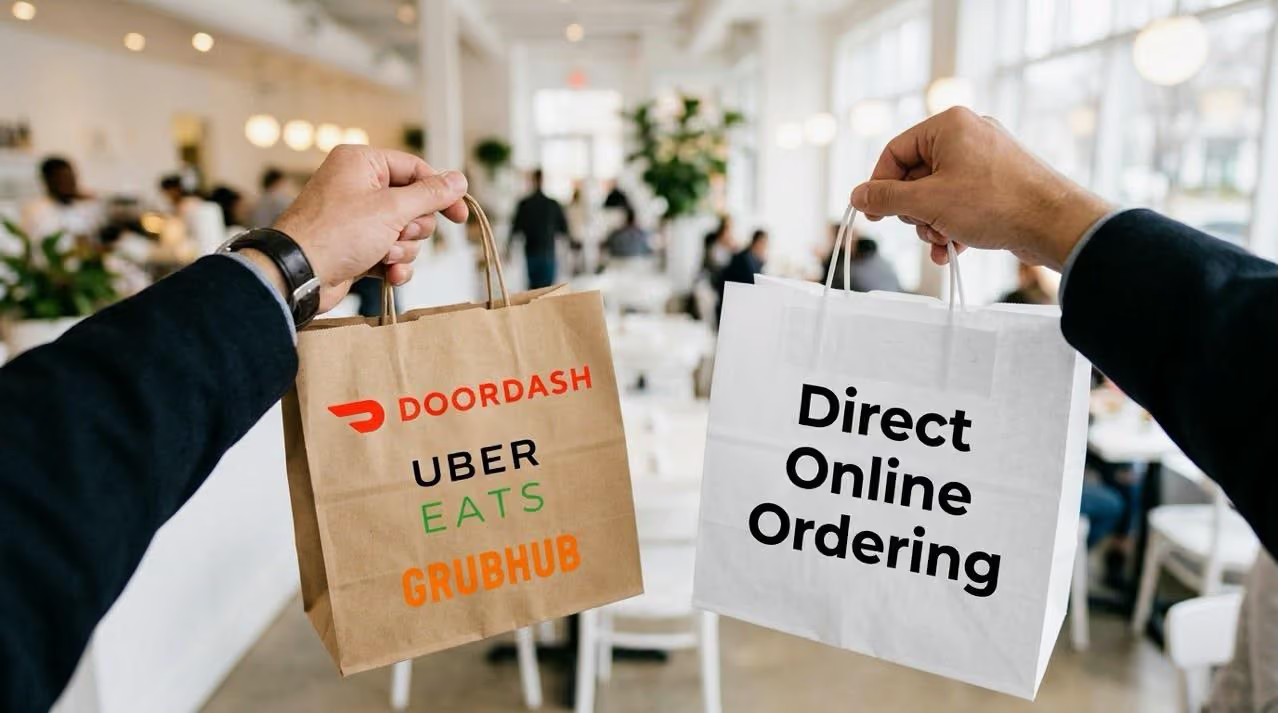
The contrast with marketplace ordering becomes obvious once you look at how each model charges. Marketplace platforms take a percentage of every ticket, so the cost scales up as you sell more. Direct, commission-free ordering flips that logic. The pricing is flat or subscription-style, which means the more you sell, the more of each sale you keep.
This is not only a pricing conversation, though. It is a control conversation. When orders flow through your own website and app, you set the branding, you keep guest contact details, and you connect the order to your POS and payment systems on your own terms. That is why owners and multi-location operators treat direct ordering as a way to own the relationship, not just save a few dollars per ticket.
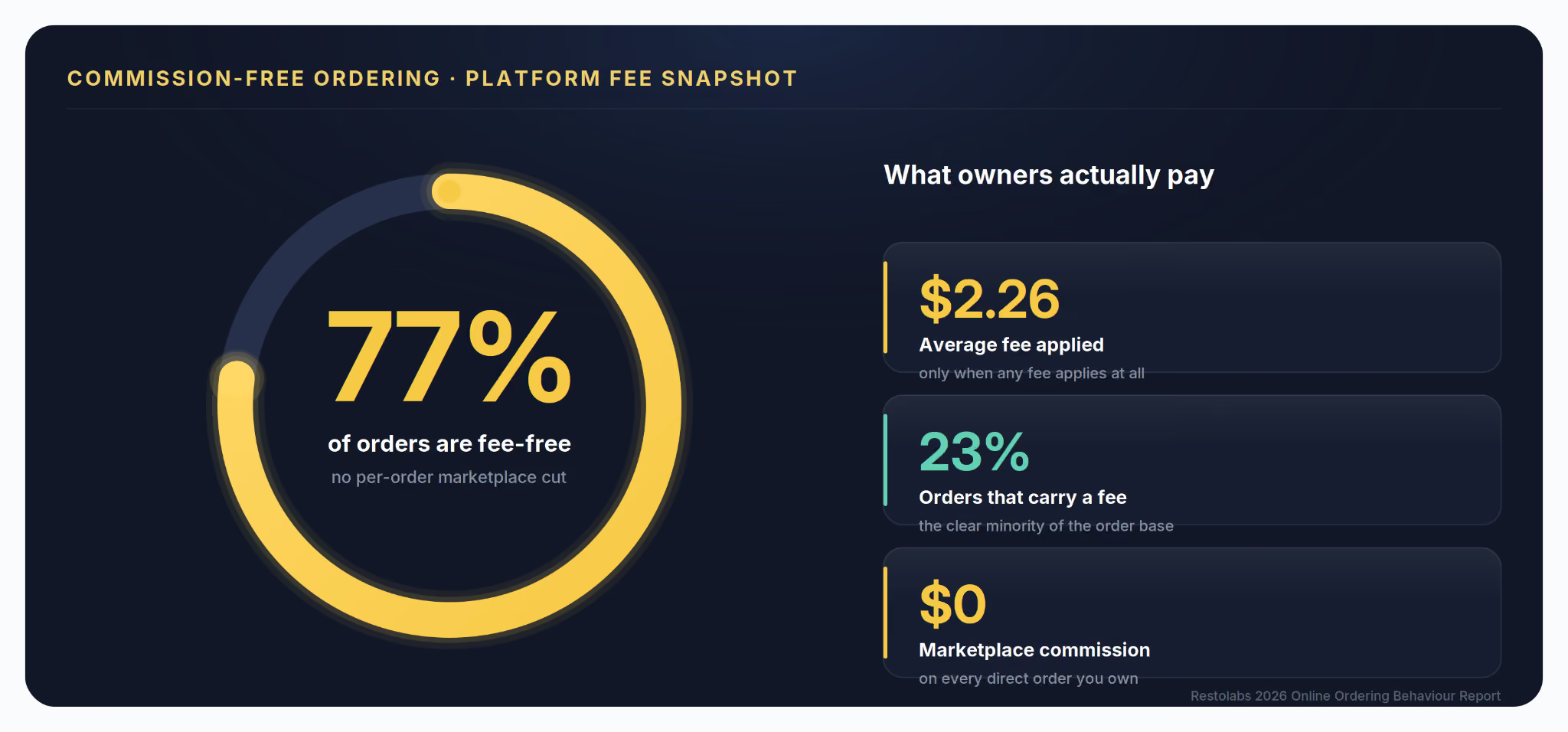
The model is not theoretical either. According to our data from the Restolabs 2026 Online Ordering Behaviour Report, most orders on the platform already carry no fee at all.
Why does pickup-heavy demand make it more valuable?
Commission-free ordering pays off most when a large share of your orders never needed third-party delivery in the first place. Most industry coverage starts with delivery as if it were the whole story, but the order data tells a different one.
When you look at how guests actually order, pickup and dine-in carry the majority. If more than half of your orders are people grabbing food themselves or eating in, routing them through a marketplace-style model adds cost and friction to transactions that never required a courier.
Our data makes the split clear.
This matters because the broader industry is trending the same direction. The National Restaurant Association reports that nearly 75% of U.S. restaurant traffic now happens off-premises, covering takeout, drive-thru, and delivery. A significant portion of that off-premises demand is pickup, which is exactly where direct ordering protects margin most cleanly.
If your concept leans on pickup, commission-free ordering is a margin strategy first and a convenience feature second. Every pickup order you move to your own channel is full-value revenue you keep, across the majority of your book, before delivery economics even enter the conversation.
Is commission-free ordering really cheaper than marketplace commissions?
Yes. Once volume grows, keeping the full order value almost always beats paying a percentage cut on every transaction.
Think about a single ticket. A fee that reads like pocket change on one order looks harmless. Run that same fee across a few hundred orders a week, then across a year, and what felt trivial per order turns into a real line item that quietly eats into profit. That is the math marketplace pricing counts on: small per-order, large in aggregate.
This is not a blanket claim that every commission-free setup is automatically cheaper on day one. The point is that predictability and ownership tend to win over variable fees as you scale, especially for concepts built on repeat orders and high-frequency guests.
Industry analysis from 2025 found that marketplace commissions can consume up to nearly one-third of a digital order's profit, while diners increasingly favor ordering direct. The same reporting notes that 58% of customers prefer a restaurant's own app or website for delivery. The demand for direct ordering is already there.
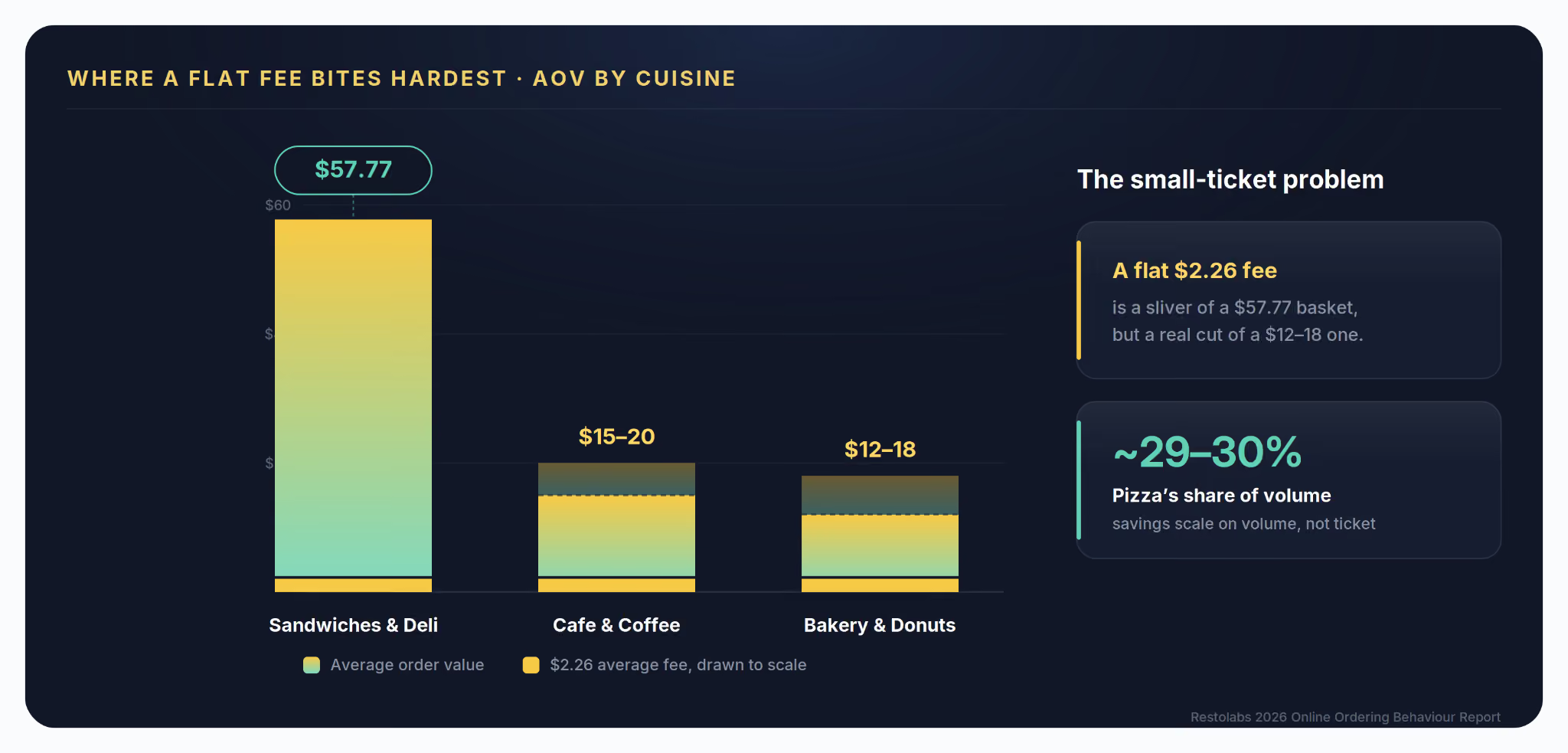
Low fees matter even more in low-ticket categories. A small charge on a $12 bakery basket or a $16 coffee order distorts the economics far more than the same charge on a $60 dinner. For breakfast, cafe, and bakery concepts, fee control is not a nicety. It is what keeps the channel worth running. If you want to model your own numbers, the commission savings calculator is a practical starting point.
When do guests reorder, and how should restaurants respond?
Restaurants should build retention around a tight, predictable reorder window rather than waiting and hoping guests drift back. First orders get the attention, but repeat orders are where the real economics live.
The good news is that reorder behavior is not random. Our data shows a clear median window and a re-engagement sweet spot that operators can plan around.
A guest who ordered last Thursday is not "due back sometime soon." They are often close to their next purchase right now. That changes the timing of everything: reminders, loyalty offers, and reactivation messages all land better when they match real behavior instead of a generic monthly email blast.
The pattern also lines up with outside findings. Paytronix reported in 2025 that direct customers return sooner and tip more when they order through a restaurant's own channel. Owning the ordering channel tightens that loop considerably.
This is where ownership and retention connect directly. If a marketplace sits between you and the guest, you cannot message on this schedule because you do not hold the relationship. When you control the channel, you re-engage on your own timing instead of paying someone else to stand between your orders and your repeat revenue. A restaurant loyalty program built around the Day 7 to Day 10 window turns that timing into recurring sales.
What should restaurant owners compare before switching?
The right choice comes down to more than fees. Branding, data ownership, integrations, and operational fit all matter before you commit to a direct ordering setup.
It is tempting to shop on price alone, but a rock-bottom fee means very little if the order flow is clunky or your team cannot connect it to the tools you already use. The sharper question is whether the setup supports direct-order growth without piling on operational drag.
A few points deserve real attention:
- Branding and flow. Does the ordering experience look and feel like your restaurant, or like a generic template? Guests trust a branded restaurant website more than an anonymous checkout page.
- Customer data ownership. Do guest details stay with you so you can run retention on your own terms?
- Integrations. Are POS and payment connections smooth, or will your staff be juggling systems during a rush?
- Multi-location support. Can the setup scale across sites with consistency, not one-off configurations per location?
One more thing worth checking: does the system handle pickup, delivery, dine-in, and curbside evenly? One fulfillment model rarely covers every service pattern well, and your mix should drive the decision. A pickup-led cafe and a delivery-heavy pizzeria have very different needs from the same channel. For a structured look at the trade-offs, this breakdown of third-party delivery versus direct online ordering covers the decision in more depth.
Which cuisine types gain the most from direct ordering economics?
The biggest gains show up wherever repeat frequency, ticket size, or fulfillment mix make marketplace fees especially costly.
Direct ordering is not one-size-fits-all, and cuisine behavior makes that concrete. Some categories benefit because they run on sheer volume, so even a small per-order fee compounds fast. Others benefit because the basket is small and every extra charge cuts deeper into an already thin margin.
Pizza is the volume story. Cafe and Coffee and Bakery and Donuts win on pickup behavior and repeat frequency, where small tickets are highly sensitive to any added fee. Sandwiches and Deli stands out for a stronger average basket, which makes protecting that value especially worthwhile.
If your concept is pickup-led or repeat-heavy, commission-free ordering does more than shave fees. It protects the economics of the entire channel, whether you are moving thousands of pizzas or hundreds of $16 coffee runs. For category-specific guidance, operators often start with resources like how to increase bakery sales or boost your coffee shop sales.
How does order timing affect staffing and uptime?
Restaurants should prepare for demand spikes before the busiest windows arrive, not scramble in the middle of them. Order volume is not spread evenly across the week, and knowing the peaks lets you plan staffing, prep, and system checks ahead of time.
Our Data: Friday is the highest ordering day, and the dinner window from 5:30-8:30 PM is the main peak - Restolabs 2026 Online Ordering Behaviour Report
Lunch from 11 AM to 1 PM is the other key window, and Friday leads the week, followed by Thursday and Saturday. This is exactly why software reliability matters when demand concentrates. When orders surge into that dinner window, even a small delay or outage costs direct revenue on the spot. The guest expects the order to go through cleanly, and the kitchen needs steady inflow through service.
For multi-location restaurants, consistency across sites is the whole game. A system that holds up at one location but stutters at another during peak hours undermines the direct channel you worked to build.
The planning sequence is straightforward: line up staffing, confirm menu availability, schedule any promos, and verify uptime before 5:30 PM on a Friday, not after the line starts building. Timing the work ahead of the rush is what keeps the direct channel dependable when it matters most.
How does Restolabs help restaurants own direct ordering?
Restolabs gives restaurants a commission-free way to take direct orders while keeping full control of customer data and integrations.
The platform is built for operators who want to keep 100% of revenue from direct orders, manage guest relationships themselves, and connect ordering to their existing POS and payment systems. The setup is designed to be simple to launch, so a restaurant can start selling online quickly rather than waiting on a long onboarding.
Restolabs offers contract-free plans and supports direct ordering across locations and dayparts, so the channel works for pickup-led cafes and delivery-heavy pizzerias alike, not just in theory but during a real Friday dinner rush.
Ready to take back your online ordering? Book a Demo

Sruthi Sekar specializes in brand strategy, growth, and user experience in the hospitality industry. As the driving force behind Restolabs, she helps restaurants harness technology to scale and thrive. With a background in design, branding, and entrepreneurship, she brings a sharp focus on crafting digital experiences that drive real business impact.
Frequently Asked Questions
Commission-free online ordering is a direct ordering setup where restaurants avoid per-order marketplace commissions and keep more of each sale.
It is especially strong for pickup-heavy restaurants, because pickup orders can avoid the dependency and cost structure tied to third-party delivery platforms.
Percentage-based commissions reduce margin on every order, which becomes more painful as volume rises or ticket sizes fall.
Yes. When restaurants own the channel and customer data, they can re-engage guests on a tighter reorder cycle and build repeat revenue more efficiently
Restaurants should compare pricing structure, customer data ownership, branding, POS integrations, payment integrations, and whether the system fits pickup, delivery, and dine-in equally well.
Our report shows an 8.9-day median reorder window, with Day 7 to Day 10 as the strongest re-engagement period and Day 30 and beyond as the churn-risk window.
Yes. The best setups support pickup and delivery together, so restaurants can





.webp)

.svg)
.webp)