
Key Takeaways
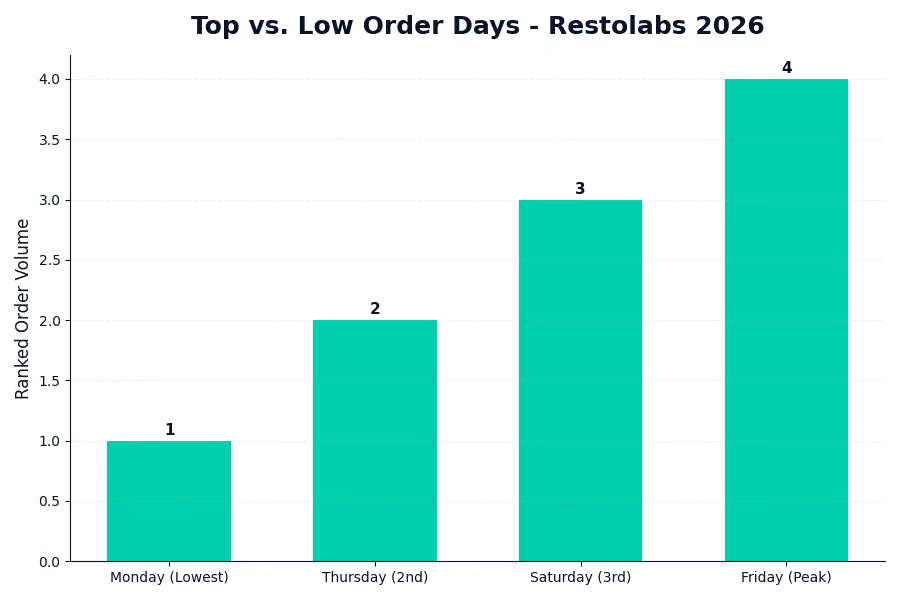
- Friday is the highest-volume ordering day platform-wide, followed by Thursday and Saturday - seafood demand concentrates heavily on the back half of the week.
- Monday is consistently the lowest-volume ordering day in our 2026 dataset, making it the smartest slot for win-back campaigns and loyalty pushes.
- The dinner peak window of 5:30 PM to 8:30 PM local time drives the bulk of daily order volume, with a secondary lunch rush of 11 AM to 1 PM local.
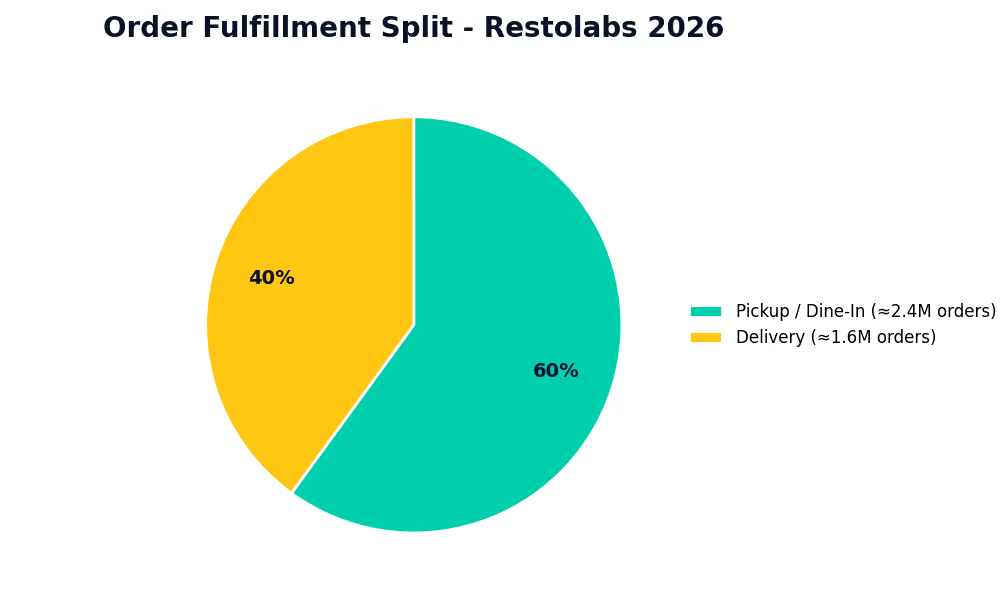
- Pickup or dine-in accounts for 60.1% of orders across our platform, versus 39.9% via delivery - your promo channel mix should reflect that.
- The median reorder interval sits at 8.9 days, which makes Day 7-10 post-purchase the sweet spot for re-engagement.
- Lent, summer grilling, and the November-December holiday window are the three biggest promotional opportunities seafood operators routinely under-prepare for.
Most seafood promotions miss because the timing is wrong.
Every guide on the internet will tell you how to promote a seafood restaurant - run an email, post on Instagram, set up a loyalty program. Almost none tell you when to fire those promotions so they actually land. For seafood operators, when is the entire game.
Lent, crab season, summer raw bars, Christmas Eve cioppino - each carries its own demand curve, and pushing the wrong message in the wrong window doesn't just underperform. It trains customers to ignore you.
According to the Restolabs 2026 Order Analytics Dataset, which covers more than 4 million orders processed across the Restolabs platform spanning 2,126 locations and 479 brands from March 2025 to March 2026, we see clear, repeatable timing patterns that quietly separate the seafood operators who win from those who burn budget. This guide turns those patterns into a calendar you can run next week.
Why timing matters more for seafood than other cuisines
Seafood is uniquely seasonal in three ways at once: ingredient availability, cultural and religious demand spikes, and weather-driven cravings. Almost no other cuisine carries that triple load.
A pizzeria sells roughly the same pie in January as it does in July. A burger spot doesn't see demand triple because of a religious calendar. Seafood does both. Lent shifts the entire ordering pattern of Catholic-heavy markets, and summer grilling weather pulls coastal traffic into raw bars overnight.
That matters for budget. When we look at peak-day behavior in the Restolabs 2026 Order Analytics Dataset, Friday emerges as the highest-volume ordering day platform-wide, followed by Thursday and Saturday - and for seafood specifically, the Friday weighting runs hotter than the platform average because of fish-fry and Lenten habits stacked on top of normal weekend demand.
Operators who run a "we're open, come eat" message every day end up flat. The ones who sync messaging to the actual demand curve - even with the same budget - pull ahead. That's why the timing layer is where a commission-free online ordering system earns its keep: every promotional dollar lands in a window your data already proved converts.
The seafood marketing calendar - month by month
This is the section nobody else writes. Below is a month-by-month view of when to plan, when to start pushing, and when to peak.
January - February: New Year health halo plus Lent prep
January gets a "lighter eating" tailwind that most seafood operators ignore. Grilled fish, poke bowls, and ceviche convert well against New Year resolutions.
Use January to rebuild email lists and tee up Lent menus. By mid-February, start teasing your Lent lineup with creative content - not discounts yet.
March - April: Lent peak - the biggest window
Lent is the single largest promotional opportunity on the seafood calendar. The lift starts roughly 7-10 days before Ash Wednesday and runs straight through Easter weekend.
Promotion should fire on a Friday cadence. In our 2026 order analytics data, Friday already carries the highest weekly volume across all cuisines - layer Lent on top and that Friday signal amplifies for seafood specifically. Push fish fry bundles, family platters, and meatless Friday combos hard during this window.
May - June: Father's Day, graduations, Memorial Day
This is the gift-card and surf-and-turf window. Father's Day in particular over-indexes for premium seafood - lobster, ribeye-and-shrimp, crab boils.
Start your Father's Day promo three weeks ahead. Memorial Day is more of a tourist-traffic spike than a promo window - show up on local search, but you don't need to discount.
July - August: Summer grilling and tourism peak
Coastal operators hit their high season. Inland operators ride summer grilling and raw-bar demand.
This is not a discount window. Demand is already saturated. Spend your budget on Google Business Profile visibility, outdoor-seating posts, and beachside takeout messaging.
September - October: Oyster R-months begin, stone crab season
The classic "R-months" rule (months containing the letter R) starts in September, and oyster-bar operators see a quiet but durable lift. Stone crab season in Florida opens October 15.
This is an education window, not a discount window. Run sustainability content, sourcing stories, and limited-time-only specials priced at full margin.
November - December: Holiday platters, NYE, cioppino season
Pre-orders for holiday seafood platters should launch by early November. Christmas Eve (Feast of the Seven Fishes) and New Year's Eve are massive for upscale seafood.
Holiday platter promotion needs a six-week runway. By December 1, your bestsellers should already be sold through to half capacity if you're pricing and timing correctly.
The best days of the week to promote your seafood restaurant online
Friday wins. Saturday is close behind. But here's the nuance most operators miss: the best day to send a promotion is not the same as the best day to fulfill one.
Our 2026 dataset confirms Friday as the highest-volume ordering day platform-wide, followed by Thursday and Saturday. That means Wednesday and Thursday are your highest-ROI promotional send days - they catch customers planning weekend meals before they've already decided where to order.
Monday tells the opposite story. We see Monday as consistently the lowest-volume ordering day, making it ideal for win-back campaigns and loyalty incentives. Don't push new-customer acquisition on Monday - push your loyal regulars with a restaurant loyalty program reward that gets them in the door on a slow day.
For social posting specifically, third-party benchmarks from Sprout Social (summarized by Menuzen in 2024) show restaurant content on Facebook peaks Friday at 1-2 PM local, while Instagram engagement is strongest Mondays from 9 AM to 1 PM. Use that for organic posting cadence - but tie your paid promotions and email sends to your own demand curve, not to a generic benchmark.
The best hours of the day to send promotions
There are two clean peaks in any 24-hour seafood ordering window.
Across our platform, we see the lunch rush of 11 AM to 1 PM local time and the dinner peak window of 5:30 PM to 8:30 PM local time driving the bulk of daily order volume. The dinner peak is much bigger, but both matter for messaging.
The rule is simple: send 3-4 hours before each peak. For dinner orders, that puts your ideal send window between 1 PM and 3 PM. For lunch orders, send between 8 AM and 10 AM.
Late-morning sends (10 AM-12 PM) consistently outperform evening sends for dinner-occasion seafood. By the time someone reads an email at 6 PM, they've already decided where to eat. By 10 AM, they're still deciding.
SMS plays by different rules - send SMS closer to the decision moment. A 4 PM "fish fry tonight, pickup ready in 25 minutes" text outperforms a 10 AM email for the same window.
Online vs. dine-in: different promo timing rules
Online and dine-in peak at different hours, and most operators promote them as if they were the same channel.
In our 2026 order analytics data, 60.1% of orders fulfilled via pickup or dine-in (representing approximately 2.4 million orders) tells you something important: the pickup-skew on direct platforms inverts the typical third-party assumption that delivery dominates. Seafood operators in particular over-index on pickup because the product travels better with shorter delivery distances and customers like controlling freshness.
Online order traffic skews earlier in the evening - customers want food now. Dine-in skews later - they're planning a reservation for 7:30 PM, not 6:00 PM. Promote pickup windows in late afternoon. Promote reservations 2-3 days ahead.
For seafood ghost kitchens and delivery-first concepts, the timing rules tilt even further. Delivery share runs higher than the platform's 39.9% baseline, Friday and weekend nights pull disproportionate volume, and your entire promo calendar should orient around late-afternoon SMS pushes timed against the dinner peak.
How far in advance to start each promotion
Lead time is where most seafood operators leave money on the table. Here's the rule of thumb that holds up across our 2026 dataset:
That last row matters. We anchor the day 7-10 post-purchase window as the optimal re-engagement timing, anchored on the 8.9-day median reorder interval. Send a win-back offer too early and it feels desperate. Send it too late and the customer has already gone somewhere else.
Channels that work best for seafood promotion timing
Each channel has a sweet spot. Stop forcing one channel to do everything.
Best for Lent, holiday platters, and loyalty re-engagement. Email is the channel where lead time pays off - a six-week holiday platter campaign needs the email arc to introduce, build urgency, and close.
SMS
Best for same-day Friday fish-fry pushes and 4-6 hour flash windows. Open rates clear 90% within minutes, so save SMS for time-sensitive offers your audience can act on immediately.
Social (Instagram, TikTok, Facebook)
Best for educational lead-up - oyster R-months, MSC sourcing stories, dock-to-plate content. Per Sprout Social's 2024 restaurant data summarized by Menuzen, restaurant Instagram engagement peaks Monday 9 AM to 1 PM, while Facebook restaurant posts peak Friday 1-2 PM. Match your platform cadence to those windows.
Google Business Profile posts
Best for tourism-season visibility, especially July-August. Tourists searching "seafood near me" in a beach town will see your GBP post before they see your Instagram. Update weekly during summer.
Branded app push notifications
Push notifications carry the highest open rate for time-sensitive promos. A branded mobile app with push notifications lets you fire a 4 PM "tonight only" push that lands on the home screen - not buried in a marketplace feed where you're competing with twenty other restaurants.
Common timing mistakes seafood restaurants make
Four mistakes show up repeatedly across the operators we work with.
Starting Lent promotions on Ash Wednesday. By then, the planning window is closed. Customers decide their Lent Friday routine in the 7-10 days before Ash Wednesday.
Discounting during peak summer. July and August demand is already saturated for coastal operators. Discounting in your busiest window cannibalizes margin without adding traffic.
Ignoring the January health window. January is when customers actively seek lighter eating, and a well-timed grilled-fish or poke promo lands in a category most competitors abandon after New Year's.
Running fish Friday specials at the wrong hours. A 6 PM email about Friday fish fry is too late. The decision was made by 3 PM. Move the send earlier.
How to build a repeatable promotion timing system
Industry averages are a starting point. Your local demand curve is the actual answer.
The operators who win on timing aren't guessing - they're pulling their own day-of-week, hour-of-day, and channel-mix data out of their ordering platform every month and adjusting. Restolabs' restaurant order analytics surface the same patterns the Restolabs 2026 Order Analytics Dataset reveals at platform scale, applied to your specific location.
Look for three things in your own data: which day of the week carries the largest share of orders, which two-hour window dominates evenings, and how your repeat-order interval compares to the 8.9-day median we see across the platform. Those three numbers determine your send cadence.
Then layer your promotional calendar on top - Lent, summer, holiday platters - and you have a system that runs on data instead of gut. Operators using owned ordering channels also retain customer contact data, which is what makes day 7-10 win-back sequencing possible at all.
Ready to time your promotions like the operators who actually convert?
You don't need a bigger budget. You need to spend the budget you already have in the right hours, on the right days, six weeks before the right holiday. The seafood operators pulling ahead are the ones who treat timing as the lever - not the afterthought.
Book a Demo to see how Restolabs helps seafood restaurants run promotions through their own ordering channels with the data to time every send.

Sruthi Sekar specializes in brand strategy, growth, and user experience in the hospitality industry. As the driving force behind Restolabs, she helps restaurants harness technology to scale and thrive. With a background in design, branding, and entrepreneurship, she brings a sharp focus on crafting digital experiences that drive real business impact.
Frequently Asked Questions
Lent (late February through Easter) is the single largest demand window, followed by summer grilling season (June-August) and the November-December holiday platter window. Plan each one with the lead time it deserves - Lent needs 10-14 days, holiday platters need six weeks.
Friday dominates seafood demand. But Wednesday and Thursday are the highest-ROI send days for emails and SMS because they catch customers while they're still planning the weekend.
Lead times vary by occasion - 10-14 days for Lent, 3 weeks for Father's Day, 6 weeks for holiday platters, and 48 hours for weekly recurring specials. Match the lead time to how far ahead customers actually plan the meal.
Late-morning sends (10 AM to 12 PM local) consistently outperform evening sends for dinner-occasion seafood. By the time a customer opens an email at 6 PM, they've already decided where to eat.
No - they peak at different hours. Online and takeout demand peaks earlier in the evening, while dine-in skews later, so schedule channel-specific messaging instead of treating them as one audience.
Yes. Friday demand already runs hottest in our 2026 dataset, and Lent stacks meatless-Friday cultural habit on top of that - the lift compounds. Operators who start 7-10 days before Ash Wednesday capture the planning window competitors miss.
SMS and branded app push notifications for same-day windows, email for multi-week campaigns, and social plus Google Business Profile for the awareness lead-up. Each channel has a sweet spot - stop forcing one to do everything.





.webp)

.svg)
.webp)