
Key Takeaways
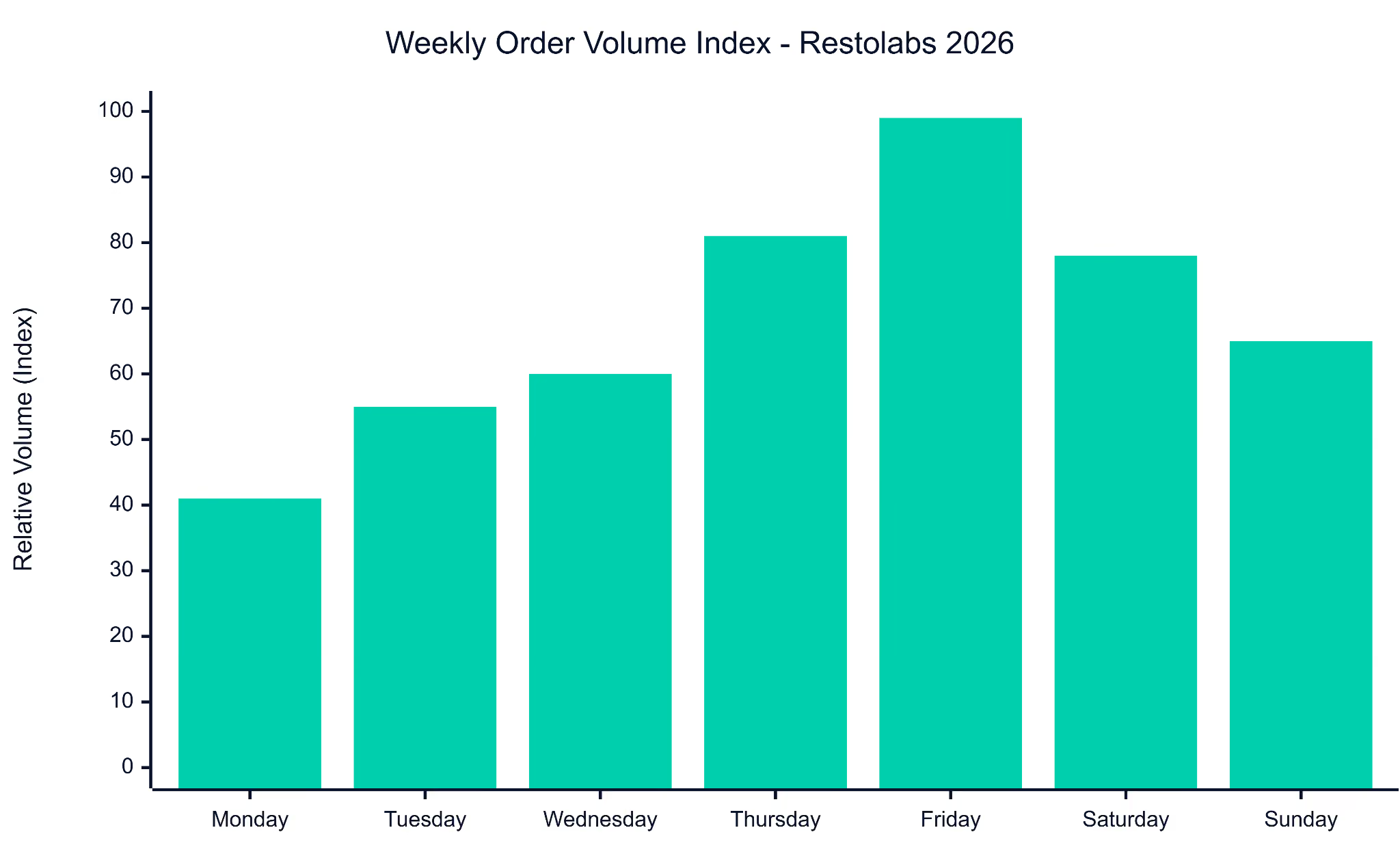
- Friday is the highest-volume ordering day platform-wide, with Thursday and Saturday close behind, while Monday consistently runs lowest.
- The lunch rush of 11 AM to 1 PM local time and the dinner peak of 5:30 PM to 8:30 PM drive the bulk of daily order volume for Mediterranean concepts.
- Middle Eastern cuisine averages $45+ per order on our platform, roughly 15% above the platform average - meaning timing investments pay back faster than for low-AOV categories.
- 60.1% of orders are fulfilled via pickup or dine-in, which flips the usual third-party-delivery assumption operators plan around.
- Direct branded channels compound timing investments because 38.2% of customers reorder within a six-month lookback, with a median reorder interval of 8.9 days.
- Tight, day-specific windows beat always-on campaigns. Schedule the promotion, don't just publish it.
Most promo dollars get spent in the wrong week.
That's the pattern we see again and again across Mediterranean restaurants on our platform. Operators push hardest when demand is already peaking, then go quiet during the exact troughs that need a nudge. The result is wasted spend at the top and missed lift at the bottom.
According to the Restolabs 2026 Order Analytics Dataset, which covers more than 4 million orders across 2,126 locations and 479 brands from March 2025 to March 2026, Mediterranean restaurants follow distinct, repeatable timing patterns that most operators are still guessing at. Friday dominates the week. Lunch concentrates inside a two-hour window. Religious calendars move catering revenue more than any social post ever could.
This guide unpacks the calendar, the clock, and the channels - using our own order data as the spine.
Why timing beats tactics for Mediterranean restaurants
The "always-on" promotion trap
Always-on promotion sounds disciplined. In practice, it dilutes everything.
When every Tuesday email looks like every Friday email, your highest-intent moments stop standing out. Customers train themselves to ignore the cadence. The 2024 restaurant social playbook from BestPOS recommends a sequenced rhythm - teaser two to three days before, reminder the day before, launch reveal, mid-campaign social proof, then a "last few hours" urgency push - precisely because attention spikes are short and timed.
How cuisine-specific demand cycles work
Mediterranean isn't pizza. Demand doesn't flatten across the week.
We see clear weekday-versus-weekend skews, sharper lunch concentration than several other cuisines, and religious-calendar surges that don't appear in cuisine-agnostic data. According to IBISWorld, the U.S. Mediterranean restaurants industry has grown at roughly a 3.0% compound annual growth rate from 2020 to 2025, reaching approximately $5.4 billion in 2025 - a market expansion driven heavily by health-positioned consumer interest. That tailwind is what makes timing leverage real.
What makes Mediterranean food unique on the promotion calendar
Three forces stack on top of each other: health positioning that surges in January, religious calendars (Ramadan, Greek Orthodox Easter) that move catering revenue, and a summer "Mediterranean vacation" association that lifts organic interest from June through August. Most cuisines have one of those. Mediterranean has all three.
The Mediterranean restaurant promotion calendar (month by month)
January - Health resolution surge
January is the single most efficient acquisition month for Mediterranean concepts. Resolution-driven search shifts toward bowls, salads, mezze, and grain-forward plates. Lean into "Mediterranean diet" framing in ad copy and menu callouts.
February - Valentine's and cold-weather comfort
Couple-oriented prix fixe and family-size warm dishes - moussaka, lamb kebabs, soups - pull weight here. Use the second week of February for paid Valentine's targeting, then pivot the back half toward weeknight comfort bundles.
March-April - Ramadan and Greek Orthodox Easter
These weeks move the AOV needle more than any other window. Iftar bundles timed to local sunset, family feast packages, and Easter lamb specials all spike catering volume. Schedule your SMS sends for 60 to 90 minutes before Iftar in your local market.
May-June - Outdoor dining and wedding season
Catering inquiries climb. Patio reopenings drive dine-in volume. Push catering landing pages hard in May before competitor inboxes fill in June.
July-August - Summer "Mediterranean vacation" peak
Organic search interest in Mediterranean cuisine is at its annual high. This is your lowest-CPC paid window of the year and your best moment for influencer seeding.
September - Back-to-school family dining
Weeknight family bundle pricing and pickup-first messaging convert well. Our 2026 dataset shows that 60.1% of orders are fulfilled via pickup or dine-in, representing approximately 2.4 million orders - a pickup-skew that inverts the typical third-party platform assumption. Translate that into your September creative: lead with pickup, not delivery.
October-November - Catering lead-in
Holiday office parties and Thanksgiving-alternative menus drive catering revenue. Start booking conversations the second week of October.
December - Holiday catering and gift cards
The last big push of the year. Gift card promotions stack well on top of catering campaigns because they recruit January redemption traffic into your slowest re-engagement window.
Best days to promote your Mediterranean restaurant online
Thursday-Sunday dinner dominance
In our 2026 dataset, Friday emerged as the highest-volume ordering day platform-wide, followed by Thursday and Saturday. Mediterranean restaurants track this pattern closely. If you only have budget for one day of paid push, Thursday afternoon into Friday morning is the highest-ROI window.
The Monday lull (and why it's actually a promo opportunity)
Monday consistently shows the lowest order volume across our platform, which is exactly why it's the right day for win-back campaigns and loyalty incentives. A 2025 restaurant marketing case study showed operators running recurring "Mediterranean Monday" offers via SMS and social - free delivery inside a small radius, day-specific only - and reporting meaningful incremental sales on otherwise slow days.
Don't promote into your peak. Promote into your trough.
Weekend brunch growth for Mediterranean concepts
Saturday and Sunday mornings (roughly 7 AM to 10 AM weekends) are a quietly growing window for shakshuka, manakish, and Greek-style brunch menus. If your concept has any brunch credibility, claim it now before competitors crowd in.
Best times of day to push promotions
The 11 AM lunch trigger window
Our order analytics data shows the lunch rush concentrating inside 11 AM to 1 PM local time. Mediterranean restaurants see particularly sharp clustering at the front of this window - the 11 AM to 11:45 AM decision zone is where lunch orders get placed.
That's your SMS send window. Not noon. Not 12:30. The reminder needs to land before the decision, not during it.
The 5-7 PM dinner decision zone
We see the dinner peak window of 5:30 PM to 8:30 PM local time driving the bulk of daily order volume. For Mediterranean concepts, the front half of that window - 5:30 to 7:00 - is where pickup decisions happen, and the back half is delivery-skewed.
Late-night order patterns
The 9 PM to 11 PM window matters for Mediterranean concepts with grill-forward or street-food menus (shawarma, gyros, kebabs). It's a smaller volume slice but a high-margin one. Don't bury it.
When to schedule push notifications and SMS
97.4% of orders in our dataset were timezone-matched for time-of-day analysis, which means our timing benchmarks reflect actual local-time behavior, not server-time guesses. Schedule push notifications 30 to 45 minutes before each meal peak. Schedule SMS 60 to 90 minutes before - texts get read on a delay.
Channel-by-channel timing playbook
Instagram and TikTok
Food content engages best in the late-morning, pre-lunch window, when followers are actively thinking about what to eat. Industry guidance from food-marketing publications consistently points to lunchtime adjacency as the highest-engagement window for restaurant social.
Email - Tuesday and Thursday mid-morning
Tuesday and Thursday mid-morning sends outperform Monday inbox-clutter sends. Tie the campaign to a specific redemption window - "valid through Sunday" beats "valid this month" every time.
SMS - 90-minute pre-meal triggers
SMS is your sharpest timing instrument. Use it 60 to 90 minutes before lunch or dinner peaks, and use it sparingly enough that customers don't opt out. We've broken down send-rhythm, length, and consent rules in our guide on SMS marketing best practices for restaurants.
Google Business Profile - Friday update cadence
Refresh your GBP post every Friday morning to ride the weekend search wave. Highlight specials, hours changes, and catering availability.
Push notifications via branded apps
Push notifications via a branded mobile app compound with timing more than any other channel, because the customer already opted in and the message bypasses the inbox triage problem. Use them sparingly: one notification per peak day, maximum.
Paid ads - when CPC drops
CPC for restaurant keywords tends to soften in early-week, mid-morning windows. Run your test budgets there before scaling into Friday afternoon, where competition spikes.
Direct orders vs. third-party apps - why timing differs
Third-party apps own your customer at the moment of conversion. You don't choose the when - they do.
Direct channels flip that. When a customer orders through your own site or app, you control the reorder timing, the win-back window, and the loyalty trigger. That's why timing investments compound on owned channels in a way they never will on aggregators.

Our 2026 dataset shows a repeat customer rate of 38.2% over a 6-month lookback window, paired with a median reorder interval of 8.9 days between repeat orders. That 8.9-day cadence is the operational backbone of any direct-channel promotion calendar - it tells you exactly when to re-engage.
Across Restolabs brands, we've estimated $8-10 million in third-party commission savings, calculated against industry-standard 25-30% commission rates. That's revenue that flows back into menu development and timed marketing instead of aggregator fees. Restolabs operators use commission-free online ordering to keep that margin on the right side of the balance sheet.
For Mediterranean operators running ghost kitchen operations - or extending into grocery and prepared-food ordering for prepared mezze and dips - direct channels matter even more, because there's no storefront discovery to fall back on. Timing is the entire growth lever.
How to build your Mediterranean restaurant promotion calendar
Audit your own ordering data first
The platform-wide patterns are your starting point, not your final answer. Pull your last 12 months and look for your specific peaks. Restolabs offers restaurant order analytics so operators can see day, hour, and channel patterns without exporting CSVs into spreadsheets.
Map promotions to AOV vs. volume goals
Mediterranean cuisine averages $45+ per order on our platform, roughly 15% above the platform average. That AOV advantage means you don't need huge volume lifts to move revenue - a tightly timed catering push can outperform a broader discount campaign.
A/B test the timing, not just the creative
Most operators A/B test subject lines. Few A/B test send times. The send-time test is usually the bigger lever.
Track attribution from direct channels
Direct channels give you clean attribution. Aggregators don't. If you can't see which campaign drove which order, you can't time the next one.
Common timing mistakes Mediterranean operators make
Promoting during your own peak. You're paying to reach customers who were already coming. Push your discount into the trough, not the crest.
Ignoring religious and cultural calendars. Ramadan and Greek Orthodox Easter move catering revenue more than any social campaign. Plan eight weeks out, not eight days out.
Treating catering and dine-in as the same campaign. They have different buyers, different cycles, and different timing logic. Run them on separate calendars.
Posting at agency-default times instead of operator-tested times. "Best time to post" generic advice is averaged across every industry. Your data beats their average every time.
Closing
Timing isn't a tactic. It's the operating system underneath every tactic you already run.
The operators who win in 2026 will be the ones who treat their own order data as the source of truth - not the agency template, not the cuisine-agnostic checklist. Book a Demo to see how Restolabs surfaces these patterns for your own restaurant.

Sruthi Sekar specializes in brand strategy, growth, and user experience in the hospitality industry. As the driving force behind Restolabs, she helps restaurants harness technology to scale and thrive. With a background in design, branding, and entrepreneurship, she brings a sharp focus on crafting digital experiences that drive real business impact.
Frequently Asked Questions
January (health-resolution searches) and July through August (summer Mediterranean interest peak) are the two strongest organic windows, with Ramadan and Greek Orthodox Easter driving the highest catering AOV. In our 2026 dataset, these windows consistently outperform the annual baseline for Mediterranean concepts.
Friday is the highest-volume ordering day platform-wide, followed by Thursday and Saturday. Sunday tends to skew heavier on catering tickets, while Monday is the lowest-volume day - making Monday the ideal slot for win-back promotions rather than peak-day pushes.
Send SMS 60 to 90 minutes before each meal peak - roughly 9:30 AM to 10:30 AM for lunch and 4:00 PM to 4:30 PM for dinner. For email, Tuesday and Thursday mid-morning sends consistently outperform Monday or Friday afternoon timing.
Both, but they serve different goals. Instagram and TikTok drive acquisition, while your own branded site and app compound retention - our 2026 data shows a 38.2% repeat customer rate on direct channels over a six-month window, which means timing investments on owned channels keep paying out.
No. You're paying to reach customers who were already coming. Push promotional spend into your trough hours and days - Monday lunches, slow afternoons - where the incremental order is genuinely incremental.
Tight 5 to 10 day windows outperform always-on campaigns because urgency drives the redemption. Use a sequenced cadence - teaser, launch, mid-campaign social proof, final-day urgency - rather than a single flat announcement.
A branded ordering site paired with a mobile app is the strongest retention engine, while Instagram, Google Business Profile, and targeted paid ads handle acquisition. Owned channels win on timing precision; social wins on reach. Build the stack so each does what it's best at.




.webp)

.svg)
.webp)