
Key Takeaways
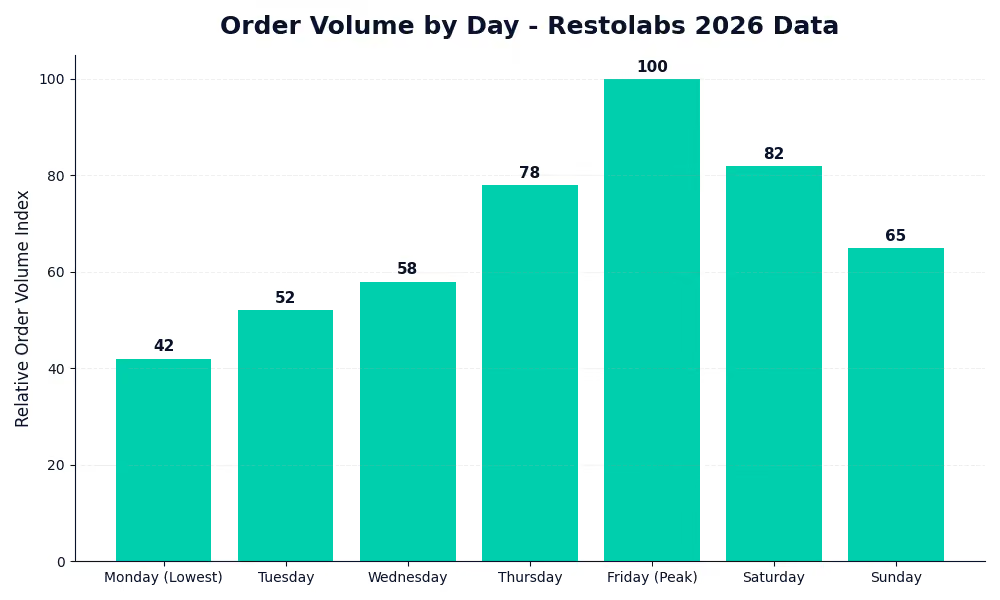
- Friday is the peak ordering day platform-wide; Monday is the lowest, which is why Monday is gold for win-back campaigns, not new-customer pushes.
- The dinner peak window of 5:30 PM to 8:30 PM local time drives the bulk of daily order volume - but the decision to order happens hours earlier.
- The lunch rush of 11 AM to 1 PM local time is a browse-and-convert window; the late-night window of 9 PM to 11 PM is dessert, ramen, and pizza territory.
- We see a median reorder interval of 8.9 days, which makes the day 7-10 post-purchase window the sharpest re-engagement timing across the dataset.
- Specialty concepts follow a different seasonal curve than mainstream concepts - and most operators promote on the wrong months because they copy generic calendars.
- Owning your channels is what makes timing actually work. You can't run a precise calendar on data you don't control.
Your promotional results feel random. They aren't.
A Tuesday email lands flat, then a Wednesday Instagram post sells out the special by lunch. A Valentine's prix fixe underperforms while a random off-peak ramen deal moves 80 covers. Most specialty operators read this as luck. It isn't luck - it's a timing pattern you haven't mapped yet.
According to the Restolabs 2026 Order Analytics Dataset, which covers more than 4 million orders processed across the Restolabs platform spanning 2,126 locations and 479 brands from March 2025 to March 2026, specialty restaurant order volume concentrates inside a small number of predictable weekly and daily windows. With 97.4% of orders timezone-matched for time-of-day analysis, we can show you exactly when your customers actually buy - and when your promo dollars are fighting for scraps.
This guide gives you a month-by-month calendar, day-of-week patterns, hour-of-day timing, and the channel-by-channel cadence that ties it all together.
Why timing matters more for specialty restaurants than for mainstream concepts
A specialty concept has a narrower audience by definition. Fewer people in your city wake up craving Ethiopian, or vegan dessert, or Nashville hot chicken on a random Tuesday. That means every promotional impression costs more in attention dollars, and every mistimed campaign burns budget you can't easily refill.
Mainstream concepts can spray and pray. You can't.
Specialty buyers come with intent. They plan further ahead, they're more likely to make a special trip, and they're more likely to share the experience socially. That changes when they decide to order - and that's the timing edge you can read off our data.
For mobile concepts, this matters even more. We see specialty food truck operators live or die by getting their promotional cadence aligned with location-specific intent windows, because their audience can't just walk in tomorrow if they miss today.
Best days to promote your specialty restaurant online
Generic restaurant advice tells you to promote on Friday because Friday is the busiest day. That advice is half-right and dangerous.
In our 2026 order analytics data, Friday is the highest-volume ordering day platform-wide, followed by Thursday and Saturday. That's when orders close - but most of those Friday orders were decided earlier in the week. If your promotion lands on Friday at 4 PM, you're often arriving after the customer already chose where to eat tonight.
Thursday is the dark horse
Thursday is where weekend decisions get made. A promo dropping Thursday morning - especially via email or SMS - lands while the customer is still building their weekend mental list.
Sunday evening - the underrated promo slot
Sunday evening is when people plan the week ahead. A Monday or Tuesday lunch promo sent Sunday at 6 PM consistently outperforms the same promo sent Monday at 9 AM in our observations.
Why Mondays kill promotional ROI for most specialty concepts
Monday is consistently the lowest-volume ordering day, which makes it ideal for win-back campaigns and loyalty incentives - not for launching net-new promotional pushes. Don't try to acquire on Monday. Re-engage instead.
Friday vs Saturday isn't interchangeable
Friday skews delivery-heavy and impulsive. Saturday skews pickup and planned. Promote different things on each - and stop treating them like one weekend block.
Day-part timing: the hours that actually convert
The hour of day matters as much as the day. Sometimes more.
The lunch window (11 AM-1 PM)
The lunch rush of 11 AM to 1 PM local time is where impulse meets convenience. Promotions sent at 10:15 AM catch the "where are we ordering from?" Slack thread inside offices. Sent at 12:30 PM, you're too late.
The 3-5 PM planning gap
When we segment the 2026 dataset by hour, the late-afternoon window is the quietest in terms of order volume - and the most underused for promotion. This is when people decide what's for dinner. A push at 3:45 PM hits the decision, not the order.
The 7-9 PM late commit
The dinner peak window of 5:30 PM to 8:30 PM local time drives the bulk of daily order volume across the platform. Promotions sent inside this window are largely chasing orders already placed. Promote into this window from the planning gap before it, not during it.
Late-night specialty
The late-night window of 9 PM to 11 PM is delivery-heavy and pizza-dominant in aggregate, but for specialty concepts in dessert, ramen, taco, and Asian categories, this window often punches well above its weight. If your concept fits, this is a window worth owning.

The 12-month specialty restaurant promotional calendar
Generic restaurant calendars overweight the December rush and underweight everything else. Specialty concepts need a different map.
January - reset and redeem
Healthy-leaning menu pivots work. So does a January gift card redemption push, because many gift cards bought in December never get used. Promote light, promote often, and don't try to sell indulgence in the first two weeks.
February - Valentine's, but earlier than you think
Valentine's prix fixe campaigns should launch by January 25. Holidays and celebration occasions often drive higher restaurant traffic, but specialty concepts compete with every fine-dining venue in town that week. Get ahead of them.
March - spring teasers
March is the quiet pivot month. Tease your spring menu before you launch it. Use March to grow the email list you'll need in April.
April - patios and plant-forward
Outdoor reopening, Earth Day for plant-forward concepts, and the first wave of "let's go out again" energy. Promote heavily mid-month.
May - Mother's Day and graduation
Mother's Day catering inquiries spike four weeks out. Graduation catering inquiries spike six weeks out. Start promoting both in early April, not May.
June - Father's Day and longer evenings
Father's Day skews more spontaneous than Mother's Day in our observations. Longer daylight pushes the dinner peak later - adjust your promo send times accordingly.
July - the mid-month strategy
July is a summer slump month for many specialty concepts, particularly indoor-only ones. Promote mid-month, not on holiday weekends when your audience is traveling. Holiday weekend promos to a city that's at the lake produce flat results.
August - back-to-school pivot
Family meal bundles and convenience-anchored promos work in August. The closer to Labor Day, the stronger the "one last summer order" urgency message lands.
September - season launches
Football season for relevant concepts, fall menu launches for everyone else. September is the second-strongest acquisition month of the year for specialty restaurants in our observations.
October - themed and harvest
Halloween-adjacent campaigns work for dessert and themed concepts. Harvest menus work for everyone with a seasonal ingredient story. Start promoting in the last week of September.
November - Thanksgiving alternatives
Specialty restaurants own the "we don't want turkey" market. Catering pre-sells should launch by October 25. The week before Thanksgiving is your highest-intent acquisition window of Q4.
December - gift cards and group dining
Gift cards, holiday party catering, and NYE prix fixe. The earlier you launch group dining inquiries (by November 15), the better your December books.
Matching promo type to channel - and timing each channel differently
Different channels reward different timing. Treating them as interchangeable is the single most common mistake we see.
Email opens for specialty restaurants cluster in early morning and late afternoon. If you want the full breakdown, our piece on the best times to send restaurant promotional emails covers payday timing and day-of-week sends in depth.
Food content gets saved between 7 PM and 10 PM, when people are scrolling on the couch. Posts at noon get scrolled past. Save-worthy beats see-worthy.
SMS
SMS belongs to the 90-minute pre-order window. A 4:45 PM text for a 6:30 PM dinner promo outperforms a 2 PM text by a wide margin. Don't text into the dinner peak - text toward it.
Direct ordering page banners
Restaurants in our 2026 dataset that refresh their ordering page hero before the lunch rush of 11 AM to 1 PM local time tend to capture stronger midday conversion than those that update overnight. A small timing change on your ordering page is one of the highest-ROI moves available - and it's something you can read directly from your restaurant ordering analytics.
Google Business Profile
Update your GBP offers Thursday morning. Local intent searches spike Thursday through Saturday for specialty queries, and stale GBP listings on a Friday evening cost you the walk-up search traffic.
The promo decay curve - when to stop promoting something
Most operators run promotions too long. By week three, they're paying attention dollars for diminishing returns.
A typical specialty restaurant promo follows a predictable curve. Week one is the spike - new audiences see it, early adopters convert. Week two plateaus. By week three, the same content is showing to the same people, and saturation kicks in.
The signal to refresh is when your repeat customers stop responding. Given the median reorder interval of 8.9 days between repeat orders in our dataset, a promo that hasn't moved repeat behavior by day 10 isn't going to. Refresh the creative, refresh the offer, or retire it.
Channel stack: the owned channels that make timing actually work
You can have the best timing calendar in the world. If you're running it through third-party marketplaces, you don't control the timing - and you don't see the data that tells you whether it worked.
Marketplaces strip your timing control three ways. They batch their own promotions, they obscure when your customer browses versus orders, and they own the relationship so you can't time the next message based on the last order.
Owning the stack flips that. A branded website, commission-free online ordering, a mobile app, and a loyalty program for specialty restaurants give you both the timing levers and the data to know which ones worked. Online food ordering has grown much faster than dine-in since 2014, and many customers prefer ordering directly from restaurant websites - owning that channel is no longer optional.
The win-back angle is where this lands hardest. We see the day 7-10 post-purchase window as the optimal re-engagement timing, anchored on the 8.9-day median reorder interval. You can only act on that timing if you own the customer data - which means owning the order flow.
Putting it together - a 30-day promo rhythm for specialty restaurants
The framework is simple. The discipline is everything.
Week 1 - plan and tease. Low-frequency social. Behind-the-scenes content. Email subscribers hear about it first. No hard sell.
Week 2 - launch. Email blast Thursday morning. Ordering page banner refresh before lunch. SMS 90 minutes before dinner peak on launch day. Instagram post 7-9 PM.
Week 3 - amplify. User-generated content, reviews, social proof. Restaurants in our dataset that gather UGC in this window see meaningfully better conversion in week 4.
Week 4 - convert and measure. Last-call urgency messaging. Then read the data. Repeat what worked. Retire what didn't.
The operators who win this rhythm aren't lucky. They're reading their order data, and they're timing their next promo based on evidence rather than instinct.
Stop guessing. Start reading.
Timing isn't a creative discipline - it's a data discipline. The operators with the sharpest promotional calendars are the ones with the sharpest read on their own order patterns. If you want to see how Restolabs gives specialty operators the timing edge with flexible, commission-free pricing and direct customer data, Book a Demo.

Sruthi Sekar specializes in brand strategy, growth, and user experience in the hospitality industry. As the driving force behind Restolabs, she helps restaurants harness technology to scale and thrive. With a background in design, branding, and entrepreneurship, she brings a sharp focus on crafting digital experiences that drive real business impact.
Frequently Asked Questions
There isn't one. Friday is the highest-volume ordering day in our 2026 dataset, but the decision to order on Friday usually happens Thursday - so Thursday morning is often the best day to send the promo that gets ordered on Friday.
Three to six weeks for a standard promo, and six to eight weeks for holiday windows like Valentine's, Mother's Day, Thanksgiving, and NYE. The lead time isn't about the launch - it's about giving your owned channels enough runway to build anticipation.
Promote for the weekend, but during the planning windows. Thursday morning and Sunday evening are the highest-leverage send slots, while Friday and Saturday are when the orders actually close.
Early morning (7-9 AM) and late afternoon (3-5 PM) tend to outperform mid-day sends for specialty restaurants. The afternoon send catches the dinner-decision window before the dinner peak of 5:30 PM to 8:30 PM local time.
Most specialty promotions plateau by the third week as the same offer reaches the same audience. Anchor your decision on the 8.9-day median reorder interval - if repeat customers haven't responded by day 10, refresh or retire.
Yes. Specialty buyers plan further ahead and come with higher intent, which means promotional timing skews earlier in the week and earlier in the day compared to mainstream casual dining.
It depends on your concept, but September and April are the two strongest acquisition months for most specialty restaurants in our observations. Both pair fresh menu energy with high "let's try something new" intent.




.webp)

.svg)
.webp)