
Key Takeaways
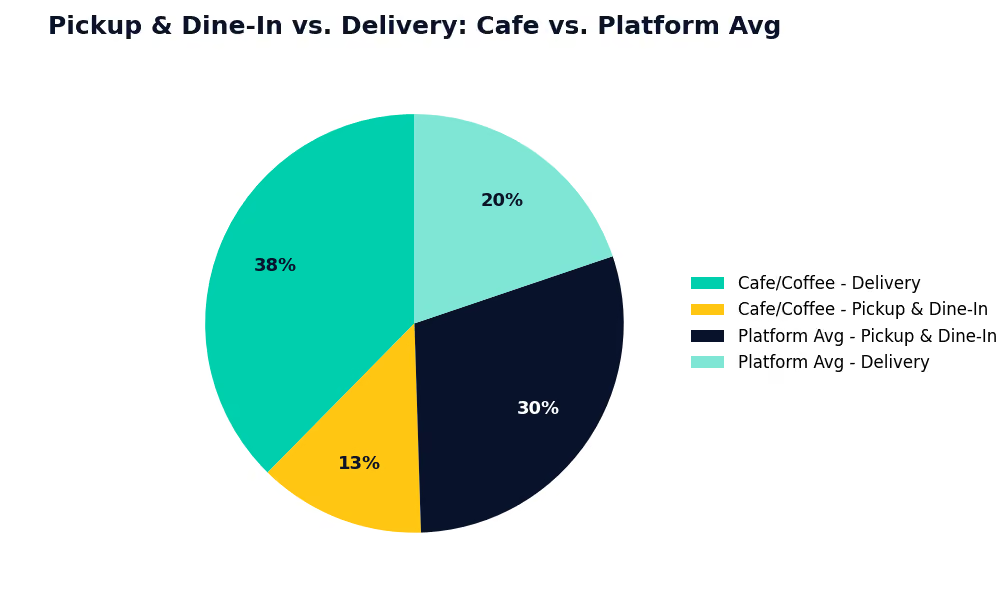
- Juice bar and cafe-style ordering skews heavily to mornings and pickup - our data shows more than 75% pickup and dine-in orders in the cafe and coffee category.
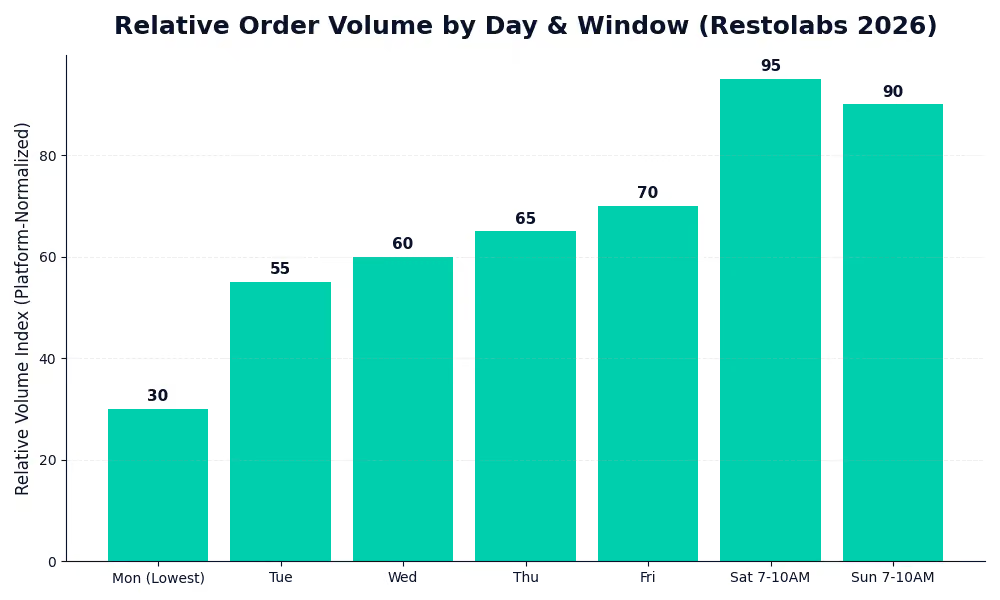
- Monday is the lowest-volume day across the platform, which makes it the best win-back day, not the best sales day.
- Weekend mornings (7 AM to 10 AM) and the 11 AM to 1 PM lunch rush are the two most reliable promotional windows we track.
- The median customer reorders in 8.9 days - so promotional cadence should match that natural rhythm, not override it.
- Mobile-first channels (SMS, push) beat email-only sends for same-day morning windows.
- January cleanse season, spring detox, summer hydration, back-to-school, and immunity season each open a distinct 2-to-4-week promotional pocket.
Most juice bar promotions land at the wrong moment.
You spend hours writing the email, picking the offer, and scheduling the send. The order graph barely flinches. Then a competitor across town runs the same promotion on a different day and pulls a queue out the door.
According to the Restolabs 2026 Order Analytics Dataset, which covers more than 4 million orders processed across the Restolabs platform spanning 2,126 locations and 479 brands from March 2025 to March 2026, the cafe and coffee segment - the closest analog we track to juice bars and healthy-food concepts - accounts for approximately 14% of platform orders, with high repeat rates and loyalty-driven behavior. That repeat behavior is a gift. But only if you push your offers into the exact windows when wellness customers are already deciding.
This is a timing playbook, built on real order data, not vibes.
Why promotional timing matters more for juice bars than most restaurants
Juice bars run on perishables and tight margins. A box of cold-pressed bottles that doesn't move by Tuesday becomes Wednesday's loss.
That's why timing isn't a marketing nicety - it's an inventory decision. A promotion that lands two hours late doesn't just underperform. It actively wastes product.
The wellness audience also behaves on routine. Morning commuters, gym-goers, and meal-prep parents all anchor their orders to specific blocks of the day. If your push notification lands at 11 AM, the 7:30 AM commuter has already bought coffee from someone else.
Three pressures every juice bar operator should hold at once:
- Perishability: promotions must drive predictable, not spiky, volume.
- Routine-driven demand: wellness customers buy on schedules, not impulses.
- Margin reality: discounts that flop are unrecoverable on a $7 cold-pressed bottle.
How we identified these promotional windows
We worked from the cafe and coffee cohort inside the Restolabs 2026 Order Analytics Dataset, which is the segment that overlaps most closely with juice bars, smoothie shops, fresh bars, and healthy-food cafes. The dataset includes order timestamps, fulfillment type, channel attribution, AOV, and reorder intervals.
Where juice-specific patterns deviated from the broader cafe segment, we flagged it. Where they tracked the cafe trend exactly, we treated the cafe benchmark as a reliable proxy.
A note on industry context: the National Restaurant Association projected restaurant industry sales at roughly $1.1 trillion for 2025, and Technomic reported industry growth near 3.3% the same year. The wellness sub-segment is growing faster than that baseline, which is why timing your promotions correctly is more lucrative now than it was three years ago.
The 7 best times to promote your healthy juice bar online
1. Monday and Tuesday morning (6:30-9:00 AM) - the wellness reset window
This is the single most reliable recurring window we see in cafe-segment data.
Our 2026 dataset shows Monday as consistently the lowest-volume ordering day, making it ideal for win-back campaigns and loyalty incentives - not blanket discounting. Customers who reset their week with a wellness order on Monday morning tend to repeat through Wednesday.
What to promote: pre-ordered immunity shots, subscription cleanse renewals, breakfast bundles, and "first order of the week" loyalty multipliers.
Channel mix that works here: SMS sent 60-90 minutes before the customer's typical pickup, paired with a push notification from a branded mobile app with push notifications. Email alone underperforms in this window because commuters are scanning notifications, not inboxes.
2. First two weeks of January - new year cleanse season
This is the biggest promotional pocket of the year for juice bars. Full stop.
Tease your campaign between December 26 and December 31, then launch hard from January 1 to January 14. Subscription cleanse packages - 3-day, 5-day, 7-day - outperform single-day discounts because they capture a customer for the next week and a half of orders.
Why subscription matters: the median reorder interval across our platform is 8.9 days between repeat orders. A 5-day cleanse drops the reorder gap to near-zero and locks in two or three reorders during the highest-intent window of the year.
According to the National Restaurant Association, roughly 71% of consumers in 2025 said they want to eat healthier when dining out or ordering in. January is when that intent peaks.
3. Mid-March to mid-April - spring detox and allergy season
Spring is gentler than January. Customers are not looking for punishing 7-day fasts. They want lighter resets.
Promote single-day green juice bundles, allergy-relief blends, and "spring refresh" subscription mini-programs. Pair the launch with Earth Day and farmer's market season for adjacent organic-content angles.
Toast reported that around 56% of operators in 2025 said local sourcing was a meaningful purchase driver for their guests. Spring is the easiest season to credibly lean into local sourcing language.
4. June through August - summer hydration and bowl season
Summer rewires customer behavior. The sharp morning spike loosens, and a second afternoon window opens.
Smoothie bowls, hydration packs, electrolyte add-ons, and post-workout bundles drive incremental orders. Push promotions between 2:00 PM and 4:00 PM perform meaningfully better in summer than they do in winter for the same product mix.
Friday is also our highest-volume day across the platform year-round, which makes Friday afternoon summer pushes a compounding bet - peak day plus peak summer afternoon window.
5. Late August through September - back-to-school routine reset
Parents and students rebuild routines in the last two weeks of August. Routines mean recurring orders.
What to promote: family bundle packs, school-week subscription packs, lunch add-ons, and "first-week-back" loyalty triggers. Position the product as a routine, not a treat.
The same Monday-Tuesday morning window from the wellness reset section reactivates here, because the back-to-school customer is a new version of the wellness reset customer. Target both windows with the same SMS cadence.
6. October through December - immunity season push
Most juice bars under-invest here because they associate wellness with summer. That's a mistake.
Ginger shots, turmeric blends, elderberry add-ons, and "immunity stacks" sell aggressively from late October through mid-December. The window narrows around the holidays - by December 22, demand collapses into hosting-and-travel mode - but the 8-to-10-week pre-holiday run is one of the most under-promoted windows on the calendar.
Channel mix: short-burst email campaigns paired with paid social. Our restaurant order analytics can help isolate which immunity SKUs are driving incremental versus cannibalized volume during this stretch. For related context on building seasonal owned-channel visibility, our piece on SEO strategies for coffee-style and grab-and-go concepts covers the broader playbook.
7. Friday afternoon (3:00-6:00 PM) - the weekend prep window
Friday is the platform-wide peak day, but most operators promote at lunch and miss the afternoon entirely.
The 3 PM to 6 PM stretch on Friday is when meal-prep customers order for Saturday pickup, when subscription renewals fire, and when weekend cleanse pre-orders consolidate. A well-timed Friday-afternoon SMS with a "Saturday morning ready" pickup window converts at a much higher rate than the same offer sent Friday morning.
Pair this with the platform's broader weekend morning peak - 7 AM to 10 AM weekends, when coffee and bakery orders surge - and you've stitched a 24-hour Friday-PM-to-Saturday-AM promotional bridge.
Matching promotional channels to each time window
Channel choice matters as much as timing. The right offer on the wrong channel still misses.
Here's how we'd map the four most common channels against the seven windows above:
- Email: Use early-morning sends on weekdays and test your audience's best-performing open window. Best for cleanse launches, subscription announcements, and longer-form storytelling.
- SMS: 30-90 minutes before the customer's typical pickup time. Best for same-day morning windows and Friday-afternoon weekend prep.
- Push notifications (branded app): Real-time and location-triggered. Best for the 6:30-9:00 AM weekday window and same-store loyalty triggers.
- Paid social (Instagram, TikTok): 24 to 48 hours before a major launch. Best for cleanse seasons, immunity pushes, and summer bowl drops.
The platform-wide pickup share sits at 60.1% of orders fulfilled via pickup or dine-in, representing approximately 2.4 million orders - a pickup-skew that inverts the typical third-party platform assumption. In the cafe and coffee segment specifically, pickup runs even higher. That means your promotional CTAs should default to "order ahead for pickup," not "delivery in 30 minutes."
The same Restolabs 2026 Order Analytics Dataset shows the lunch rush of 11 AM to 1 PM local time is the second-largest daily order block after the dinner peak - which makes it the best window for paid social driving same-day pickup at juice counters tucked inside office districts.
If you operate inside or adjacent to a grab-and-go concept, online ordering for coffee shops and grab-and-go concepts is the playbook we'd point you to first. The behavior overlap is significant.
The promotional calendar most juice bars get wrong
Three mistakes show up repeatedly when we look at under-performing accounts.
Mistake one: blasting promotions into the dead zones. Mid-afternoon weekdays in winter, late-night hours, and Friday after 7 PM all show low conversion in our 2026 data. Sending a 10 PM email on a Tuesday in February is the marketing equivalent of throwing flyers into a parking lot.
Mistake two: ignoring Tuesday. Operators chase Monday as a "new week" day and Friday as a "weekend" day and treat Tuesday as filler. Tuesday is actually the second-strongest morning for wellness routines, sitting just behind Monday in our cafe-segment behavior.
Mistake three: front-loading January and skipping the rest of Q1. Many juice bars empty their promotional budget by January 20 and go silent until April. Spring detox season starts mid-March. You need fuel left.
How to set up your online ordering system to capture promotional windows
Timing falls apart without the infrastructure to capture it. A perfectly-timed promotion that sends customers to a clunky checkout converts at half the rate it should.
A few setup choices matter more than the rest:
Pre-schedule menu changes for cleanse seasons. Don't ask your team to manually swap January menus on January 1 at 6 AM. A commission-free online ordering system should let you draft and schedule the seasonal menu weeks in advance.
Set up subscription products properly. Cleanse packages, weekly green-juice subscriptions, and immunity-shot bundles need their own SKU structure with auto-renew, pause, and skip logic.
Wire loyalty triggers to your peak windows. A double-points push on Monday morning closes the lowest-volume day gap. Loyalty program triggers tied to promotional windows outperform flat discounts because they protect AOV while still driving frequency.
Use push notifications, not just email. Your branded app is the only channel where you control delivery timing down to the minute.
According to Square's 2025 operator data, around 49% of small restaurant operators said building owned digital channels was a top priority for the year - which lines up with what we see in our own platform: operators who control their channel can run promotions at all seven of these windows. Operators who don't, can't.
Measuring whether your promotional timing is working
Most operators measure the wrong things.
Open rates, impressions, and reach are vanity metrics for juice bars. The metrics that actually matter:
- Incremental order lift: orders during the promotional window minus orders expected without the promotion.
- AOV change: average order value during the promo period vs. the prior 14-day baseline.
- 14-day repeat rate: the share of promo-window customers who reorder within two weeks. Our platform repeat rate sits at 38.2%, with a median reorder interval of 8.9 days - so a 14-day window captures most natural repeats.
- Channel attribution: which channel drove the order, not just which channel sent the most messages.
- Customer lifetime spend trajectory: our 2026 dataset shows an average lifetime spend of $123.79 per customer across 3.2 orders, with a 20% new / 80% returning customer split. Promotions that move the returning-customer line are worth more than promotions that briefly inflate new-customer count.
According to the National Restaurant Association, about 62% of consumers in 2025 said loyalty rewards and personalized offers influenced where they ordered from. If your measurement stack doesn't tie back to specific customer behavior, you can't act on that signal.
Closing
Timing isn't magic. It's pattern recognition layered on top of an ordering channel you actually own.
Operators stuck on third-party platforms can't run timed promotions effectively because they don't control the customer relationship, the data, or the send window. The juice bars pulling ahead in 2026 are the ones building their own promotional engine - and showing up in the right window, on the right channel, every time.
Book a Demo to see how we help juice bars and healthy-food operators capture every promotional window.

Sruthi Sekar specializes in brand strategy, growth, and user experience in the hospitality industry. As the driving force behind Restolabs, she helps restaurants harness technology to scale and thrive. With a background in design, branding, and entrepreneurship, she brings a sharp focus on crafting digital experiences that drive real business impact.
Frequently Asked Questions
Between 6:30 AM and 9:00 AM on Monday and Tuesday, with mobile-first channels like SMS and push notifications. The wellness reset behavior is strongest in this window, and our 2026 dataset shows cafe and coffee orders skew heavily to pickup in this exact block. Avoid email-only sends here - they underperform mobile pushes by a wide margin.
Tease in late December (December 26-31) and launch the full campaign from January 1 to January 14. Subscription cleanse packages outperform single-day discounts because they capture three to four reorders inside the 8.9-day median reorder window.
Two to three timed promotions per month aligned with the peak windows we cover above. Constant discounting erodes AOV and trains your best customers to wait for the next promo instead of buying at full price.
It depends on the window. SMS wins for same-day morning windows, email is best for cleanse and subscription launches, and paid social works 24 to 48 hours ahead of a major drop to build awareness. Push notifications from your own app outperform all three for repeat customers.
Online captures pre-order and advance-order behavior, which wellness customers index heavily on. In-store signage only captures walk-ins who've already committed to visiting. Both work, but online is the only channel that can move customers from "considering" to "ordered" before they leave home.
Mid-afternoon weekdays in winter (2-4 PM), late-night hours (after 9 PM), and Fridays after 7 PM. Our 2026 dataset consistently shows low conversion across these blocks for cafe and healthy-food merchants.
Measure incremental order lift, AOV change, 14-day repeat rate, and channel attribution. Skip vanity metrics like open rate and impressions - they tell you whether the message was seen, not whether it sold anything.





.webp)

.svg)
.webp)