
Key Takeaways
- Friday is the platform-wide peak ordering day; Monday is the lowest-volume day and your best win-back window.
- The dinner peak window of 5:30 PM to 8:30 PM local time drives the bulk of daily order volume - schedule send-for-conversion campaigns to land there.
- Grocery and Convenience operate at a 99.8% delivery rate with $40+ AOV, so your promo logic must assume a delivery-native customer.
- The median reorder interval across our 2026 dataset is 8.9 days, making day 7 to day 10 post-purchase the sharpest replenishment-nudge window.
- 97.4% of orders in our 2026 dataset were timezone-matched, which means hour-of-day analysis is a real lever - not a guess.
- Stop blasting all channels at once. Stagger SMS, email, push, and paid social by 4-12 hours.
Most grocery delivery promos fail on timing, not copy.
You've seen it. The bundle email goes out Tuesday morning. The SMS fires Saturday at noon. The paid social campaign runs flat for two weeks. Open rates look fine. Conversion is a ghost.
We've been watching this pattern for a while now. According to the Restolabs 2026 Order Analytics Dataset, which covers more than 4 million orders processed across the Restolabs platform spanning 2,126 locations and 479 brands from March 2025 to March 2026, the operators who win on grocery delivery aren't the ones with the cleverest creative. They're the ones who time the send window against actual order behavior. This guide walks through when to promote, by day, hour, channel, and season - and why getting the timing right is the most under-optimized lever in online grocery marketing strategy.
What "promotion timing" actually means for grocery delivery
Timing isn't just "what hour to hit send." It's a layered question. You're choosing a day-of-week, an hour-of-day, a channel, a customer cohort, and a trigger condition - all at once. Get any one wrong, and the whole stack underperforms. For businesses expanding into online grocery, building a reliable grocery delivery operation is just as important as optimizing when and how promotions are sent.
Grocery delivery is also different from restaurant delivery in ways that compound timing decisions. The basket is bigger. The reorder cycle is more predictable. The fulfillment is almost entirely delivery, not pickup. That last point matters more than most operators realize.
In our 2026 dataset, Grocery and Convenience runs at a 99.8% delivery rate, effectively a delivery-only model, with average tickets of $40+ per order - well above the platform-wide AOV of $38.96. That single fact reshapes promotion timing because every send is, in effect, scheduling a delivery slot.
Why timing beats creative for grocery delivery promotions
Most operators we work with spend 80% of their promotion energy on creative. New banner, new subject line, new discount percentage. Then they ship the email Tuesday at 10 AM because that's when the marketing person had time to hit send.
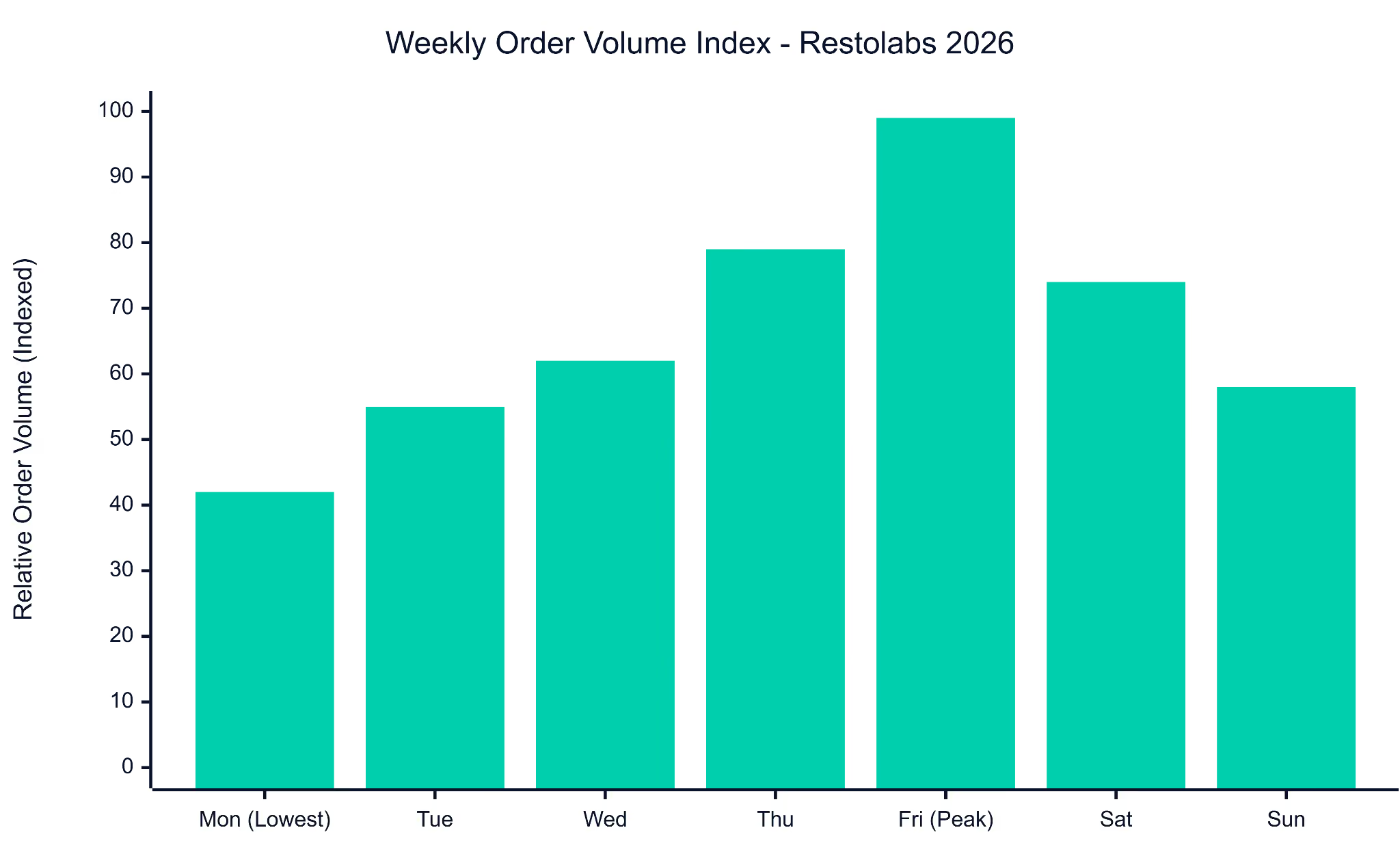
The problem is structural. Grocery delivery demand isn't smooth - it clumps around a few predictable windows. The Restolabs 2026 Order Analytics Dataset identifies Friday as the highest-volume ordering day platform-wide, followed by Thursday and Saturday, with Monday as consistently the lowest-volume ordering day. That's a near 2:1 spread between best and worst days before you've written a word of copy.
When your send time aligns with peak intent, average copy outperforms great copy that lands on a Monday afternoon. Operators who pair first-party order analytics with their send calendar are the ones we see consistently moving the needle. Online grocery is also no longer niche - eMarketer pegged digital grocery at 13% of U.S. grocery sales in 2024, and Brick Meets Click reported a monthly online grocery total of $11.6 billion in 2025. The audience is there. The question is whether your promo shows up at the right moment.
When to promote grocery delivery by day of week
Start with the floor and the ceiling. Promote into peak demand for conversion. Promote into the trough for win-back. Both work - they do different jobs.
Thursday and Friday - the weekly stockup window
This is where intent peaks. Households finalize weekend meal plans, replenish staples, and place orders that need to land before Saturday morning. Send conversion-focused promos here: bundle offers, weekend-ready baskets, free-delivery thresholds.
Sunday - the planning lean-in
Sunday isn't the peak ordering day, but it's the day shoppers plan for the week ahead. Soft-touch content works here - meal-plan inspiration, a new-arrivals digest, a subscription nudge. Don't burn your hard discount on Sunday; save it for Thursday.
Monday - your win-back lab
Monday is consistently the lowest-volume ordering day, making it ideal for win-back campaigns and loyalty incentives. Treat Monday as a testing day. Send to lapsed segments. Run reactivation discounts. Test new creative against audiences you'd otherwise miss. The opportunity cost of a Monday send is the lowest of any day in the week.
When to push promotions by hour of day
Hour-of-day decisions are where most operators leak conversion. They send when it's convenient for them, not when the customer is ready to buy.
Our 2026 dataset is built on 97.4% of orders being timezone-matched for time-of-day analysis, which means we can read hour-by-hour patterns with real confidence. The dinner peak window of 5:30 PM to 8:30 PM local time drives the bulk of daily order volume across the platform. That's the conversion window. The lunch rush of 11 AM to 1 PM local is the secondary peak. Anything outside those two windows is awareness territory, not conversion territory.
7-9 AM - the commute window for SMS and push
Phone is in hand. Inbox is being triaged. This is when restock reminders and same-day-delivery prompts get noticed. Keep the message short and the CTA single-tap.
11 AM-1 PM - email opens spike
Lunch-hour scrolling is when email performs hardest. Weekly digest, bundle previews, and new-category launches land well here.
5:30 PM-8:30 PM - the decision window
This is where carts actually close. Schedule push notifications, abandoned-cart nudges, and your "delivery slots filling fast" messages to fire 30 to 90 minutes ahead of this window. Hit send too late and you've missed the conversion. Hit send too early and the customer has already moved on.
Channel-by-channel promotion timing
Different channels do different jobs. Treating SMS like email is how you train customers to opt out.
The pattern: owned channels (SMS, email, push) win on weekday mornings and the pre-dinner window. Paid social skews to evenings, when feeds get scrolled at home rather than at work.
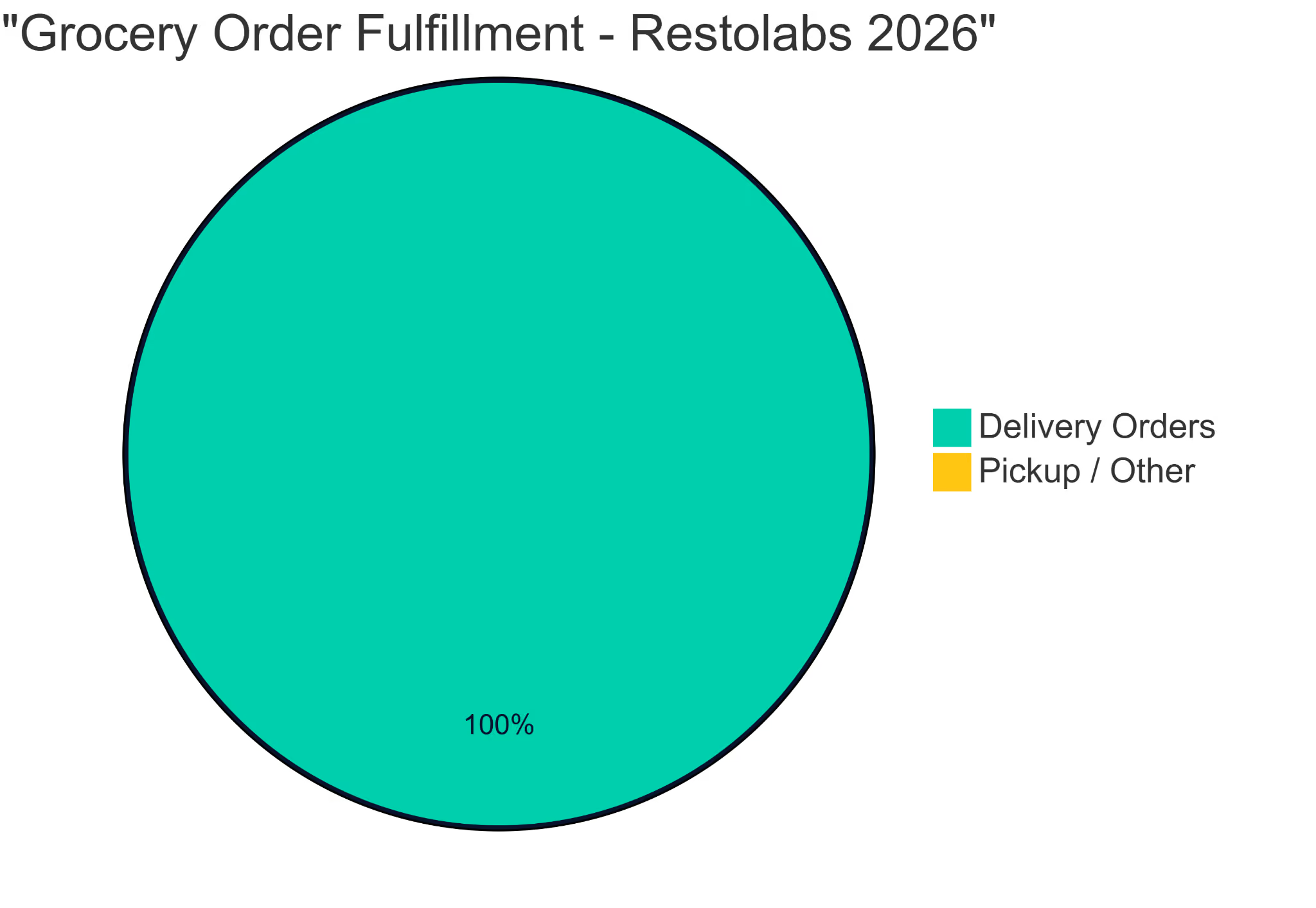
Because grocery is delivery-dominant, every channel decision is implicitly a delivery-slot decision. Operators with a tight delivery management workflow can promote against capacity in real time - boosting promo intensity when slots are open, cooling it when they're not.
Seasonal and calendar-based promotion windows
Grocery delivery has a sharper seasonal curve than most operators model for. Plan the calendar a quarter ahead, not week by week.
Back-to-school: mid-August to mid-September
Family meal-prep behavior surges. Lunchbox staples, snack bundles, and weekday-dinner kits perform here. Start teasing two weeks before school start dates in your geography.
Holiday pre-loading: mid-November to late December
Pantry stockup is the dominant behavior. Promote bundles, hosting kits, and gift cards. The U.S. online grocery market continues to grow - Grand View Research valued it at $67.64 billion in 2024, and Technavio projects a 23.1% CAGR for the broader online grocery delivery services market through the late 2020s. Holiday windows are where that growth concentrates.
New Year reset: first two weeks of January
Health-food categories spike. Subscription signups peak. This is the strongest single window of the year for converting trial customers into repeat customers - if you have a built-in loyalty program capturing them on the way in.
Summer: June through August
Weekend ordering dominates. BBQ, beverages, and grab-and-go categories outperform. Weekday volume softens - lean into Thursday and Friday sends.
Trigger-based timing - beyond the calendar
The calendar gets you 70% of the way. Triggers get you the rest. These are the promotion sends that fire because a specific customer did a specific thing, not because it's Thursday.
The replenishment window
This is the single highest-ROI trigger in grocery. In our 2026 dataset, we see a median reorder interval of 8.9 days between repeat orders. That gives you a clean targeting rule: anchor your replenishment nudge to day 7 to day 10 post-purchase. We've isolated the day 7-10 post-purchase window as the optimal re-engagement timing across the platform, anchored on the 8.9-day median reorder interval.
Send earlier and you're nagging customers who haven't run out yet. Send later and you've missed the buying moment.
Cart abandonment recovery
Three-touch rule: first nudge at 45 minutes, second at 24 hours, third at 72 hours. The 45-minute window is where intent is freshest and friction is lowest. Past 72 hours, conversion drops to almost nothing - let those customers re-enter the regular cadence.
Loyalty milestone triggers
When a customer crosses a reward threshold, the redemption invite should fire same-day. Waiting 48 hours kills the dopamine hit. For more on how to structure earn-redeem mechanics, our guide on structuring a loyalty program covers the cadence in detail.
Common timing mistakes operators make
We see these on repeat across the grocery and specialty food brands on our platform. None of them are creative problems. All of them are calendar problems.
- Promoting heavily on Monday. Monday is the lowest-volume day. Use it for win-back, not hard pushes.
- Sending all channels simultaneously. SMS, email, and push hitting at 9 AM is channel cannibalization. Stagger by 4-12 hours.
- Treating grocery like restaurant delivery. Restaurant peaks are Friday-Sunday evenings. Grocery clusters differently and runs on an 8.9-day cycle, not a daily one.
- Ignoring payday cycles. Order frequency on the 1st and 15th of each month skews higher in many markets - your replenishment nudge calendar should respect that.
- Bulk-blasting instead of segmenting. A customer on day 3 of their reorder cycle and a customer on day 12 need entirely different messages.
For more on the broader pattern of repeat-purchase psychology, our piece on promotion tactics that drive repeat orders goes deeper on segmentation logic.
Building a 30-day grocery delivery promotion calendar
A practical template you can run starting Monday.
Week 1 - Baseline. Pull your last 90 days of order data. Map your own day-of-week and hour-of-day curves. Don't assume our platform averages match your store - verify against your numbers.
Week 2 - Day-of-week test. Run a Thursday morning email and a Sunday evening SMS to matched audiences. Measure conversion to order, not opens.
Week 3 - Replenishment trigger build-out. Implement the day 7-10 post-purchase nudge against your full customer base. Anchor on the 8.9-day median where you don't have segment-specific data yet.
Week 4 - Seasonal and paid layer. Layer in the next upcoming seasonal window (back-to-school, holiday, reset). Add Thursday-Saturday evening paid social for new-customer acquisition.
Operators running their own commission-free online ordering channel have a real advantage here - you own the customer data, so you can act on the timing insights instead of relying on a third-party app's algorithm to decide when your customer hears from you. Grocery-specific operators can also explore our purpose-built setup for grocery stores and specialty retailers.
Where to go from here
Timing is the unglamorous lever. It doesn't win awards. It just moves orders.
The operators who pull ahead in 2026 are the ones treating their promo calendar as a data product, not a marketing afterthought. If you want to see how grocery and food operators on our platform are using their own order data to schedule promos that actually convert, book a demo.

Sruthi Sekar specializes in brand strategy, growth, and user experience in the hospitality industry. As the driving force behind Restolabs, she helps restaurants harness technology to scale and thrive. With a background in design, branding, and entrepreneurship, she brings a sharp focus on crafting digital experiences that drive real business impact.
Frequently Asked Questions
Across our 2026 dataset, Thursday and Friday mornings deliver the strongest combination of intent and capacity, with Friday standing as the highest-volume ordering day platform-wide. Pair a Thursday AM email with an SMS nudge timed an hour before the 5:30 PM to 8:30 PM dinner peak for the cleanest conversion arc.
Two to three touches per week is the ceiling for most audiences. One mid-to-late-week conversion push, one Sunday planning soft-touch, and one trigger-based send (replenishment or abandoned cart) is a sustainable cadence. Anything more frequent tends to push unsubscribe rates up faster than it lifts orders.
Both - used for different jobs. SMS wins for time-sensitive restock reminders and same-day delivery prompts in the 7-9 AM commute window. Email wins for weekly digests, bundle offers, and category launches sent during the 11 AM to 1 PM lunch window.
First nudge at 45 minutes, second at 24 hours, third at 72 hours. The 45-minute window converts at the highest rate because intent is still fresh and the basket is still emotionally "owned" by the shopper. Past 72 hours, return the customer to your standard cadence.
Mid-November through late December is the strongest single window, driven by holiday pantry stockup behavior. The first two weeks of January follow closely for health-food categories and subscription signups. Back-to-school (mid-August to mid-September) is a strong third.
Yes. Grocery delivery follows a roughly 8.9-day reorder cycle and operates at a 99.8% delivery rate - the customer is planning a basket, not picking dinner. Restaurant delivery peaks Friday through Sunday evenings on a daily decision pattern. Mixing the two playbooks is one of the most common timing mistakes we see.
Look at your own order data and calculate the average reorder cycle for each customer segment. Send replenishment nudges roughly 70-80% of the way through that interval - for the platform-wide median of 8.9 days, that lands at day 7 to day 10. Then layer in time-of-day analysis to pick the send hour.





.webp)

.svg)
.webp)