

Key Takeaways
- Understand control boundaries: You need clarity on who sets pricing, manages billing, and handles support because these factors directly affect your margins, operational effort, and customer ownership.
- Your earning model shapes your income curve: Commission-based, referral, and white-label structures produce very different long-term results.
- Evaluate operational workload: Onboarding, configuration, and customer support consume time, so you must account for this effort in your pricing to protect your effective margin.
- Verify commercial terms early: Contract length, payout timing, exclusivity, and billing ownership determine your flexibility and long-term profitability.
- Prioritize retention over acquisition: Your recurring revenue depends more on how long restaurants remain active than on how many accounts you onboard initially.
- Select programs with visibility and enablement: Access to account data, escalation support, and partner training helps you manage accounts effectively and grow revenue within restaurant software reseller programs.
- Use Restolabs to extend recurring revenue: Restolabs allows you to offer branded ordering and customer-facing experiences without managing infrastructure while you recommend restaurant software reseller programs and retain control over pricing, branding, and customer relationships.
If you work with restaurants as an agency, consultant, POS provider, technology integrator, or marketing partner, you’ve likely encountered this moment:
A client asks about online ordering. They mention a competitor launching a branded app. They complain about high third-party commission fees and ask how to own customer data or run loyalty programs more effectively.
You know they need a solution but you also know building software yourself isn’t the answer.
That’s where restaurant software reseller programs come in.
These allow you to monetize your existing restaurant relationships by offering proven technology without developing or maintaining the platform yourself.
The thing is, restaurants increasingly adopt technology for operations and online ordering. The global online food delivery market is projected to reach $223 billion by 2027. Professionals in various roles can benefit from restaurant software reseller programs.
This guide explains to you how they work, how partners generate recurring revenue, and how to evaluate the right fit for you.
What Are Restaurant Software Reseller Programs?
Simply put, it’s a partner arrangement where you purchase or license restaurant software from a vendor at partner terms and resell it to restaurants under your own commercial agreement.
You may also handle pricing, billing, onboarding, and first-line support, depending on the partnership. Revenue is earned through resale margin, recurring revenue share, or a combination of both and is tied to the number of active restaurant accounts you manage.
Standard Reseller vs Referral Partner vs White Label
Even though these terms are often used interchangeably, they describe different commercial arrangements. The table below breaks those down in detail:
Program structures and onboarding approaches can also vary by provider.
Which Restaurant Software Reseller Business Model Is Right for You?
When you move into a reseller program, you’re usually trying to formalize how you earn from the software you recommend.
In most cases, that means choosing between recurring commission, one-time referral payouts, or controlling your own margin under a white-label model. There are three primary types of restaurant software reseller programs:
1. Standard reseller model
Here, you actively sell the software to restaurants and earn a percentage of the subscription value for as long as that restaurant remains an active customer. Resellers can earn recurring revenue from customer subscriptions.
The software is sold under the vendor’s brand. In most cases, the vendor handles billing and technical support, while you focus on bringing in new restaurants and maintaining the relationship.
You’re responsible for introducing the solution, positioning it correctly, and often supporting adoption, but the underlying infrastructure remains with the vendor.
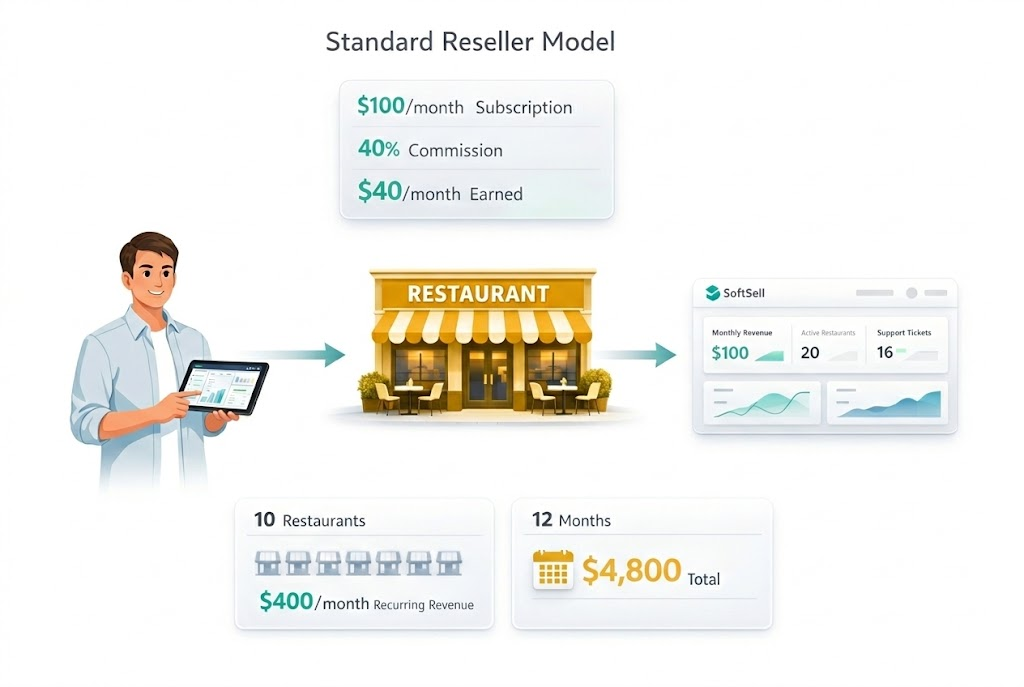
For example, if a restaurant pays $100 per month for the software and your commission rate is 40%, you earn $40 per active location per month. If you onboard 10 restaurants at that same subscription level, your recurring monthly income becomes $400.
If those restaurants remain active for 12 months, that single cohort generates $4,800 over the year. The key dynamic in this model is compounding. Every new restaurant you onboard adds to a growing base of recurring revenue.
2. Referral model
In the referral model, you connect a restaurant to the software vendor, and the vendor manages the sales conversation, onboarding process, billing, and ongoing support. You don’t close the deal or manage the account; only make the introduction.
So, if the restaurant signs up and activates successfully, you receive a one-time payout.
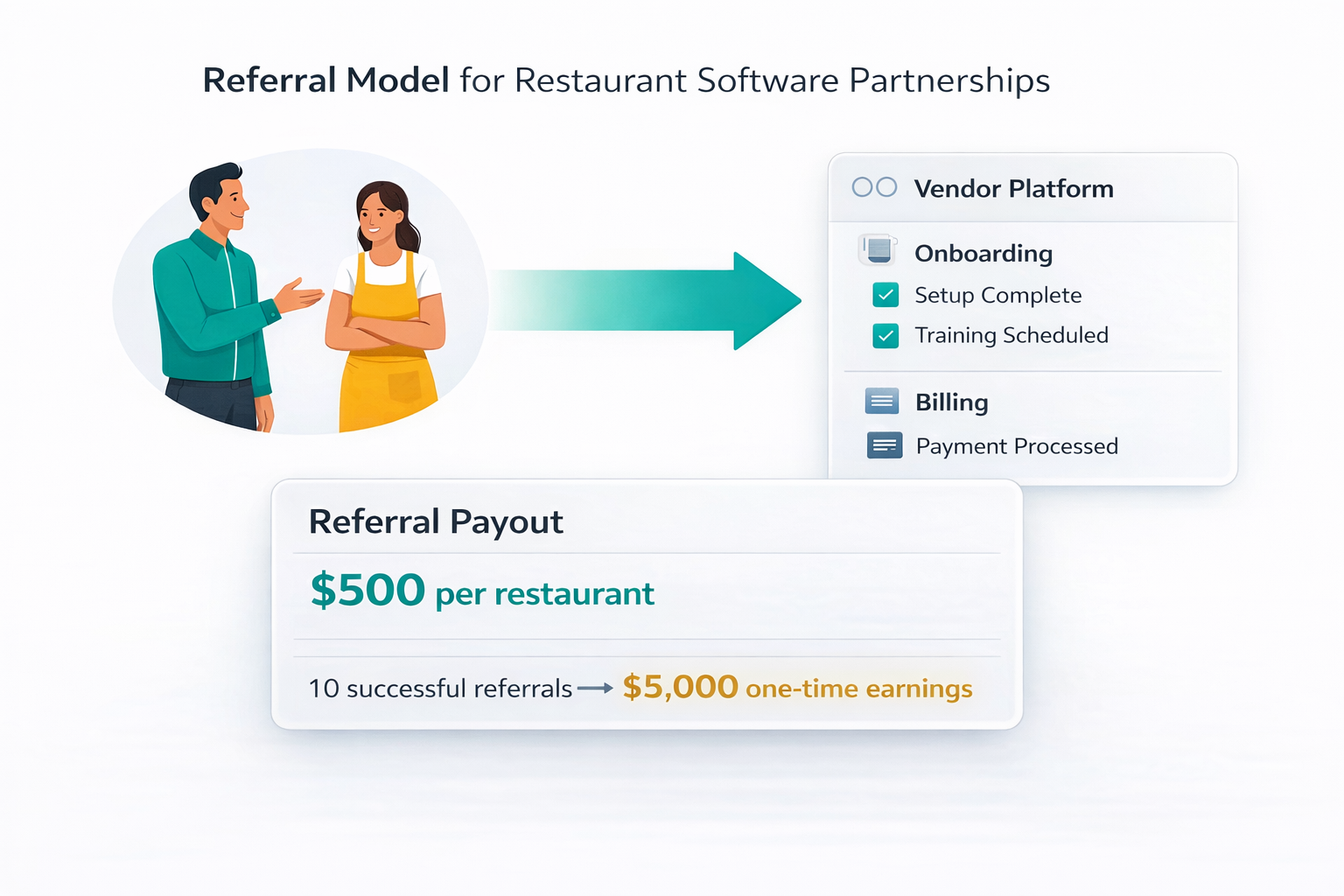
For example, if the referral payout is $500 per activated restaurant and you refer 10 restaurants that successfully go live, you earn $5,000 in total. That payment doesn’t change based on how long those restaurants remain active—whether they stay for one month or three years.
3. White label reseller model
The white label model gives you the highest level of control and the highest level of responsibility. In this structure, the vendor provides access to the software at a wholesale partner price. You then resell it to restaurants under your own brand, at your own pricing.
From the restaurant’s perspective, the product is yours:
- You set the retail price
- You invoice the restaurant directly
- You manage the customer relationship
Resellers can create their own pricing structure for added income. Your earnings come from the margin between what you pay the vendor and what you charge the restaurant.
For example, if the vendor charges you $75 per location per month and you price the software to the restaurant at $125 per month, your gross margin is $50 per active location per month.
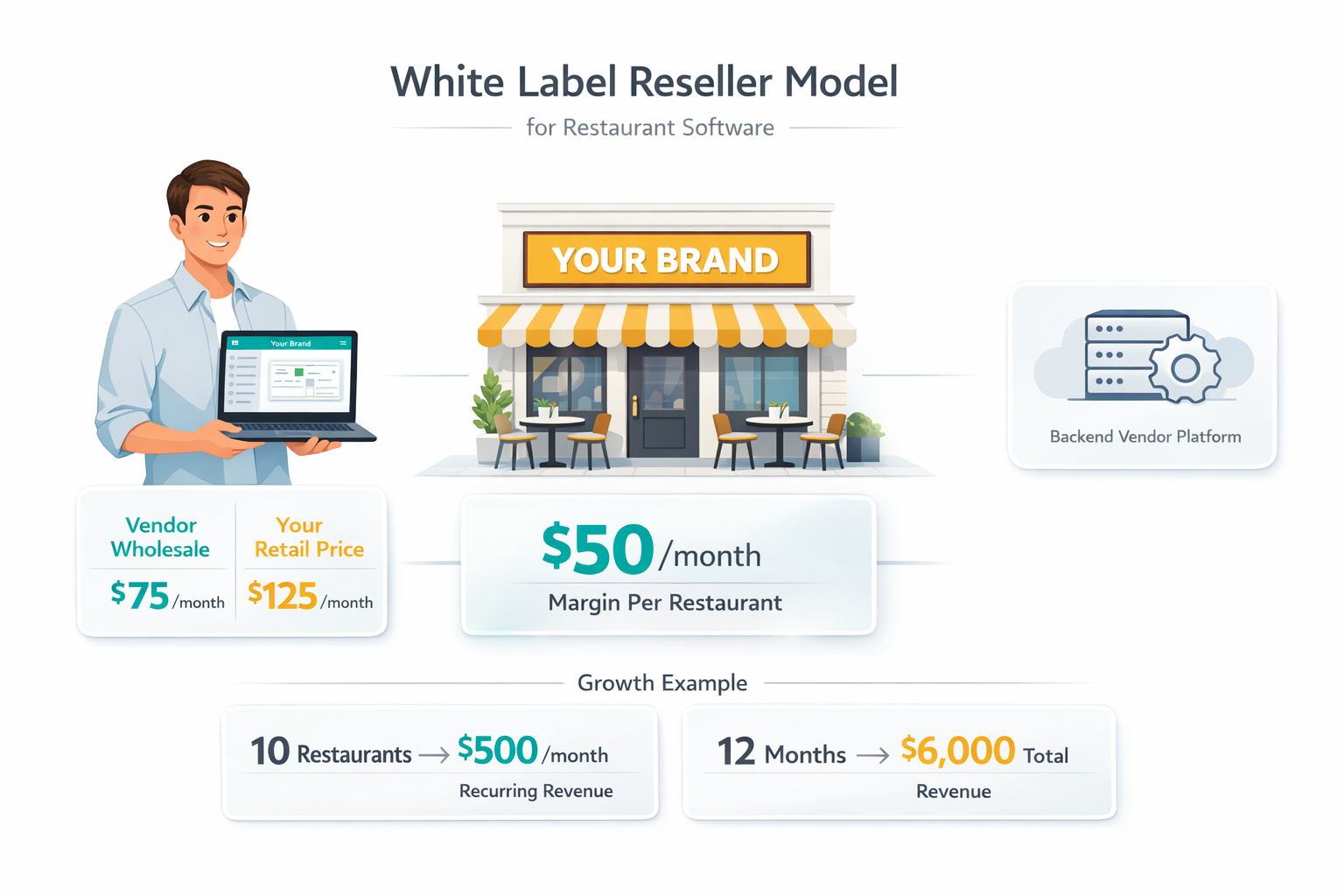
If you onboard 10 restaurants at that pricing, your recurring monthly revenue becomes $500. Over 12 months, that produces $6,000 — assuming the accounts remain active.
Unlike the standard reseller model, there’s no fixed commission percentage. Your margin depends on how you position and price the offering.
White label solutions allow for multiple revenue streams. Value-added resellers bundle software with additional services for increased value. These services can include marketing, consulting, implementation, or POS support, with pricing adjusted accordingly.
You can bundle the software with additional services — marketing, consulting, implementation, or POS support — and adjust pricing accordingly.
White label restaurant software allows rebranding of existing technology. Implementation of white label solutions is typically faster and cheaper than custom development. Resellers can launch businesses with minimal technical expertise.
Projected earnings by reseller program model and account volume
Below is a consolidated scenario table to show how these models compare over time. Let’s assume the following parameters:
- Average restaurant subscription: $100/month
- Standard Reseller (40% commission): $40 per active location per month
- Referral Partner (one-time payout): $500 per location (one-time)
- White Label (margin-based):
- Vendor price: $75
- You sell at: $125
- Your margin: $50 per location per month
Earnings comparison by active locations
Operational factors that reduce reseller earnings
Here’s what prevents reseller revenue from compounding:
1. Short customer lifespans
If restaurants cancel within a few months, recurring models never accumulate meaningful value. A margin or revenue share looks attractive on paper. But the revenue curve flattens quickly when accounts churn early.
2. Unpriced support and account management
Every onboarding call, menu update, or troubleshooting request consumes time. When that effort is not explicitly priced into your offering, it silently erodes gross margin. This is the most common failure point in reseller and white-label models.
3. Poor alignment between product and customer type
Selling software to restaurants that don’t align with the product’s capabilities increases churn and support load. Adding more accounts doesn’t compensate for this. Volume increases operational strain when the product doesn’t match the restaurant’s operational needs.
What to Check Before Joining Any Restaurant Software Reseller Program
Once you bring restaurants onto a platform, you inherit consequences that don’t show up in partner decks. The best way is to start by assessing your business model and audience. Evaluate program terms, enablement, and support before applying.
Look for programs that offer recurring revenue opportunities. Here’s what to consider before making a decision:
1. Commercial terms
Look at payout type and payout timing first. Some restaurant software reseller programs pay monthly. Others delay payouts until accounts clear a minimum activity window. If you’re covering onboarding or setup work upfront and payouts arrive months later, account for that.
Move next to contract length, termination terms, and exclusivity. Long commitments with limited exit options lock you into underperforming products.
Then discuss pricing control. If you can’t set or adjust pricing, you can’t respond to edge cases, bundled services, or unexpected effort. Every exception becomes unpaid work. Over time, this compels you to absorb cost.
Choose a program that allows you to create your own pricing structure. Finally, confirm who invoices the restaurant. If you invoice, you manage collections and payment issues.
If the vendor invoices, you lose visibility into late payments, downgrades, and cancellations. In both cases, the responsibility needs to match your margin.
2. Key features and product market fit
Be clear about what the software covers. A tool that handles online ordering behaves very differently from a POS, reservations platform, or front-of-house system. Point-of-sale systems are crucial for managing payments and inventory in restaurants.
Match that scope to the restaurant size you work with most. Products that work well for single-location restaurants often struggle in multi-unit environments. Reporting gaps, permission models, and configuration limits show up after rollout, not during demos.
3. Comprehensive training and implementation responsibility
Many restaurant software reseller programs include product training and technical support.
Therefore, select a reseller program with comprehensive training and support. Without clear positioning guidance, demo access, and updated collateral, every conversation becomes custom.
Clarify onboarding and implementation ownership. Who handles setup, configuration, data import, and first-use issues? Confirm how escalation works? If all of that work lands on you, it needs to be priced into your model.
4. Ownership and data visibility
Check whether you can see account-level data for the restaurants tied to your revenue. You should know when an account is activated, underused, downgraded, or at risk. If that information is hidden, you learn about churn only after payouts change.
How Can the Restolabs Partner Program Help You Grow Your Business?
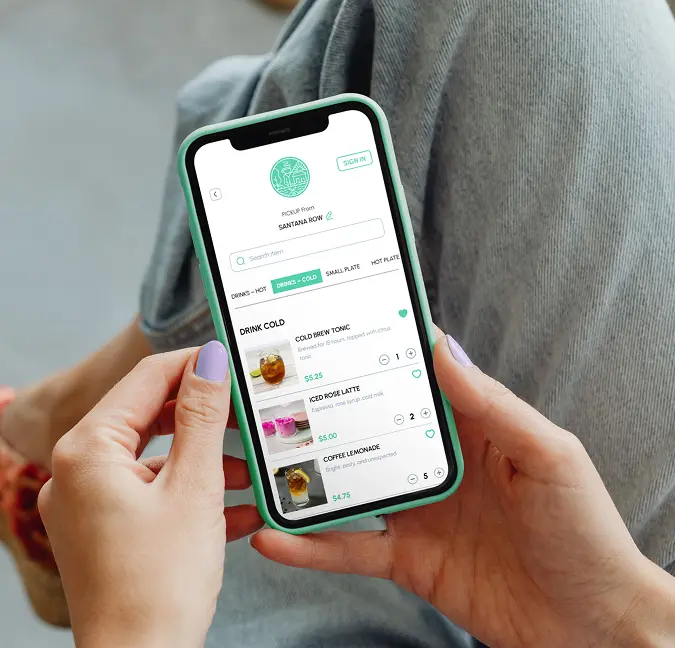
Restolabs is a white-label online ordering and branded app platform that partners resell to restaurants. Here, the benefit applies specifically to orders moved from commission-based marketplaces to the restaurant’s direct ordering channel.
White label solutions eliminate high commission fees from third-party platforms. Restolabs is designed for:
- Agencies selling websites, marketing, or growth services that want to bundle commission-free online ordering and branded apps
- Consultants who want recurring revenue tied to active restaurant accounts without owning product development
- POS providers and VARs looking to complement core systems with ordering, QR, and customer-facing experiences
Restolabs covers ordering, checkout, and branded experiences, while delivery fulfillment is handled through third-party services. That clarity makes the platform easier to package, price, and support as part of a partner-led offering.
A guided entry into the program to get you revenue-ready
Getting started with Restolabs is easy and we follow a demo-led onboarding process rather than a self-serve signup:
- You typically begin with a walkthrough of the platform to review ordering flows, white-label capabilities, and implementation scope. This helps you see how the product fits into your existing services and how it will appear to restaurant clients under your brand.
- This is followed by a conversation with our partnership team to align on business model, target restaurant profiles, and go-to-market approach.
Because the underlying platform is already developed and maintained, partners do not need software-development expertise to get started. Resellers can launch businesses with minimal technical expertise.
Direct partner support that reduces sales friction
We completely understand that reselling software only works when you feel fully supported behind the scenes. That’s why Restolabs works closely with you to ensure you’re never left handling technical or operational challenges alone.
Our team is available via email, text, and WhatsApp, and we can regularly get on calls to resolve issues quickly when needed. Whether it’s a configuration question, integration clarification, or a restaurant-specific scenario, you have direct access to us.
For instance, when a restaurant asks a technical question or needs custom clarification, you can rely on our team to step in and help you close and launch smoothly.
In addition, reseller partners receive access to a dedicated Partner Portal dashboard. This allows you to:
- Monitor all client accounts in one place
- Track subscription status and performance
- View revenue visibility across active locations
- Stay informed on account activity
This visibility helps you manage your recurring revenue more predictably and stay proactive with your clients.
A proven framework for clearer commercial conversations
Restolabs removes ambiguity from how you position, price, and implement the platform. From the first conversation through onboarding, we provide structure that helps partners sell with clarity and confidence:
- Pricing clarity: We help you separate software fees from your service fees so sales discussions with restaurants stay transparent and straightforward.
- Onboarding structure: Our setup process ensures menu data, branding elements, payments, and testing steps follow a consistent and predictable sequence.
- Sales guidance: We help you lead product walkthroughs with clarity, highlighting ordering flow, QR functionality, and checkout experience — the parts restaurants evaluate most closely.
So, if your business already supports restaurants and you want to add recurring software revenue without maintaining your own platform, apply to the Restolabs reseller program today.

Asavari drives content development at Restolabs. With over a decade of experience partnering with fast paced technology and marketing teams, she turns complex product and industry details into clear, meaningful communication for restaurant partners.
Frequently Asked Questions
Yes. Many partners bundle ordering software with services such as website development, digital marketing, POS setup, or consulting. This allows you to present software as part of a broader solution rather than as a standalone product. Bundling also gives you flexibility in how you price and position the offering while strengthening your customer relationship.
Responsibility is usually shared. You may handle initial troubleshooting, onboarding questions, and configuration support, while the vendor manages infrastructure, system errors, and platform-level fixes. Before committing, confirm escalation timelines and resolution ownership. This ensures you know when to intervene and when the vendor takes over.
You should evaluate payout structure, billing control, support responsibilities, onboarding effort, and account visibility. Programs differ significantly in how much control and revenue ownership you retain. Before deciding, review contract terms, escalation processes, and partner enablement resources. This evaluation process will help you recommend restaurant software reseller programs with confidence based on operational and commercial alignment.
Revenue depends on how quickly you onboard restaurants and how long they remain active. Most recurring models accumulate gradually, especially in the first three to six months. Revenue becomes more predictable once you maintain a base of active accounts that renew monthly. Short-term earnings are typically lower than long-term recurring revenue, which compounds as your customer base grows.
Yes. If you operate or support food trucks, you can use an online ordering system with integrated payments to accept orders and reduce manual entry. Look for software that is user friendly and offers reliable order management, flexible pickup settings, and suitable delivery integrations. This can streamline operations, improve the customer experience, and make it easier to encourage repeat orders.
With an affiliate program, you usually introduce leads and receive a commission when they convert, while the vendor controls sales, billing, onboarding, and support. Through a POS reseller program, you take a more active role in selling point of sale or POS software, managing the pricing structure, and supporting customers in the restaurant industry. Choose the business model that matches your service offerings, customer satisfaction goals, and capacity to earn recurring income.





.webp)

.svg)
.webp)