
Key Takeaways
Short answer: Free online ordering systems can work for basic testing, but they often become expensive once commissions, limited features, weak integrations, and lost customer data enter the picture. For restaurants treating online orders as a serious revenue channel, a commission-free platform tends to protect more margin long term.
If a restaurant is already juggling phone orders, third-party app fees, and staff shortages during the dinner rush, a "free" online ordering system can sound like a relief. No subscription. No setup cost. No big decision.
But free rarely means cost-free. For many restaurants, the real price shows up later—in commissions, limited customer data, weak integrations, or a system that cannot keep up once order volume grows.
This guide breaks down when a free online ordering system makes sense, where it starts to limit growth, and why a commission-free platform can protect margins over the long run.
What Is a Free Online Ordering System for Restaurants?
Free online ordering systems let restaurants accept orders through a basic digital menu or order form without paying an upfront subscription fee. For a small restaurant testing online demand, that can feel like a low-risk first step.
The tradeoff usually appears later. Some platforms charge commissions on every order, restrict access to customer data, limit integrations, or require paid upgrades for features restaurants need once order volume grows.
What "Free" Usually Includes — and Excludes
Not all free tools work the same way. Here are the most common models restaurants encounter:
- Truly free basic tools: No cost, no commission — but minimal features and no data ownership. Best for pop-up concepts or very low order volume.
- Free plans with paid upgrades: The core tool is free, but features like POS sync, loyalty programs, or analytics require a monthly fee.
- Commission-based free tools: No subscription, but the platform takes 5–15% of every order. Costs compound fast as volume grows.
- Marketplace storefronts: Visibility on a third-party platform in exchange for commissions and loss of customer data ownership.
- Open-source or self-hosted systems: No licensing cost, but setup complexity and ongoing maintenance can be significant for most independent operators.
Understanding which model a "free" tool uses is the first step before committing to any platform.
Types of Online Ordering Systems Restaurants Can Choose From
Before evaluating whether a free system is worth it, it helps to understand what the full landscape looks like. Restaurant online ordering tools fall into several distinct categories — each with different cost structures, ownership implications, and operational tradeoffs.
Hidden Risks of Free Restaurant Online Ordering Systems
Security and data ownership become more important once online ordering moves from a side channel to a serious revenue stream. If customer payment data, order history, and contact details sit inside another platform, the restaurant has less control over both risk and repeat sales.
- Data Security: Many free platforms may not be PCI compliant, which puts customer payment information at risk. A secure online ordering system should employ advanced encryption and verified security protocols.
- Customer data ownership: If order history, contact details, and preferences stay inside another platform, the restaurant has fewer ways to bring guests back directly through loyalty, promotions, and repeat-order campaigns.
- Lack of Support in Case of Fraud: If a restaurant encounters chargebacks or fraud, free providers typically offer little to no support — leaving the business to resolve costly issues alone.
- Transaction fees and commissions: Many free tools recover costs by charging 5–15% per order. At $10,000 monthly volume, that's $500–$1,500 leaving the business every month.
- Feature caps and upgrade dependencies: Essential capabilities like POS sync, loyalty tools, or delivery zone management often sit behind a paid tier, creating pressure to upgrade as the restaurant grows.
- Limited branding control: Free platforms often host the ordering experience on their own domain, making it harder to build a branded direct-ordering channel.
- Order volume limits: Some free tools throttle order capacity, which creates friction exactly when a restaurant is gaining momentum.
- Migration difficulty: Moving away from a free platform — including exporting customer data and order history — can be difficult or impossible once the restaurant is locked in.
Free vs Commission-Free Online Ordering: Side-by-Side Comparison
When a paid platform starts to make more sense
A free tool may be enough if a restaurant only needs a basic order form. But once online orders become a meaningful revenue channel, the limits become harder to ignore.
If staff are re-entering orders into the POS, customers are ordering through a third-party domain, or marketing data is trapped inside another platform, the restaurant is not really building a direct ordering channel. It is renting one.
The difference becomes clearer as order volume grows. A restaurant doing $20,000 a month in online orders could lose $1,000–$3,000 every month if every order carries a commission. With a commission-free platform, that revenue stays closer to the business. Restaurants can estimate their own exposure using the commission savings calculator.
How to Calculate the True Cost of a Free Online Ordering System
The upfront cost of a free system is $0. The real cost depends on what the platform charges per order — and how quickly that adds up as volume grows.
Simple formula:
Monthly Commission Cost = Monthly Order Volume × Average Order Value × Commission Rate
At $10,000 monthly volume, a 10% commission model costs roughly $10,800 more per year than a flat-fee commission-free platform. That gap widens as order volume increases.
Key Features to Look for in a Free Online Ordering System for Restaurants
If evaluating a free system, these are the capabilities that separate a functional tool from one that will create problems at scale:
- Mobile-friendly ordering: The majority of restaurant orders now happen on mobile. A system that is not optimized for mobile loses orders.
- Menu customization: Modifiers, add-ons, combo options, and photo support are table stakes — not premium features.
- Pickup and delivery settings: The ability to configure prep times, delivery zones, and order scheduling should be included by default.
- Payment processing: Clear pricing on payment fees and support for major gateways (Stripe, Square, etc.) without hidden markups.
- POS integration: Orders flowing directly into the POS eliminate manual re-entry and reduce errors during busy periods.
- Customer data access: The restaurant should own and be able to export the full customer record — email, order history, preferences.
- Loyalty and coupon tools: Basic promotional capabilities help restaurants drive repeat orders without relying on third-party marketplaces.
- Analytics and reporting: Revenue by time period, item performance, and customer retention data should be accessible without a paid upgrade.
- Branded experience: The ordering interface should reflect the restaurant's brand — not the platform's.
- Reliable customer support: When a system goes down during a Friday dinner rush, self-service documentation is not enough.
If a free tool checks fewer than six of these, it is likely to become a bottleneck before the restaurant reaches meaningful online order volume.
Free vs Commission-Free Online Ordering: What Restaurants Should Compare
When online ordering works well, the difference shows up fast. Fewer missed phone calls. Cleaner tickets in the kitchen. More repeat customers ordering directly instead of through a marketplace that takes a cut.
What restaurants gain with a commission-free platform
- Better margins: Restaurants avoid per-order commissions that eat into revenue as order volume grows. At $20,000 monthly, the difference between a 10% commission model and a flat-fee platform can exceed $2,000 every month.
- Cleaner operations: POS, payment, and delivery integrations reduce manual order entry and staff confusion — fewer re-keyed orders means fewer mistakes during peak service.
- Stronger customer relationships: Restaurants can use owned customer data for loyalty programs, targeted promotions, and repeat-order campaigns — none of which are possible when the data sits inside a third-party platform.
- Room to scale: A platform built for growth can support higher order volume, new locations, and more advanced ordering workflows without requiring a disruptive migration.
Why Customer Data Ownership Matters for Direct Online Ordering
One of the most significant advantages of a dedicated online ordering system is gaining complete ownership of customer data. This is what that actually means in practice:
- Targeted Marketing: Order history, frequency, and promotion response data allow restaurants to build campaigns that drive repeat visits — without paying a marketplace for that access.
- Building Loyalty: Loyalty programs built on real first-party data are more effective than generic programs based on limited platform-level data.
- Personalized Experiences: Past orders and preferences power personalized recommendations, which improve average order value and reduce customer churn.
POS, Payment, and Delivery Integrations to Prioritize
A strong restaurant online ordering platform should connect with the systems a restaurant already uses, including POS, payment, and delivery tools. When orders flow directly into the POS, staff stop re-entering tickets manually — which means fewer errors, faster prep, and a cleaner picture of daily sales without reconciling multiple systems at close.
Dedicated Customer Support and Security
Investing in a paid online ordering platform means gaining access to dedicated customer support. Expert support helps restaurants troubleshoot issues and get back online quickly — which matters most during peak service when a technical problem cannot wait for a community forum response. These platforms also implement PCI compliance and advanced encryption to protect customer payment data.
Free Online Ordering vs Third-Party Delivery Apps
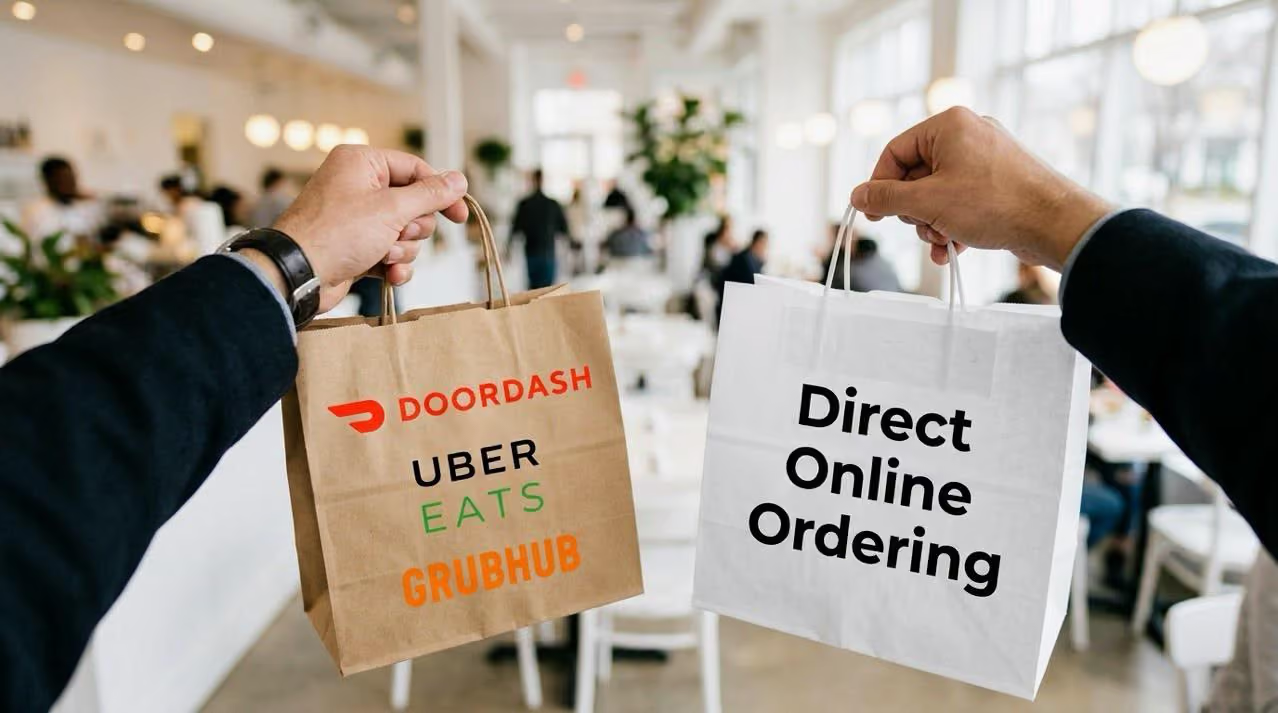
Many restaurant owners weigh free direct ordering tools against third-party delivery apps like DoorDash or Uber Eats. These are fundamentally different options — and conflating them leads to misaligned decisions.
Third-party apps can help with discovery — especially for new restaurants building an audience. But relying on them as a primary ordering channel means paying high commissions indefinitely while never owning the customer relationship. A direct ordering tool, even a basic free one, is a step toward building a more sustainable revenue channel.
Which Online Ordering System Is Right for Your Restaurant?
The right choice depends on where the restaurant is now — and where it is heading. This matrix offers a starting point.
Real-World Signals That Your Restaurant Has Outgrown a Free Ordering Tool
Some restaurants start on a free tool and stay too long. These are the signals that it's time to upgrade:
- Staff are manually re-entering online orders into the POS after every service
- Commission charges are appearing on every monthly statement and growing with volume
- Customers are ordering through a third-party domain — not the restaurant's own branded page
- Menu updates require manual changes in multiple places because there is no central system
- There is no way to contact past customers directly for promotions or win-back campaigns
- The platform cannot support a second location or a catering menu
- Support requests go unanswered for hours during service — or there is no live support at all
- The ordering experience looks and feels generic, with no restaurant branding
If three or more of these describe the current situation, the free tool is likely costing more — in lost revenue, lost data, and operational friction — than a paid platform would.
How a Commission-Free Online Ordering Platform Helps Restaurants Grow
Restolabs is built around a simple idea: restaurants should be able to sell online without surrendering margins, customer relationships, or operational control to third-party platforms.
Restolabs gives restaurants a direct online ordering system that is simple to launch and built to scale. Restaurants can publish menus, accept online orders, connect key systems, and start selling online in as little as one day.
The bigger advantage is ownership. Instead of sending customers through third-party marketplaces, restaurants can keep the order relationship direct, retain customer data, and avoid paying commissions on every sale.
Why restaurants choose Restolabs
- Launch online ordering quickly with expert setup support.
- Keep more revenue with commission-free direct ordering.
- Own customer data for loyalty, remarketing, and repeat sales.
- Connect POS, delivery, and payment systems to simplify operations.
- Choose flexible, contract-free plans that support growth.
With Restolabs, restaurants get:
- Zero Commissions: Keep 100% of online order revenue.
- Complete Data Ownership: All customer data belongs to the restaurant, for marketing, loyalty, and retention initiatives.
- Seamless Integrations: Connect with existing POS, payment, and delivery partners without manual workarounds.
- Scalability: Designed to grow with the business, whether operating one location or many.
- Advanced Features: Including QR code ordering, mobile ordering app capabilities, and robust reporting.
- Dedicated Support: Expert support helps restaurants get set up quickly and resolve issues without delays.
Ready to see what commission-free online ordering could look like for your restaurant? Book a Demo
Team Restolabs is a group of hospitality tech experts, strategists, and innovators dedicated to helping restaurants thrive in the digital age. With deep expertise in branding, growth, product development, and restaurant technology, we provide insights on scaling, streamlining operations, and enhancing customer experience.
Frequently Asked Questions
The best choice depends on the restaurant's order volume, commission tolerance, POS setup, and need for customer data. For very low volume, a basic free tool may work. As orders grow, a commission-free platform typically protects more revenue and provides better operational control than any commission-based free option
Free online ordering systems usually work best for basic order-taking. The limitations appear when a restaurant needs POS integrations, customer data access, reliable support, branded ordering, or room to scale without paying commissions on every order.
Many do. "Free" typically refers to the upfront subscription cost — not the total cost of use. Commission-based free tools charge 5–15% per order, which adds up quickly at higher volumes. Always check the transaction fee and commission structure before committing to any platform.
Free platforms typically generate revenue through per-order commissions (often 5–15%), payment processing markups, upsells to paid tiers, and by monetizing the customer data they retain on behalf of restaurants.
Yes, but the real costs often arrive as commissions, payment fees, or feature limitations. A restaurant can accept orders through a free tool with $0 upfront, but at 10% commission on $10,000 monthly volume, the effective annual cost is $12,000 — more than most paid subscription plans.
Customer data helps restaurants bring guests back without relying on third-party marketplaces. With access to order history, contact details, and preferences, restaurants can run better promotions, build loyalty programs, and increase repeat orders.
At minimum: mobile-friendly ordering, menu customization with modifiers, pickup and delivery settings, POS integration, payment processing transparency, customer data access, and reliable support. Analytics, loyalty tools, and branded ordering pages become important as volume grows.






.webp)

.svg)
.webp)